Hurom H70 Review: Is This Premium Slow Juicer Worth the Money?
Summarized from peer-reviewed research indexed in PubMed. See citations below.
Slow juicers carry some of the most aggressive marketing in the kitchen appliance world, with claims of miracle nutrient retention, double the yield, and whisper-quiet operation that rarely survive contact with the published research. The Hurom H70 is a $649 vertical slow juicer with a genuinely different cleaning architecture: a strainer-free two-part chamber that replaces the mesh filter found on most masticating machines. A 2019 comparison study found no significant difference between cold-pressed and centrifugal juice in vitamin C, total phenolics, or total carotenoids measured right after extraction, but refrigerated cold-pressed juice held its antioxidant capacity through day five while warm storage degraded it within 48 hours (PubMed 31286079). A grape juice study found higher polyphenol, anthocyanin, and vitamin C content from a low-speed masticating juicer than from a high-speed centrifugal one (PubMed 30263614). The H70’s case rests on easy cleaning, a 10-year motor warranty, quiet operation, and better handling of leafy greens, not on the exaggerated nutrient numbers in the marketing copy. Here is what the machine actually offers, what the research supports, and who should buy it.
Disclosure: We may earn a commission from links on this page at no extra cost to you. Affiliate relationships never influence our ratings. Full policy →
What Is the Hurom H70, and How Is It Different?
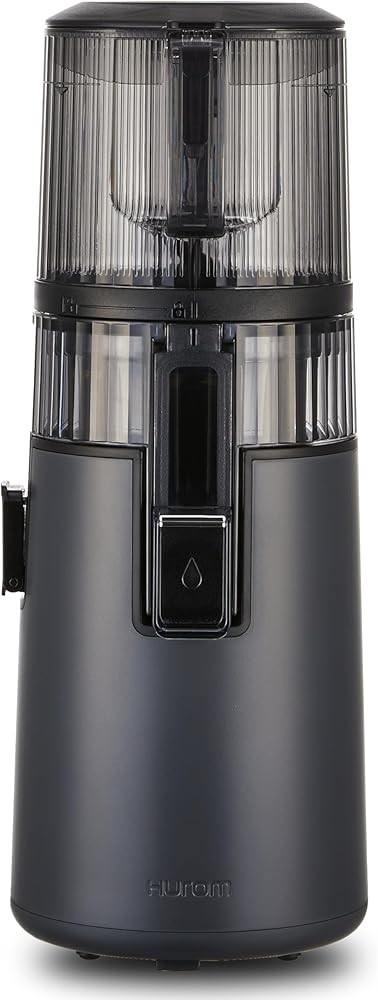
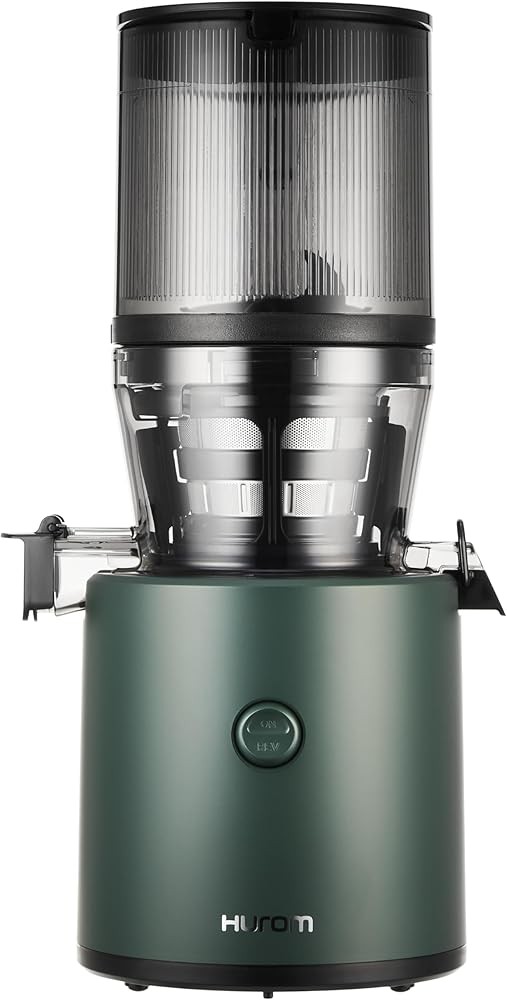
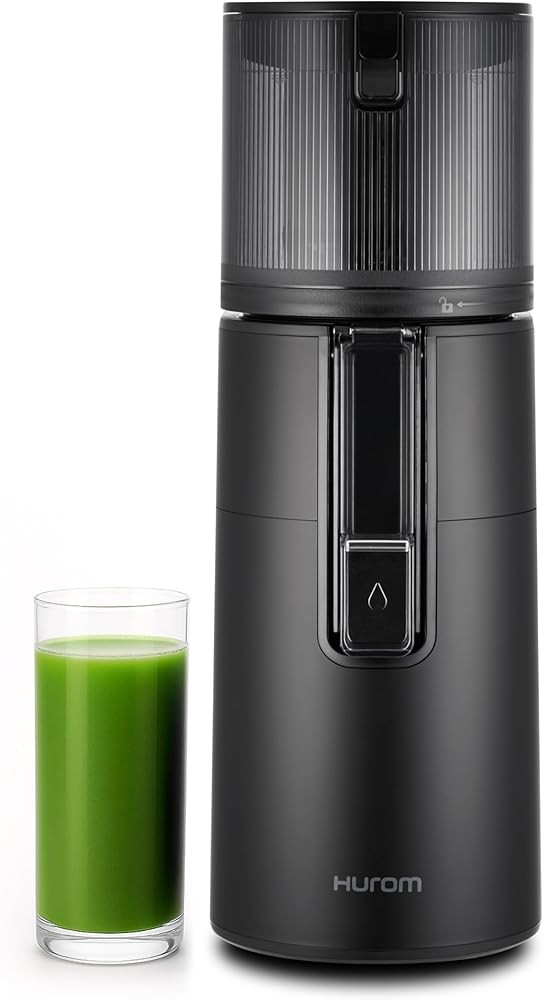
The H70 is a vertical single-auger slow juicer. It crushes and presses produce at about 43 RPM instead of shredding it with blades spinning at thousands of revolutions per minute, which is the fundamental design difference between masticating and centrifugal juicers.
Three features separate the H70 from most of the slow-juicer market:
Strainer-free chamber. The defining feature of the H70 is its two-part chamber with no mesh strainer. On most masticating juicers, the mesh filter is the part that traps pulp, clogs, and demands the most cleaning effort. Hurom’s design presses juice through the gap between the two chamber halves instead, which removes the single most tedious cleaning step in slow juicing. This is not a cosmetic difference; it changes the daily maintenance equation.
Self-feeding hopper. The H70 feeds produce through a hopper rather than requiring every piece to be pushed through a narrow tube, which reduces prep and hands-on time. Pieces still need to be cut to fit, but the self-feeding action means you are not standing over the machine pushing every chunk.
10-year motor warranty. Hurom backs the motor for a decade, which is a strong signal about expected service life. The 2-year parts warranty covers the chamber, auger, and accessories.
The H70 is a compact machine designed for daily countertop use. It is not the highest-capacity model in Hurom’s lineup (that is the H400), and it is not the cheapest (that is the H320). It sits in the middle as the daily-driver option, priced at $649.
Bottom line: The Hurom H70 is a $649 vertical slow juicer defined by its strainer-free two-part chamber, self-feeding hopper, and 10-year motor warranty; the strainer-free design removes the most tedious cleaning step found on traditional masticating juicers and is the machine’s strongest argument for its price.
How Does the H70 Compare to Buying Juice?
For many buyers the real financial comparison is not the H70 versus another juicer. It is the H70 versus the juice bar they already visit several times a week.
What Does Retail Juice Cost?
A 16 oz fresh juice at a retail juice bar typically runs $8 to $12 depending on the market and the ingredients. A daily habit at $9 per glass costs $3,285 a year. A three-times-weekly habit costs about $1,404 a year. Those figures exclude tips, parking, and the time spent traveling to and waiting at the bar, which for a 15-minute round trip three times a week adds roughly 39 hours a year.
What Does Home Juicing Cost?
The honest home-juicing ledger has three lines:
- Produce: a 16 oz glass needs roughly 1.5 to 2 pounds of produce, retailing at $3 to $7 depending on the ingredients. The working figure here is $5 per glass.
- Equipment amortization: the H70 at $649, with roughly $130 of maintenance over ten years, spread across 3,650 daily juices, comes to about $0.21 per glass.
- Electricity: 150 watts for five minutes is 0.0125 kWh, about $0.0015 at the average US residential rate, or about $0.55 a year for daily use.
The total is about $5.21 per 16 oz glass, of which the produce is roughly 96%.
What Is the Honest Payback Period?
Against a daily $9 juice bar habit, each home glass saves about $3.79. The $649 machine pays for itself in roughly 171 days of daily use, about six months, and saves about $1,383 in year one. At three juices per week, payback stretches to roughly 13 months. At one juice per week, payback exceeds three years, which is long enough that the purchase only makes sense if you plan to increase frequency.
The six-month figure for daily juice bar customers is the honest headline. The 44-to-66-day figures that appear in older marketing were computed by dividing the machine price by the full $9 bar price while ignoring the $5 produce cost of every home glass, which is arithmetic designed to sell juicers rather than inform buyers.
Bottom line: A 16 oz home juice costs about $5.21 including produce, equipment, and electricity versus $9 at a juice bar; the H70 pays for itself in roughly six months of daily use or about 13 months at three times weekly, and the honest payback math must include the $5 produce cost that most marketing calculations omit.
What Should You Check Before Buying the H70?
A few pre-purchase checks separate a satisfied buyer from a disappointed one.
Have You Established the Habit First?
The single most common failure mode for expensive juicers is not mechanical. It is behavioral. Machines bought during a wellness phase and used three times before being shelved are the real cost of entry into slow juicing. If you have never maintained a regular juicing habit, the rational sequence is to buy a budget masticating juicer first, use it daily for a month, and upgrade to the H70 once the habit is real. The H70’s price only makes sense against demonstrated frequency, not intended frequency.
Do You Understand the Speed Trade-Off?
A 16 oz glass takes several minutes of feeding and pressing with any slow juicer, and the H70 is no exception. If your morning routine has no room for a five-to-eight-minute session plus a minute of cleaning, the honest recommendation is a centrifugal machine, which trades nutrient and shelf-life advantages for speed. Buyers who purchase a slow juicer despite knowing they are speed-first users typically abandon the machine.
What Is the Warranty Process?
Hurom backs the H70 motor for 10 years and parts for 2 years. The practical questions to answer before purchase are where the machine was bought (authorized dealers handle warranty claims more smoothly than third-party marketplace listings) and what documentation you need to keep. Save the receipt, register the product if the manufacturer offers registration, and confirm the return window with the seller before ordering. The 10-year motor warranty is one of the H70’s strongest arguments, and it is only as good as your ability to claim it.
When Is the Best Time to Buy?
Premium juicers see regular discounts during major retail sales events, and the H70 is no exception. If the $649 price is a stretch, waiting for a holiday or seasonal sale can reduce the cost by 10-20%. Price-tracking tools and simple history checks on the listing will show whether the current price is a genuine discount or a markup disguised as one. There is no functional difference between units sold at different prices; the machine is the same.
Bottom line: Before buying the H70, establish a real daily or near-daily juicing habit with a cheaper machine first, accept that slow juicing takes several minutes per glass, confirm the warranty and return process with an authorized seller, and consider timing the purchase to a major sale if the $649 price is a stretch.
Frequently Asked Questions About the Hurom H70
Is the H70 the best juicer for the money?
It depends on the comparison. Against the juice bar, yes: no retail juice purchase can compete with $5 of produce plus $0.21 of equipment per glass for daily users. Against other slow juicers, the H70 is the strongest choice for buyers who prioritize cleaning ease and compact size, while the H320 offers pulp control at a lower price and the H400 adds wide-mouth throughput for batch households. Against a $100 centrifugal machine, the H70 only wins if you juice greens and fibrous vegetables regularly, because that is where slow extraction’s yield and shelf-life advantages actually show up in the research (PubMed 30263614, PubMed 31286079).
Does the H70 really preserve 90-95% of nutrients?
No. That figure is marketing, and the published research does not support it. The 2019 comparison study found no significant difference between cold-pressed and centrifugal juice in vitamin C, total phenolics, or total carotenoids measured immediately after extraction (PubMed 31286079). What the research does show is that refrigerated cold-pressed juice retains its antioxidant capacity longer, and that some produce, like grapes, yields higher polyphenols and anthocyanins from a masticating juicer (PubMed 30263614). Buy the H70 for its cleaning design, its longevity, and its shelf-life advantage, not for a nutrient claim no study supports.
How many juices per day do you need to justify the H70?
At one 16 oz juice per day, with $5 of produce and a $9 juice bar comparison, the H70 pays for itself in roughly six months. At three juices per week, payback stretches past a year. Below three juices per week, the machine is hard to justify economically, and the honest recommendation is a cheaper masticating juicer or the juice bar itself. The crossover point where the H70’s cleaning and warranty advantages over a $150 machine become worth their premium is roughly five or more sessions per week.
Can the H70 make nut milk?
Yes. Soaked almonds or other nuts can be processed with water into fresh nut milk using the blank screen, and the result is free of the additives found in many commercial nut milks. This is a bonus use rather than the machine’s core purpose, but it is genuinely useful for households that already juice daily.
Does the H70 handle frozen fruit?
Partially thawed frozen fruit can be pressed into a sorbet-like texture using the blank screen. Fully frozen fruit should not be fed to the machine, because ice can stress the auger and chamber. If frozen-fruit smoothies are your primary use, a blender is the correct tool; the H70 is a juicer first.
What happens if the H70 breaks after the warranty period?
The strainer-free design has a short parts list. The small seals, caps, and cleaning brush are inexpensive to replace, and the auger and chamber are available as parts from Hurom. The motor, the most expensive component, carries the 10-year warranty. This parts availability is one of the quieter arguments for buying a major-brand machine rather than an obscure budget model whose replacement parts vanish after a couple of years.
What Comes in the Box and What Does the Spec Sheet Say?
Before committing $649, it helps to know exactly what arrives and what the published specifications claim.
What Is Included?
The H70 ships with the motor base, the two-part strainer-free chamber, the auger, the self-feeding hopper, a juice cup, a pulp cup, a cleaning brush, and the pusher. Some bundles add a blank screen for nut milk and sorbet-style processing, which expands the machine’s range beyond juice. The included brush is the right tool for the auger grooves, and the cups are sized for single-session output.
What Are the Key Specifications?
The specifications that matter for daily use are the motor (150 W, low-speed AC), the auger speed (about 43 RPM), the footprint (roughly 7 by 8 inches with a height near 17 inches), and the weight (about 13 pounds). The compact footprint is a genuine advantage in small kitchens, and the weight keeps the machine stable during operation while staying manageable when you move it for cleaning. The 10-year motor warranty and 2-year parts warranty are the headline numbers on the spec sheet.
What Do the Specifications Not Tell You?
Spec sheets do not tell you how the machine feels in daily use. The auger speed number matters less than the feeding behavior, the cleaning time matters more than the footprint, and the warranty matters most when something goes wrong at year six. The practical review conclusions in this article come from the design features and the published research on extraction and storage, not from the marketing sheet.
Bottom line: The H70 ships with the motor base, two-part chamber, auger, hopper, cups, brush, and pusher, runs a 150 W motor at about 43 RPM in a roughly 7 by 8 inch footprint, and carries a 10-year motor warranty; the specs that matter most in daily use are the strainer-free chamber design and the cleaning time, which no spec sheet captures.
What Does the Published Research Actually Support?
The marketing around slow juicers leans heavily on nutrient claims, so it is worth separating what the research shows from what the ads promise.
What Did the Head-to-Head Cold Press Study Find?
The most relevant study, published in Heliyon in 2019, compared cold-pressed and centrifugal juicing directly (PubMed 31286079). Its findings are frequently misquoted, so they are worth stating precisely:
- Immediately after extraction, there was no significant difference in vitamin C, total phenolic content, total carotenoid content, or antioxidant capacity between the two methods.
- Over refrigerated storage, the cold-pressed juice retained its antioxidant capacity through day five, while juice stored at warmer temperatures degraded within 48 hours.
- The practical takeaway is that slow juicing is not a fresh-juice nutrient miracle. Its research-backed advantage is shelf life: juice made gently and kept cold stays better longer.
What Did the Grape Juice Study Find?
A 2017 study compared fresh grape juices made with a low-speed masticating juicer and a high-speed centrifugal juicer and found the masticating machine produced juice with significantly higher total polyphenols, anthocyanins, and vitamin C (PubMed 30263614). Pigmented fruits carry much of their antioxidant content in the skin, and gentle pressing extracts more of it. This is the study that supports the claim that slow extraction can preserve more of certain compounds in certain produce, and it explains why the H70 shines on grapes, berries, and dark leafy greens.
What Do the Processing and Storage Studies Show?
A wider body of food-science research reinforces the same pattern: gentler, cooler processing preserves more of the heat- and oxygen-sensitive compounds in juice, and cold storage slows degradation. Studies on orange-carrot juice, blueberry juice, strawberry nectar, grape juice, tropical juices, and melon juice all show that processing method and storage temperature measurably shape nutrient retention over days (PubMed 36903442, PubMed 38739462, PubMed 41581484, PubMed 41750861, PubMed 42195926, PubMed 42436745). Thermal degradation research on citrus juice documents how heat accelerates the breakdown of vitamin C and related antioxidants (PubMed 17451252), and the older extraction literature explains why yield and clarity pull in opposite directions (PubMed 9315434).
None of this makes the H70 a nutrient-preserving miracle machine. What it does is explain why the two-to-three-day refrigerated window for homemade cold-pressed juice is the honest claim: process gently, refrigerate promptly, and drink within a few days.
Bottom line: The research shows cold-pressed juice is nutritionally similar to centrifugal juice when fresh, retains antioxidants longer under refrigeration, and can be meaningfully higher in polyphenols and anthocyanins for pigmented produce like grapes; the H70’s honest value is gentler extraction, better shelf life, and higher yield on greens, not the dramatic nutrient claims in most marketing.
How Does the H70 Handle Different Types of Produce?
Yield expectations should be grounded in reality. Slow juicers shine on some produce and are merely adequate on others.
How Does It Handle Leafy Greens?
Leafy greens are where the H70 earns its reputation. Kale, spinach, and chard are difficult for centrifugal machines, which struggle to extract liquid from fibrous leaves and often produce wet pulp. Slow auger designs press greens more thoroughly, and alternating greens with harder produce like apple or celery improves throughput. The pulp from a slow juicer comes out noticeably drier than centrifugal waste, which is the practical sign that extraction was thorough.
How Does It Handle Hard Vegetables and Roots?
Carrots, beets, celery, and ginger process well in the H70. The auger crushes cell walls gradually, and the low speed means the motor never sounds strained the way high-speed machines do with dense produce. Beets will briefly tint light-colored plastic parts; the H70’s chamber materials rinse clean without permanent staining. Celery’s fibrous strings are the main cleanup consideration, though the strainer-free chamber makes removing them simpler than scrubbing a mesh filter.
How Does It Handle Soft Fruits and Citrus?
Apples, pears, and oranges juice cleanly. Citrus should be peeled first because the pith adds bitterness, and very soft fruit like grapes may leak slightly around the auger before being pressed, which is normal for slow machines. A dedicated citrus press is more efficient if citrus is the only thing you juice.
How Does It Handle Specialty Ingredients?
Wheatgrass, ginger, turmeric, and soaked nuts for nut milk are all within the H70’s range. Wheatgrass is best alternated with apple chunks so the auger can grip it. Turmeric and ginger should be cut small. Soaked almonds can be processed with water into fresh nut milk using the blank screen, and partially thawed frozen fruit can be pressed into a sorbet-like texture. None of these are daily-use cases for most buyers, but the versatility is real.
How Does the H70 Handle Carrots, Beets, and Celery?
Hard vegetables are where a slow juicer’s torque shows. Carrots feed through steadily with dry, ribbon-like pulp and no motor strain. Beets process well but release heavy pigment, so rinse the chamber promptly after juicing them; the H70’s smooth chamber surfaces clean up without permanent staining. Celery is mostly water with tough structural fibers, so it juices easily but leaves fibrous residue that rinses away quickly in the strainer-free chamber. Ginger and turmeric should be cut into small pieces and alternated with softer produce so the auger can grip them without the pieces bouncing in the hopper.
A practical note on prep: cut dense produce to roughly finger-sized pieces. The self-feeding hopper does the pushing, but it cannot compress oversized chunks, and oversized pieces slow the session and increase the chance of a stall. Ten seconds of cutting saves minutes of feeding.
How Does the H70 Handle Apples, Oranges, and Soft Fruit?
Apples and pears are near-ideal slow-juicer produce: firm enough to feed well, juicy enough for high yield, and mild on the chamber. Applesauce-textured pulp is the expected result, and the pulp is dry enough to compost easily. Citrus should be peeled before juicing, because the white pith adds bitterness that pressing extracts more efficiently than centrifugal shredding does. Very soft fruit like grapes and ripe berries may ride around the auger briefly before being pressed; alternating them with firmer pieces keeps the feed moving. The yield from soft fruit is good but rarely the highest of the produce categories, and that is normal for the method.
How Does the H70 Handle Wheatgrass, Nuts, and Frozen Produce?
Specialty ingredients extend the machine’s usefulness beyond juice. Wheatgrass, which defeats many juicers entirely, processes when fed in small bunches alternated with apple or cucumber chunks. Soaked almonds produce fresh nut milk with the blank screen, and the result is smoother and cheaper than most carton nut milks. Partially thawed frozen fruit can be pressed into a sorbet-like texture. The limits matter: fully frozen fruit should never go in, because ice stresses the auger and chamber, and hard pits or stones will damage the machine. None of these specialty uses are the reason to buy the H70, but they are real capabilities once you own one.
Bottom line: Carrots, beets, celery, apples, and citrus all process cleanly with dry pulp and simple prep, ginger and turmeric need small pieces, wheatgrass and soaked nuts extend the machine’s range with the right feeding technique, and fully frozen fruit or hard pits should never go through the chamber.
What Is Cleaning Really Like?
Cleaning is the make-or-break metric for a daily-use juicer, and it is the H70’s strongest category.
How Long Does Daily Cleaning Take?
The H70 disassembles into a short list of parts: the hopper, the two chamber halves, the auger, the juice cap, the pulp cap, and the pusher. With no mesh strainer to scrub, a daily rinse-and-reassemble routine takes about a minute. A deeper wash with dish soap takes two to three minutes. Both chamber halves are dishwasher-safe for a weekend deep clean.
This is the honest comparison that matters: most masticating juicers at lower price points require brushing pulp out of a mesh strainer after every session, which takes several minutes and is the reason many machines end up in storage. The H70 removes that step entirely.
What Parts Need Occasional Attention?
The auger grooves can hold pulp if juice is left to dry, so cleaning immediately after use is the right habit. If pulp does dry, a five-minute warm-water soak releases it. The small rubber seals and caps are the parts most likely to need eventual replacement, and Hurom sells them individually. There are no mesh screens to replace every year or two, which is a real cost difference versus other designs.
What Is the Weekly Deep-Cleaning Routine?
A weekly deeper clean keeps the chamber from building up residue, especially if you juice beets, turmeric, or carrots regularly. A warm-water soak with a little baking soda, a soft brush over the auger and chamber surfaces, and a thorough rinse and dry is sufficient. Avoid abrasive pads, which can scratch the chamber surface.
What Happens If You Skip a Daily Clean?
The honest answer is that the H70 forgives an occasional skipped rinse better than a mesh-filter juicer does, but not indefinitely. If pulp dries in the chamber, the auger can stick, and dried beet or carrot residue is harder to remove than fresh. A five-to-ten-minute warm-water soak releases dried pulp completely. The right habit is a 60-second rinse after every session and a deeper wash when the chamber looks cloudy. That routine keeps the machine ready for the next morning with no scrubbing session required.
How Do the Parts Hold Up Over Years?
The strainer-free architecture means the parts list is short: the auger, two chamber halves, hopper, caps, and brush. The components that eventually wear are the small rubber seals and the caps, both inexpensive and available from Hurom. There are no mesh screens to replace every year or two, which is a genuine cost difference versus traditional masticating designs. The motor, protected by the 10-year warranty, is the component least likely to fail. Owners who clean promptly and avoid hard objects in the feed report the machine running like new for years, which aligns with the warranty structure Hurom chose.
Bottom line: The H70 forgives an occasional skipped rinse but rewards a 60-second daily clean with no scrubbing; dried pulp releases with a warm-water soak, the short parts list means no recurring screen replacements, and the small seals and caps are the only components that realistically wear over years of daily use.
How Loud Is the H70?
Slow juicers are quiet compared with centrifugal machines, and the H70 is at the quiet end of the slow-juicer spectrum. Centrifugal juicers spin blades at thousands of RPM and produce a loud whine; the H70’s low-speed AC motor produces a modest hum that is closer to conversational level. Hurom positions the machine for early-morning use, and in practice it will not wake someone in a nearby room the way a high-speed juicer or blender will.
The honest caveat is that decibel numbers in marketing are rarely measured under identical conditions. The useful comparison is qualitative: if early-morning quiet operation matters, a slow juicer is the right category, and the H70 is a good representative of that category.
Why Does Slow Speed Mean Less Noise?
Noise in a juicer comes from two sources: motor vibration and the sound of produce being shredded. A centrifugal machine’s blades spin at thousands of RPM, which creates a high-pitched whine and transmits vibration through the countertop. A slow auger crushes and presses at about 43 RPM, so the dominant sound is a low hum from the motor rather than the roar of cutting. The physics is straightforward: less kinetic energy in the spinning parts means less acoustic energy coming out.
The H70’s 150-watt motor is another factor. Slow masticating juicers need less power than centrifugal machines because they are not spinning a heavy basket against resistance; they are turning a screw slowly through produce. A smaller, slower motor running within its design range is quieter and runs cooler than a high-wattage motor pushed hard.
How Loud Is Loud Enough to Matter?
For households where someone sleeps near the kitchen or works from home, the difference between a 45 dB hum and a 75-80 dB whine is the difference between juicing at 6 AM and not juicing at all. Quiet operation is not a luxury feature; it is a consistency feature, because people use the machine they can tolerate running. This is one of the less-quantified but most practical advantages of the slow-juicer category, and the H70 is a strong representative of it.
Bottom line: Slow extraction is inherently quieter than centrifugal shredding because less kinetic energy means less acoustic energy; the H70’s low-speed 150-watt motor produces a modest hum rather than a high-pitched whine, and quiet operation is a consistency feature that determines whether early-morning juicing actually happens.
How Does the H70 Compare Within Hurom’s Lineup?
The H70 sits between the H320 and the H400 in Hurom’s current lineup, and the choice between the three is mostly about use patterns.
| Feature | Hurom H70 | Hurom H320 | Hurom H400 |
|---|---|---|---|
| Price (verified) | $649 | $599 | $749 |
| Design | Compact vertical | Family-size vertical | Wide-mouth vertical |
| Chamber | Strainer-free two-part | Fine + coarse strainers | Strainer-free two-part |
| Feed | Self-feeding hopper | Self-feeding hopper | Wide self-feeding hopper |
| Pulp control | No | Yes (control lever) | No |
| Motor warranty | 10 years | 10 years | 10 years |
| Best for | Daily single-glass users | Users who want pulp control | Batch juicing households |
The H320 is the most affordable and the only one with a pulp-control lever and selectable strainers, but the strainers reintroduce the mesh-cleaning step the H70 eliminates. The H70 and H400 share the strainer-free chamber; the H400 adds a wider mouth and faster throughput for households that batch-juice, at a higher price and with a larger footprint.
What About the H400 for Families?
The H400 is the answer for households that juice for more than one person per session. Its wide mouth accepts larger produce pieces, which cuts prep time noticeably when you are processing several pounds at once, and the two-part easy-clean chamber keeps the maintenance burden low at higher throughput. The trade-offs are the higher price and the larger footprint. A family that juices two to four glasses per session will find the H400’s capacity worth the premium; a household that juices one glass at a time should take the H70 and save $100.
What About the H320 for Budget Buyers?
The H320 is the entry point into Hurom’s current lineup and the only one of the three with a pulp-control lever and selectable strainers. That makes it the right machine for people who want to dial in juice texture from fine to coarse. The cost of pulp control is the return of mesh strainers, which need brushing after use. If texture control matters more than cleaning speed, the H320 is the value pick; if cleaning speed is the priority, the H70’s strainer-free chamber is worth the extra $50.
Bottom line: The H400 is the family and batch machine whose wide mouth pays off at multi-glass throughput, the H320 is the budget pick for buyers who want pulp control and accept strainer cleaning, and the H70 is the daily single-glass machine whose strainer-free chamber makes it the easiest of the three to live with.
How Does the H70 Compare to Cheaper and Different Juicers?
How Does It Compare to Centrifugal Juicers?
A $60-150 centrifugal juicer is the budget alternative, and for occasional soft-fruit juicing it is a reasonable one. The trade-offs appear with daily use: centrifugal machines are loud, generate more foam, extract less from leafy greens, and leave wetter pulp. The research on grape juice shows the low-speed masticating approach can also preserve more polyphenols and anthocyanins (PubMed 30263614). Budget centrifugal machines typically last two to four years with regular use, which means the ten-year cost of repeated replacements approaches the H70’s single purchase price.
How Does It Compare to Budget Masticating Juicers?
A $120-200 masticating juicer delivers the same slow-extraction concept with a mesh strainer, a shorter warranty, and more cleaning friction. For someone who juices a few times a week, a budget masticating machine is the rational starting point. The H70’s premium buys the strainer-free chamber, the 10-year warranty, and the self-feeding hopper, which matter most to daily users.
How Does It Compare to Wide-Mouth and Horizontal Models?
Other premium slow juicers offer different trade-offs. Wide-mouth vertical models like the H400 accept larger produce pieces and cut prep time, at the cost of a bigger footprint. Horizontal masticating models from other brands offer long warranties and strong reputations but take up more counter depth and have more parts to clean. The H70’s position is the compact, easy-cleaning middle ground.
Bottom line: The H70 beats centrifugal machines on greens handling, shelf life, noise, and ten-year cost, competes with budget masticating juicers on extraction while adding the strainer-free chamber and a decade motor warranty, and trades prep speed and capacity to wide-mouth and horizontal models in exchange for the smallest footprint and simplest cleaning.
Is the $649 Price Justified?
The price question has two parts: value against the juice bar, and value against other machines.
How Does It Compare to Juice Bar Spending?
A 16 oz fresh juice at a retail juice bar runs $8-12. Using $9 as the working figure, a daily habit costs $3,285 a year. Home juicing costs roughly $5 in produce plus about $0.21 in equipment amortization per glass, so each homemade glass saves about $3.79 against the bar. The H70 pays for itself in roughly 171 days of daily use, about six months, and saves about $1,383 in year one. At three juices per week, payback stretches to about 13 months.
The honest math must include the produce cost. Marketing figures that divide the machine price by the full bar price while ignoring the $5 of produce in every home glass produce absurd payback claims that do not survive contact with a grocery receipt.
How Does It Compare to Other Machines Over 10 Years?
Over a decade of daily use, the H70’s ten-year cost of ownership is roughly $780 including maintenance. A budget masticating path that requires two or three replacement machines costs $550-700 over the same period while delivering a mesh strainer to clean and a one-year warranty. The H70 premium over budget machines is largely recovered through longevity, and every machine path is dramatically cheaper than the daily juice bar.
What Is the Intangible Value?
The H70 reclaims the time spent traveling to juice bars, puts the ingredient list entirely in your hands, and makes juice that is consumed at its freshest point with two-to-three-day refrigerated shelf life. For a daily user these intangibles are worth real money, even though they do not appear on a cost ledger.
Bottom line: The H70 pays for itself in about six months of daily use against juice bar prices and about 13 months at three times weekly once the $5 produce cost is included in the math, its ten-year cost of ownership is competitive with repeated budget-machine purchases, and the intangibles of time saved, ingredient control, and fresher juice justify the premium for daily users.
What Are the Honest Downsides?
No juicer is right for everyone, and the H70 has real drawbacks that reviews often bury.
Slow processing. A 16 oz glass takes several minutes of feeding and pressing. If your morning has no room for a five-to-eight-minute juicing session plus a minute of cleaning, the H70 will frustrate you. Centrifugal machines are faster, and for speed-first users they are the honest choice.
Upfront price. At $649, the H70 is a significant purchase. A $150 masticating juicer or a $100 centrifugal machine will make juice for a fraction of the cost, and for occasional users the cheaper machine is the rational buy.
Feed chute size. Produce must be cut to fit the hopper. The H70 is not a whole-apple machine; wide-mouth models like the H400 or Kuvings-style designs cut prep time if that matters more to you than cleaning ease.
Not dishwasher-safe as a whole. The chamber halves are dishwasher-safe, but the auger and motor base are hand-wash. This is standard for the category, but it is worth knowing before purchase.
Residential rating. The H70 is designed for home use. High-volume commercial or juice-bar operation requires a different class of machine.
The nutrient claims are overblown. If you are buying the H70 because marketing promised 90-95% nutrient preservation, you will be disappointed. The research shows fresh-juice nutrients are similar across extraction methods; the H70’s advantages are shelf life, greens handling, cleaning, and longevity.
Bottom line: The H70’s honest downsides are slow processing time, the $649 upfront price, a feed chute that requires cutting produce, hand-washing for the auger and base, a residential-only rating, and the gap between marketing nutrient claims and what the research actually shows; each of these points to a specific buyer who should choose a different machine.
Who Should Buy the H70, and Who Should Skip It?
Who Should Buy It?
The H70 is the right machine for someone who:
- Juices five or more days a week and currently buys juice at a bar or owns a mesh-filter juicer they resent cleaning.
- Drinks green juice and wants a machine that actually extracts from kale and spinach.
- Values quiet early-morning operation.
- Wants a machine backed by a 10-year motor warranty with a realistic decade-plus service life.
- Understands that the value is cleaning ease and longevity, not a nutrient miracle.
Who Should Skip It?
Skip the H70 if you:
- Juice once or twice a month; a budget masticating juicer or the juice bar is the rational choice.
- Have not yet established a daily juicing habit; buy a cheaper machine first and upgrade once the habit is real.
- Need juice in under two minutes; a centrifugal machine fits that lifestyle.
- Only juice citrus; a dedicated citrus press is cheaper and better.
- Are buying on the strength of 90-95% nutrient claims; the research does not support them.
Bottom line: The H70 fits daily and near-daily juicers who want strainer-free cleaning, quiet operation, greens performance, and a decade-plus service life; it is the wrong purchase for occasional juicers, unproven habits, speed-first users, citrus-only juicers, and buyers chasing nutrient claims the research does not support.
What Is the Final Verdict on the Hurom H70?
The Hurom H70 is a well-made, thoughtfully designed slow juicer whose best feature is also its least glamorous: cleaning is genuinely fast because there is no mesh strainer. The 10-year motor warranty, quiet operation, and strong greens performance round out a machine that earns its keep for daily users.
The price is the sticking point. At $649, the H70 is only worth it for people who will actually use it most days, and the honest payback math against juice bars is about six months of daily use, not the six weeks some marketing claims. Against cheaper masticating juicers, the premium buys the strainer-free chamber and the warranty, which are worth real money to daily users and wasted on occasional ones.
The nutrient story deserves the most careful framing. The published research does not support the dramatic preservation claims attached to slow juicers; it supports gentler extraction, better refrigerated shelf life, and higher polyphenol recovery from pigmented produce. Buy the H70 for what it genuinely is: the easiest-cleaning, quiet, long-warranty daily slow juicer. Do not buy it expecting a nutrient miracle.
For the daily green-juice drinker who hates cleaning mesh filters, the H70 is one of the best purchases in the category. For everyone else, the cheaper machines and the juice bar remain perfectly rational options.
The H70 is the pick for daily users who rank cleaning ease first. The strainer-free chamber rinses in about a minute, the self-feeding hopper cuts hands-on time, and the 10-year motor warranty backs a machine built for a decade of service. The research case is honest: slow extraction is equal to modestly better on fresh-juice nutrients depending on produce, clearly better on refrigerated shelf life, and the cleaning and longevity advantages are real and measurable (PubMed 31286079, PubMed 30263614).
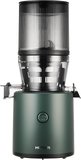
The H320 is the value pick in Hurom’s current lineup. It shares the family-size self-feeding platform and slow extraction technology with the H70, adds a pulp-control lever with fine and coarse strainers, and costs $50 less. The trade is the return of mesh strainers to clean. Buyers who want pulp control more than they hate cleaning strainers should take the H320 and save the money.
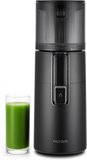
The H400 is the high-volume choice for households that batch-juice two to three days of juice at once. The wide mouth accepts larger pieces of produce, and the two-part easy-clean chamber keeps maintenance reasonable despite the bigger throughput. The premium over the H70 only makes sense if you actually juice in volume; for single glasses daily, the H70 or H320 is the better buy.
Related Reading
- Hurom H70 Cost-Benefit Analysis: Is It Worth the Investment?
- Cold Press vs Centrifugal: The Nutrient Retention Showdown
- 10 Juice Recipes That Replace Your Daily Supplements
- The Ultimate Guide to Juicing for Better Immunity
- Cold Press Juicing for Dogs
- Juice vs Whole Food: Bioavailability Compared
References
-
Khaksar G, Assatarakul K, Sirikantaramas S. Effect of cold-pressed and normal centrifugal juicing on quality attributes of fresh juices: do cold-pressed juices harbor a superior nutritional quality and antioxidant capacity? Heliyon. 2019;5(6):e01917. PubMed: 31286079
-
Kim MJ, Jun JG, Park SY, et al. Antioxidant activities of fresh grape juices prepared using various household processing methods. Food Science and Biotechnology. 2017;26(4):861-869. PubMed: 30263614
-
Beveridge T. Juice extraction from apples and other fruits and vegetables. Critical Reviews in Food Science and Nutrition. 1997;37(5):449-469. PubMed: 9315434
-
Bai J, et al. Effect of extraction, pasteurization and cold storage on flavonoids and other secondary metabolites in fresh orange juice. Journal of the Science of Food and Agriculture. 2013;93(11):2771-2781. PubMed: 23408388
-
Dhuique-Mayer C, et al. Thermal degradation of antioxidant micronutrients in citrus juice: kinetics and newly formed compounds. Journal of Agricultural and Food Chemistry. 2007;55(10):4209-4216. PubMed: 17451252
-
Lepaus BM, Santos AKPO, Spaviero AF, Daud PS. Thermosonication of orange-carrot juice blend: overall quality during refrigerated storage, and sensory acceptance. Molecules. 2023;28(5):2136. PubMed: 36903442
-
Adhikari J, Araghi LR, Singh R, Adhikari K. Continuous-flow high-pressure homogenization of blueberry juice enhances anthocyanin and ascorbic acid stability during cold storage. Journal of Agricultural and Food Chemistry. 2024;72(20):11629-11639. PubMed: 38739462
-
Rincon S, Dufour C, Murray H, Gossinger M. Impact of conventional and non-conventional processing technologies on phenolic compounds and polysaccharides in strawberry nectar: a comparative study. Food Chemistry. 2026;505:148127. PubMed: 41581484
-
Eran Nagar E, Romano A, Shazman A, Lesmes U. Comparative assessment of semi-industrial thermal and non-thermal pasteurization technologies for Red Globe grape juice. Foods. 2026;15(4):494. PubMed: 41750861
-
Fernandez-Rosillo F, Mori-Mestanza D, Cabrejos-Barrios AS, Medina-Mendoza M. Kinetic modeling of vitamin C degradation for predicting shelf life in tropical juices made from camu camu and naranjilla under accelerated storage conditions. Foods. 2026;15(10). PubMed: 42195926
-
Shangguan R, Nie X, Li H, Zhu H. Effects of thermal and non-thermal processing technologies on physicochemical stability, nutritional quality, and flavor profile of melon juice. Food Chemistry: X. 2026;37:104164. PubMed: 42436745
Recommended Products