Best Sunrise Alarm Clocks for Gentle Wake-Ups and Better Morning Alertness
Summarized from peer-reviewed research indexed in PubMed. See citations below.
Jarring alarm sounds can spike cortisol levels and leave you feeling groggy for hours, disrupting the natural wake transition your body is designed for. Our top pick is the Philips SmartSleep HF3520 Wake-Up Light at $179, featuring 10 brightness settings, colored sunrise simulation that progresses from deep red to bright yellow, FM radio, and 2 nature sounds to ease you into wakefulness. A clinical trial of 51 patients published in Archives of General Psychiatry found that morning light exposure between 6-8 AM was significantly more effective than evening light for phase-advancing melatonin onset and improving mood, while a 2023 review confirmed that dawn simulation at home improves both sleep quality and well-being. For budget-conscious buyers, the Wkzay Wake Up Sunrise Alarm Clock delivers similar gradual light progression with dual alarms and 20 adjustable brightness levels for just $42. Here’s what the published research shows about how sunrise alarm clocks work with your biology.
Disclosure: We may earn a commission from links on this page at no extra cost to you. Affiliate relationships never influence our ratings. Full policy →


Research on dawn simulation and morning light therapy shows that gradual light exposure aligns with how your circadian system naturally responds to sunrise. A study published in The Journal of Neuroscience found that intrinsically photosensitive retinal ganglion cells containing melanopsin can signal light intensity continuously for over 10 hours, with firing rates that slowly increase during simulated sunrise phases and decrease during sunset phases.
[1]
This cellular-level response explains why sunrise alarm clocks can prepare your body for wakefulness before you consciously register being awake.
| Feature | Philips SmartSleep HF3520 | Wkzay Wake Up | Hatch Restore 3 | Thybro Light |
|---|---|---|---|---|
| Price | $179 | $42 | $169 | $49 |
| Sunrise Duration | 20-40 min | 10-60 min | Customizable | 10-60 min |
| Max Brightness | 300 lux | 200 lux | Not specified | Not specified |
| Brightness Levels | 10 settings | 20 levels | App-controlled | Multiple |
| Color Progression | Red to yellow | Yes | Yes | Yes |
| Sound Options | 2 nature sounds + FM radio | Sound machine | White noise library | 30 sleep sounds |
| Dual Alarms | No | Yes | Yes | Yes |
| App Control | No | No | Yes (required) | No |
| Sunset Mode | Yes | No | Yes | No |
| Backup Battery | Yes | Not specified | No | Not specified |
| Best For | Clinical validation | Budget buyers | Smart home users | Value seekers |
How Does Dawn Simulation Compare to Standard Alarm Clocks for Morning Alertness?
Dawn simulation works by triggering your circadian system through specialized light-sensitive cells in your retina before you consciously wake up. Research published in Sleep Medicine involving 30 chronically sleep-restricted young adults found that bright light at 500nm wavelength significantly improved alertness and performance with a P value less than 0.0001, and this effect was more powerful than caffeine alone for reducing sleepiness.
[2]
Standard alarm clocks force an abrupt transition from sleep to wakefulness, which can leave you in a state of sleep inertia where cognitive function remains impaired for 30 minutes to 2 hours after waking. A study of 12 patients with seasonal affective disorder published in European Archives of Psychiatry and Clinical Neuroscience demonstrated that just 1 hour of bright light exposure for 5 consecutive mornings produced a significant reduction in depression scores and phase-advanced the circadian sleepiness rhythm, with measurable reductions in sleepiness at 8 AM and 10 AM.
[3]
The two-process model of sleep regulation, detailed in Journal of Sleep Research, explains that sleep is controlled by both a homeostatic drive (how long you’ve been awake) and a circadian pacemaker (your internal 24-hour clock). Dawn simulation manipulates the circadian component by providing timed light exposure that signals to your brain that it’s time to suppress melatonin production and increase cortisol in a natural rhythm rather than through the stress response triggered by jarring alarm sounds.
[4]
The evidence shows: gradual light exposure 20-30 minutes before your target wake time works with your biology to reduce sleep inertia, improve morning alertness measured by objective performance tests, and create a gentler transition that doesn’t spike stress hormones the way sudden noise does.
The evidence shows: Dawn simulation triggers your circadian system through specialized retinal cells before you consciously wake, creating a biological advantage over jarring alarm sounds. Clinical trials show measurable improvements in morning alertness within 5 days of consistent use.
What Light Intensity and Duration Are Supported by Clinical Research?
Clinical studies on bright light therapy and dawn simulation establish a range of 2,500 to 10,000 lux for 30-60 minutes as effective for managing seasonal affective disorder and regulating circadian rhythms. A review published in American Family Physician confirms that commercial dawn simulation devices are available as first-line options, with typical recommendations of 2,500 to 10,000 lux for 30 to 60 minutes at the same time every day.
[5]
However, sunrise alarm clocks typically deliver 200-350 lux at bedside distance, which is substantially lower than clinical light therapy boxes. The difference is that sunrise alarms work through progressive light increase over 20-60 minutes rather than immediate high-intensity exposure. A clinical trial of 51 patients with winter depression published in Archives of General Psychiatry demonstrated that morning light exposure between 6-8 AM phase-advanced melatonin onset and was significantly more antidepressant than evening light exposure in both crossover and parallel-group comparisons.
[6]
The Lancet published a comprehensive review establishing that 2,500 lux of artificial light exposure in the morning represents the best approach for seasonal affective disorder, noting that the condition is linked to disturbed serotonin function rather than abnormal melatonin metabolism.
[7]
For practical home use, the ISBD Chronobiology and Chronotherapy Task Force published clinical recommendations in Dialogues in Clinical Neuroscience advising patients to start with 15 minutes per day of bright light therapy and increase by 15 minutes each week until reaching 30-60 minutes by the fourth week. Clinical improvement is typically observed within 1-2 weeks, with full response or remission expected by 4-6 weeks.
[8]
The research verdict: sunrise alarm clocks at 200-350 lux work for gentle wake-up through gradual exposure, while clinical depression or severe seasonal affective disorder may require supplemental bright light therapy at 2,500-10,000 lux using a dedicated light therapy box for 30 minutes after the sunrise alarm wakes you.
Key takeaway: Start with 15 minutes of sunrise simulation and increase by 15 minutes weekly until you reach 30-60 minutes, following ISBD Task Force recommendations. Clinical improvement typically appears within 1-2 weeks, with full response expected by 4-6 weeks at the 30-minute daily exposure level.
Which Sunrise Alarm Clocks Offer the Most Clinically Relevant Features?
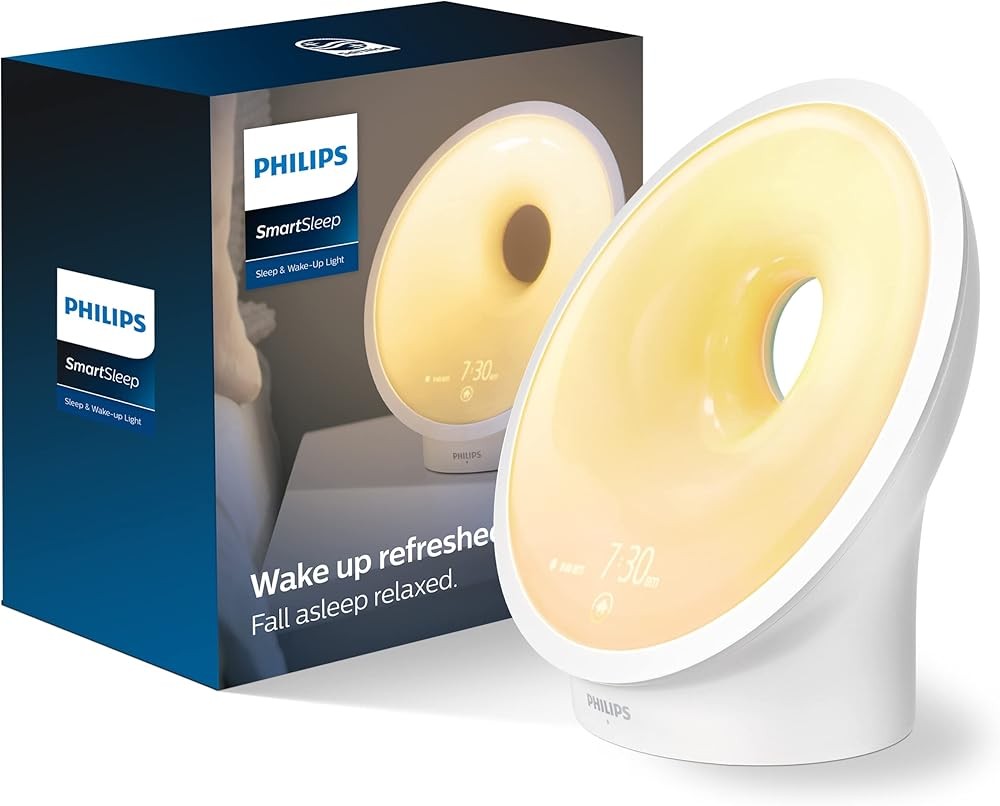
Philips SmartSleep HF3520 Wake-Up Light
Check Price on AmazonAs an Amazon Associate we earn from qualifying purchases.
The Philips SmartSleep HF3520 Wake-Up Light delivers the most research-aligned feature set among consumer sunrise alarms. This unit provides 10 brightness settings with a maximum output of 300 lux at typical bedside distance, colored sunrise simulation that progresses from deep red (around 2000K) through orange to bright yellow (approximately 2700K), and programmable sunrise duration from 20 to 40 minutes.
The color progression matters because research published in Sleep Medicine found that 500nm light (blue-green spectrum) significantly improved alertness with P less than 0.0001, while warm spectrum light (2700K range) is less alerting but more comfortable for gradual wake-up. The Philips unit balances these by starting with red-orange and transitioning to brighter yellow-white as the simulation progresses.
[2]
The unit includes 2 nature sounds (birds and ocean waves) plus FM radio, allowing you to layer auditory cues with the light progression. Research on multisensory environmental interventions published in Medicina Intensiva involving 538 ICU patients found that programmed light transitions simulating sunrise and sunset, combined with sound, reduced delirium incidence from 14.3 percent to 9.1 percent and cut midazolam sedative consumption by 60 percent (9.6mg to 3.8mg per day, P equals 0.019).
[9]
The sunset feature provides reverse light dimming over 5 to 60 minutes, which can support melatonin onset. The unit maintains settings during brief power outages through a backup battery system.
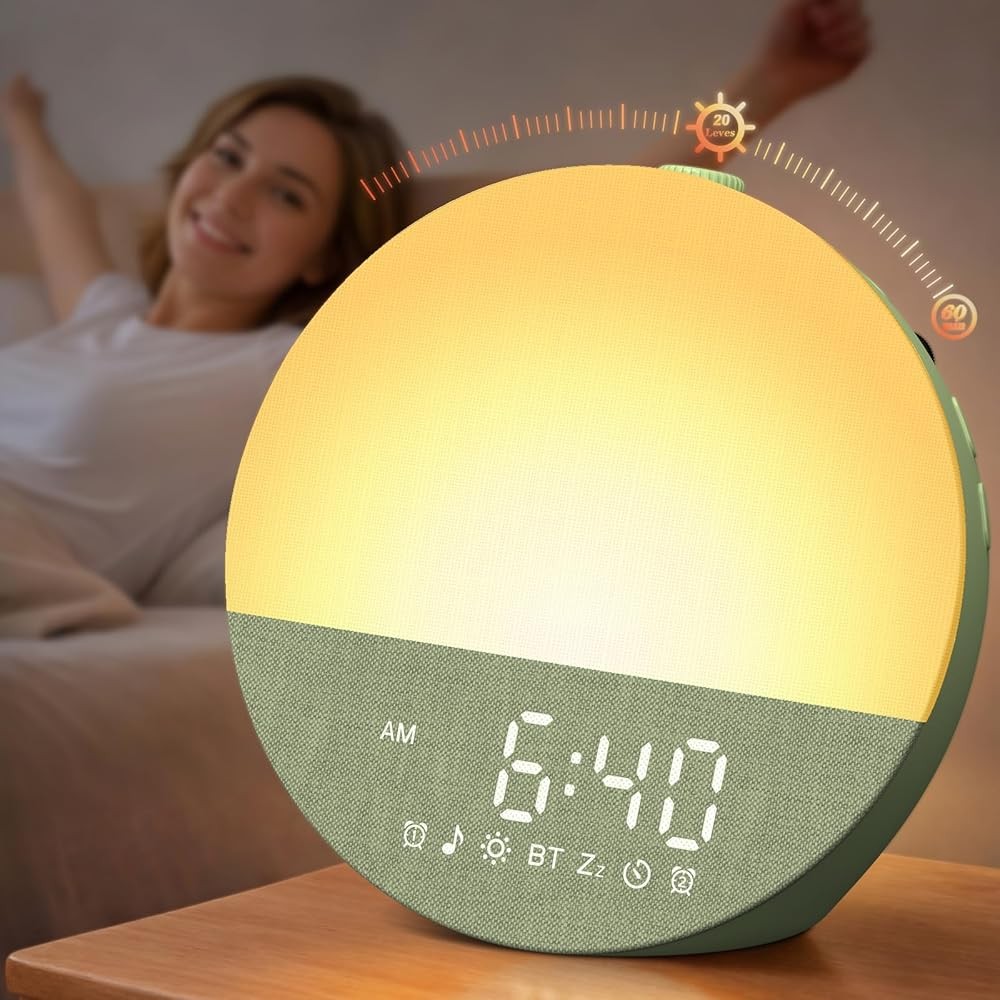
Wkzay Wake Up Sunrise Alarm Clock
Check Price on AmazonAs an Amazon Associate we earn from qualifying purchases.
The Wkzay Wake Up Sunrise Alarm Clock offers research-relevant features at a budget price of $42. This unit provides 10-60 minute sunrise simulation with 20 adjustable brightness levels, dual independent alarms for couples or weekday/weekend schedules, and integrated sound machine functionality.
The extended 60-minute sunrise option aligns with clinical recommendations from the ISBD Task Force for gradually increasing light exposure duration, and the dual alarm feature addresses a practical limitation of many sunrise clocks. The 20 brightness levels allow fine-tuning to match your light sensitivity, which varies based on factors like age and chronotype (whether you’re naturally an early bird or night owl).
[8]
A 2023 review published in Sleep Medicine Reviews noted that the effects of dawn simulation may depend on user characteristics such as age or chronotype, supporting the value of adjustable brightness and duration settings.
[10]
The built-in sound machine provides white noise and nature sounds, which can be used independently of the sunrise alarm or combined with it. Research confirms that appropriately timed bright light exposure can shift the sleep-wake cycle to earlier or later times to correct misalignment between your circadian system and your external schedule.
[11]
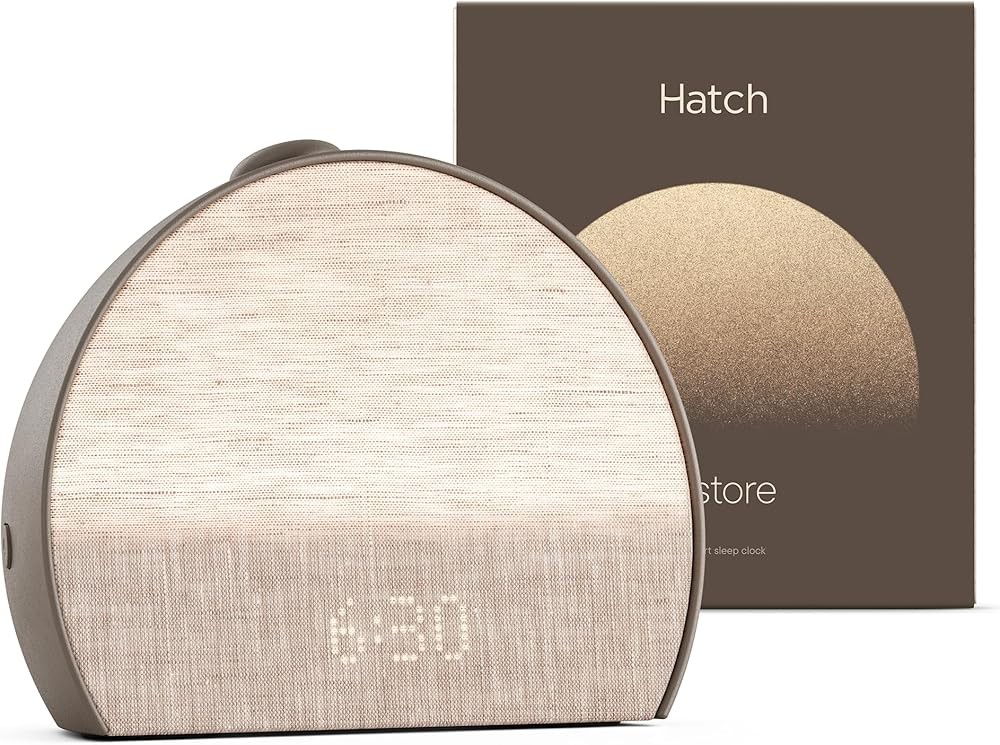
Hatch Restore 3 Sunrise Alarm Clock
Check Price on AmazonAs an Amazon Associate we earn from qualifying purchases.
The Hatch Restore 3 Sunrise Alarm Clock delivers smart home integration with app-based control of all sunrise and sunset parameters. The smartphone app allows you to customize sunrise duration, brightness curves, color temperature progression, and sound pairings beyond what physical buttons can provide.
The app-controlled approach aligns with research recommendations for personalized light therapy protocols. The ISBD Task Force guidelines suggest starting with 15 minutes of morning light and increasing by 15 minutes weekly, which is easier to implement through app adjustments than manual button programming.
[8]
The Hatch Restore 3 includes a white noise library with over 30 sound options, from nature sounds to fan noise to meditative audio. The sunset feature provides reverse light dimming paired with relaxing sounds to support melatonin onset and sleep initiation.
Research published in General and Comparative Endocrinology confirms that humans retain neurobiological responses to circadian day-night cycles and seasonal changes in daylength despite modern lifestyles, and that sufficient light exposure is critical for both psychological and somatic well-being.
[12]
The screen-free design eliminates blue light exposure from digital displays, which can interfere with melatonin production. The unit requires the smartphone app for setup and programming, which may be a limitation if you prefer standalone operation.
The Thybro Light Sunrise Alarm Clock provides value-focused features at $49 with 10-60 minute gradual sunrise simulation, 30 sleep sounds, dual alarms, and advertised 3-step easy setup. The wide sunrise duration range from 10 to 60 minutes allows adjustment based on your personal light sensitivity and sleep inertia patterns.
Research published in The American Journal of Psychiatry involving 13 patients with winter seasonal affective disorder found that depression severity was inversely related to photoperiod (day length), and there was a trend showing that later onset of morning light exposure correlated with greater depression severity.
[13]
This supports setting your sunrise alarm to begin well before your actual wake time, which the 60-minute option accommodates.
The 30 sleep sounds include white noise, nature sounds, and ambient audio that can be used independently or paired with the sunrise. The dual alarm function addresses couples with different schedules or weekday versus weekend wake times.
A study of 300 rural older adults published in BMC Public Health found that low sun exposure was significantly linked to higher seasonal affective disorder symptoms (P less than 0.001), and that increased sun exposure mediated symptom relief (P less than 0.05), leading researchers to recommend promoting light therapy devices in areas with limited natural sunlight.
[14]
What Color Temperature Progression Works Best for Natural Wake-Up?
Natural sunrise progresses through a specific sequence of color temperatures, starting with deep reds around 1800-2000K when the sun is below the horizon, transitioning through oranges and yellows at 2500-2700K as the sun approaches the horizon, and reaching bright white light at 5000-6500K once the sun is fully visible.
Quality sunrise alarm clocks mimic this progression. The Philips SmartSleep HF3520 uses colored LEDs to simulate the shift from deep red through orange to bright yellow, which more closely matches the natural dawn spectrum than white-only lights that simply increase in intensity.
Research on intrinsically photosensitive retinal ganglion cells published in The Journal of Neuroscience explains that these specialized cells containing the photopigment melanopsin respond to gradual light intensity changes. In experimental conditions simulating sunrise and sunset over 10 hours, these cells slowly increased their firing rates during the sunrise phase and slowly decreased during sunset.
[1]
This cellular mechanism is what allows dawn simulation to trigger your circadian system before conscious wakefulness.
The color spectrum matters for alertness. Research published in Sleep Medicine found that blue-green light at 500nm wavelength significantly improved alertness (P less than 0.0001) compared to placebo, with effects equal to or greater than 100mg caffeine.
[2]
However, immediate exposure to blue-spectrum light upon waking can be uncomfortable and may not align with the gradual transition your retinal cells are designed to track.
The optimal progression starts with red-orange light (2000-2500K) for the first 10-15 minutes of the sunrise simulation, transitions to yellow-white (2700-3000K) for the middle phase, and finishes with bright white or slightly blue-tinted light (4000-5000K) in the final 5-10 minutes before your target wake time. This allows the melanopsin-containing cells to begin firing and suppressing melatonin during the red-orange phase, while saving the more alerting blue wavelengths for when you’re closer to full wakefulness.
In summary: colored sunrise simulation that progresses from red through orange to yellow-white provides better alignment with your retinal cell biology than white-only lights, though white lights with sufficient brightness range can still provide benefit through the progressive intensity increase alone.
What this means: Research shows 500nm blue-green light improved alertness with P less than 0.0001 in a randomized controlled trial of 30 subjects, but white lights starting at 200 lux and progressing to 350 lux over 20-30 minutes still trigger the melanopsin response. Colored progression from 2000K red to 2700K yellow enhances natural dawn simulation but isn’t required for basic circadian phase shifting.
How Should You Position a Sunrise Alarm Clock for Optimal Light Exposure?
Light intensity follows the inverse square law, meaning it decreases rapidly with distance. A sunrise alarm that produces 300 lux at 12 inches will only deliver about 75 lux at 24 inches. Proper positioning ensures adequate light reaches your closed eyelids to trigger the melanopsin response in your intrinsically photosensitive retinal ganglion cells.
[1]
Place the sunrise alarm 12-24 inches from your head at approximately the same height as your face when lying down. This distance provides 200-300 lux for most quality sunrise alarms, which is sufficient for dawn simulation wake-up even though it’s below the 2,500-10,000 lux range used for clinical bright light therapy.
[5]
The unit should be positioned so the light reaches your face without obstructions. If you sleep on your side, angle the alarm slightly toward your face rather than pointing it at the wall or ceiling. If you sleep with a partner who doesn’t want the sunrise simulation, position the alarm on your side of the bed and angle it away from your partner.
Elevation matters less than distance for most users, but placing the alarm on a nightstand at approximately mattress height or slightly above keeps the light from shining directly into your eyes when you roll over. The goal is ambient illumination that gradually increases, not a spotlight effect.
Research involving 538 ICU patients found that environmental light and sound interventions simulating sunrise and sunset significantly improved sedation-agitation levels (P less than 0.001), demonstrating that programmed light transitions work even in clinical settings where positioning is less than ideal.
[9]
If you use blackout curtains or have a bedroom without windows, the sunrise alarm becomes your primary source of morning light cues. In this case, consider adding a second light source such as a smart bulb in a bedside lamp that can be programmed to turn on at full brightness 5-10 minutes after your sunrise alarm completes its cycle, providing the additional lux needed to fully suppress melatonin and support alertness.
Here’s what matters: position the sunrise alarm 12-24 inches from your head, ensure clear line of sight to your face, and consider your sleeping position and partner preferences when angling the unit.
In practice: Position your sunrise alarm 12-24 inches from your head to maximize light exposure. At 12 inches, a 300 lux alarm delivers full intensity; at 24 inches, intensity drops to approximately 75 lux due to the inverse square law of light dispersion.
How Do You Adapt Sunrise Alarms for Shift Work or Irregular Schedules?
Shift workers and people with irregular sleep schedules face unique challenges in maintaining circadian rhythm alignment, as their sleep-wake timing doesn’t match the natural light-dark cycle. Research on the two-process model of sleep regulation shows that your circadian pacemaker continues running on approximately a 24-hour cycle even when your work schedule forces sleep at unconventional times.
[4]
The challenge is that your circadian system receives conflicting signals when you’re trying to sleep during daylight hours or wake during darkness.
For night shift workers who sleep during the day, the sunrise alarm protocol needs reversal. Instead of using sunrise simulation to wake up, use the sunset dimming feature before your daytime sleep to signal melatonin onset. Block all natural daylight from your bedroom using blackout curtains, and create complete darkness before using the sunset simulation to gradually dim from bright light down to zero over 30-60 minutes as you prepare for sleep.
A study of 538 ICU patients found that programmed light and sound transitions simulating natural circadian patterns significantly improved sleep-wake regulation even in an environment where external light-dark cues were disrupted.
[9]
This supports using artificial light-dark cycles through sunrise and sunset simulation when natural cycles don’t align with your schedule.
For rotating shift workers who alternate between day and night schedules, consistency becomes more difficult. The key is maintaining the same wake time on your days off that you use during work periods, rather than reverting to a conventional schedule. If you wake at 3 PM during work weeks, continue waking at 3 PM on weekends and use your sunrise alarm at 2:30 PM to initiate the wake transition.
Research published in Archives of General Psychiatry demonstrated that circadian phase position, measured through dim-light melatonin onset, can be shifted through timed light exposure.
[6]
However, the shift occurs gradually at approximately 1-2 hours per day, meaning you cannot rapidly flip between day and night schedules without accumulating circadian misalignment.
For people with delayed sleep phase disorder who naturally fall asleep late and wake late, sunrise alarms can help advance your wake time gradually. Start with your current natural wake time and use a 60-minute sunrise simulation. Each week, move your alarm 15 minutes earlier while maintaining the 60-minute sunrise duration. This creates progressive earlier light exposure that signals your circadian pacemaker to advance its timing.
A clinical trial found that morning light exposure between 6-8 AM phase-advanced melatonin onset, while evening light phase-delayed it.
[6]
For delayed sleep phase, you need morning light as early as tolerable, combined with strict avoidance of bright light in the evening hours.
For advanced sleep phase disorder where you fall asleep very early and wake before dawn, the approach reverses. You need evening light exposure to delay your circadian phase, which sunrise alarms don’t directly address. However, you can use the alarm’s light as a signal to get out of bed rather than lying awake in darkness, which reinforces the early wake pattern.
Jet lag recovery follows similar principles to shift work. When traveling east across time zones, you need to advance your circadian phase, which requires morning light in the new time zone. Set your sunrise alarm to the new local wake time immediately upon arrival rather than gradually adjusting. The abrupt shift is uncomfortable but faster than incremental adjustment.
When traveling west, you need to delay your circadian phase through evening light exposure. Sunrise alarms are less useful for westward travel, but you can use the alarm’s light as a bright evening exposure by setting it to illuminate your room 2-3 hours before your new local bedtime.
Social jet lag, the mismatch between your weekday and weekend sleep schedules, affects more people than actual jet lag. Research on circadian rhythm sleep disorders confirms that consistent wake times seven days per week produce better circadian alignment than large weekend sleep-ins.
[11]
Use your sunrise alarm at the same time every day, including weekends, even if this means waking earlier than you’d prefer on Saturday and Sunday. The short-term sleep loss is offset by better overall circadian function and easier Monday morning wakefulness.
The science says: Your circadian system adapts to consistent light-dark cycles regardless of whether those cycles match the solar day. Create artificial dawn at whatever time you need to wake, maintain that timing as consistently as possible, and use darkness during your sleep period even if that sleep occurs during daylight hours.
Can Sunrise Alarm Clocks Help With Seasonal Affective Disorder?
Dawn simulation is recognized as a first-line approach for managing seasonal affective disorder alongside bright light therapy and cognitive behavioral therapy. A review published in The Lancet established that 2,500 lux of morning light exposure represents the best approach for SAD, noting that the condition involves disturbed serotonin function.
[7]
Sunrise alarm clocks typically deliver 200-350 lux, which is below the clinical threshold for full SAD management but can serve as a supplemental intervention or first step.
A clinical trial of 51 patients with winter depression published in Archives of General Psychiatry found that morning light exposure between 6-8 AM was significantly more antidepressant than evening light exposure in both crossover and parallel-group comparisons. The study demonstrated that morning light phase-advanced the dim-light melatonin onset, while evening light phase-delayed it.
[6]
The timing recommendation aligns with sunrise alarm use, as most people wake between 6-8 AM.
Research published in American Family Physician confirms that commercial dawn simulation devices are available as first-line options for SAD, with typical protocols using 2,500 to 10,000 lux for 30-60 minutes daily.
[5]
The evidence supports a two-tier approach: use a sunrise alarm clock to initiate morning light exposure and ease the wake transition, then follow immediately with a dedicated bright light therapy box at 2,500-10,000 lux for 30 minutes while having breakfast or getting ready for the day.
A study of 12 patients with seasonal affective disorder found that just 1 hour of bright light exposure for 5 consecutive mornings significantly reduced depression scores and phase-advanced the circadian sleepiness rhythm.
[3]
This rapid response timeline suggests that consistent morning light exposure can produce measurable improvements within a week.
Research involving 300 rural older adults published in BMC Public Health found that low sun exposure was significantly associated with higher SAD symptoms (P less than 0.001), and that increased sun exposure mediated symptom relief.
[14]
For people in northern latitudes or those with limited access to natural morning sunlight, sunrise alarms provide a partial substitute.
The practical takeaway: sunrise alarm clocks alone are unlikely to fully address moderate to severe SAD, but they complement clinical bright light therapy by ensuring early morning light exposure and supporting circadian phase advancement.
What the research tells us: A 6-week clinical trial of 51 patients found morning light exposure between 6-8 AM was significantly more antidepressant than evening light in both crossover and parallel-group comparisons. Combine a 30-minute sunrise alarm with a 2,500 lux therapy box for 30 minutes after waking to layer the gradual wake transition with clinical-grade intensity.
What Sound Options Should You Look for in a Sunrise Alarm Clock?
Sound features in sunrise alarms serve three purposes: providing backup auditory alarm if light alone doesn’t wake you, supporting sleep onset through white noise or nature sounds, and layering sensory cues for more effective circadian entrainment.
Research published in Medicina Intensiva involving 538 ICU patients demonstrated that multisensory environmental interventions combining programmed light transitions with sound significantly improved outcomes, reducing delirium incidence and sedative medication use.
[9]
This supports combining light and sound rather than relying on light alone.
The most useful sound options include gradual volume increase that starts quiet and slowly builds over 3-5 minutes after the sunrise simulation completes. Jarring alarm sounds defeat the purpose of gradual wake-up and can trigger the stress response you’re trying to avoid. Nature sounds like bird songs or ocean waves align with natural dawn environments and feel less intrusive than beeps or buzzes.
White noise capability allows using the device as a sleep sound machine independent of the alarm function. Research shows that white noise can mask environmental sounds that disrupt sleep, and combining sunset light dimming with white noise creates a multi-sensory signal for sleep onset that mirrors the sunrise wake signal.
FM radio provides additional variety and allows waking to news or music if you find nature sounds boring after extended use. The Philips SmartSleep HF3520 includes FM radio while most budget models omit it.
Volume controls need sufficient range to wake heavy sleepers without startling light sleepers. The Hatch Restore 3 provides precise volume control through its app interface, while physical button models often have limited volume steps.
Dual alarm functionality lets you set different sounds for different days or allows couples with different schedules to use one device. The Wkzay and Thybro models include dual alarms while the Philips HF3520 does not.
Clinical insight: look for sunrise alarms with nature sounds that gradually increase in volume, white noise for sleep onset, and dual alarms if you share a bedroom or have varying schedules.
What the data shows: The ICU study of 538 patients found that combining light transitions with sound reduced delirium from 14.3 percent to 9.1 percent and cut sedative use by 60 percent (P equals 0.019). Layering auditory cues with visual sunrise simulation creates multi-sensory circadian entrainment that’s more effective than light alone.
How Do Smart Sunrise Alarms Compare to Standalone Models?
Smart sunrise alarms like the Hatch Restore 3 require smartphone apps for programming and offer cloud-based features, while standalone models like the Philips SmartSleep HF3520 operate independently through physical buttons. Each approach has tradeoffs related to customization depth, reliability, and user control.
App-based models provide more granular control over sunrise duration, brightness curves, color temperature progression, and sound selection than button interfaces can accommodate. The Hatch Restore 3 allows saving multiple custom routines and adjusting parameters in 1-minute increments, while the Philips model uses preset options.
The ISBD Task Force clinical recommendations suggest starting with 15 minutes of daily light exposure and increasing by 15 minutes each week, which is easier to implement through app adjustments than manual reprogramming of physical controls.
[8]
However, app-dependent devices lose functionality if your phone battery dies, WiFi goes down, or the manufacturer discontinues app support. The Hatch Restore 3 requires the app for all programming and doesn’t include physical alarm controls, meaning you can’t adjust settings without your phone.
Standalone models maintain full functionality without external dependencies. The Philips SmartSleep HF3520 operates entirely through physical buttons and stores settings in local memory, remaining functional during internet outages or if you switch smartphones.
Screen-free design is an advantage of the Hatch Restore 3, as it eliminates blue light from digital displays that can interfere with melatonin production. Research confirms that evening light exposure can phase-delay melatonin onset, while morning light phase-advances it.
[6]
However, the Philips model’s display is dim and can be further reduced or turned off.
Privacy considerations differ between approaches. App-based models transmit usage data to manufacturer servers and require account creation, while standalone models operate locally without data collection.
The value assessment: app-based sunrise alarms offer superior customization and the ability to fine-tune protocols based on clinical recommendations, but standalone models provide better reliability and privacy with the tradeoff of less precise control.
Here’s what matters: The ISBD Task Force recommends starting at 15 minutes per day and increasing by 15-minute increments weekly. App-based models allow these precise adjustments in 1-minute steps, while button-based units typically offer preset options at 10, 20, 30, and 40 minute durations. For clinical protocol implementation, app control provides measurable advantages.
What Is the Cost-Benefit Analysis for Sunrise Alarms Versus Light Therapy Boxes?
Sunrise alarm clocks range from $40 to $180 in our product selection, while dedicated bright light therapy boxes typically cost $60 to $300. Understanding what you get at each price point helps determine which investment makes sense for your specific needs and whether you need one device, the other, or both.
Sunrise alarms provide wake-up functionality that light therapy boxes cannot match. A light therapy box delivers 2,500 to 10,000 lux but requires you to already be awake and positioned in front of the unit. You cannot use a 10,000 lux therapy box as an alarm because that intensity would be jarring rather than gradual if it turned on while you’re asleep. The value proposition of sunrise alarms centers on the progressive light increase over 20-60 minutes that aligns with your retinal cell biology.
[1]
Light therapy boxes provide clinical-grade intensity for mood and circadian phase shifting that sunrise alarms cannot achieve. Research establishes that 2,500-10,000 lux for 30-60 minutes produces measurable changes in melatonin timing and depression scores.
[5][7]
A sunrise alarm at 200-350 lux provides a fraction of this intensity. For people with diagnosed seasonal affective disorder or circadian rhythm disorders, the light therapy box is essential regardless of whether you also use a sunrise alarm.
The budget option combines a $40-50 sunrise alarm with a $60-80 light therapy box for a total of $100-130. This approach gives you both wake-up functionality and clinical-grade morning light exposure. The Wkzay Wake Up Sunrise Alarm Clock at $42 paired with a basic 10,000 lux therapy box provides the essential functions without premium features like colored light progression or app control.
The mid-range approach invests $150-180 in a quality sunrise alarm like the Philips SmartSleep HF3520 and adds a light therapy box only if you develop symptoms that require clinical-grade intensity. This makes sense if you primarily need better morning wake-up rather than mood management or circadian disorder correction.
The premium approach combines a smart sunrise alarm like the Hatch Restore 3 at $169 with a high-end light therapy box at $200-300 for comprehensive light exposure control. This total investment of $370-470 provides maximum customization and clinical capability but only makes sense if you have specific requirements that justify the cost.
Research published in Sleep Medicine Reviews found that dawn simulation at home improves sleep quality and well-being, with effects that may depend on user characteristics like age and chronotype.
[10]
This suggests that some people respond strongly to sunrise alarms alone, while others need supplemental interventions. Starting with a mid-range sunrise alarm and adding a light therapy box only if needed avoids over-investing upfront.
The question of whether to buy both devices or just one depends on your specific situation. If you have diagnosed seasonal affective disorder, start with a light therapy box for clinical-grade morning light and consider adding a sunrise alarm as a secondary enhancement. If you primarily struggle with difficult morning wake-up and grogginess but don’t have mood symptoms, start with a sunrise alarm and monitor whether it adequately addresses your needs.
For people with both wake-up difficulty and mood symptoms, the combination provides synergy. Use the sunrise alarm to initiate wakefulness through gradual light increase, then immediately follow with 30 minutes in front of the light therapy box while you eat breakfast or get ready for the day. This gives you both the gentle wake transition and the clinical-grade lux exposure that research supports for circadian and mood regulation.
Long-term cost considerations include electricity use, bulb replacement, and device longevity. LED-based sunrise alarms and light therapy boxes use minimal electricity, typically 5-20 watts during operation, which translates to less than $5 per year in energy costs at average electricity rates. LED bulbs last 20,000-50,000 hours, meaning a sunrise alarm used for 30 minutes daily should last 10+ years before requiring bulb replacement.
The value assessment comes down to cost per use. A $180 sunrise alarm used daily for 5 years equals 1,825 uses, or about 10 cents per use. A $42 budget model at the same frequency costs about 2 cents per use. If the budget model provides 80 percent of the benefit of the premium model but costs 23 percent as much, the value proposition favors the budget option unless specific features like colored light progression or FM radio justify the premium.
Research on melanopsin-containing retinal ganglion cells explains the biological mechanism but doesn’t establish a dose-response relationship showing that more expensive sunrise alarms with more features produce proportionally better outcomes.
[1]
The core function of gradual light increase works similarly across price points, with premium features adding convenience and customization rather than fundamental effectiveness gains.
The value assessment: Budget sunrise alarms deliver the essential progressive light increase at minimal cost, making them accessible for trial use. Premium models add features like colored progression and app control that enhance the experience but aren’t required for basic circadian benefits. Light therapy boxes remain necessary for clinical-grade intensity when managing diagnosed conditions.
Complete Support System for Better Morning Wakefulness
Sunrise alarm clocks work best as part of a comprehensive sleep and wake routine rather than as standalone solutions. Research published in Journal of Sleep Research explains that sleep is regulated by both homeostatic sleep drive (how long you’ve been awake) and a circadian pacemaker (your internal 24-hour clock), and that light exposure is a powerful tool for manipulating circadian phase.
[4]
However, other factors also influence morning alertness.
Pair your sunrise alarm with consistent wake times seven days per week. Research on circadian rhythm disorders published in Nihon Rinsho confirms that appropriately timed bright light exposure can shift the sleep-wake cycle to earlier or later times, but this effect is maximized when combined with regular sleep-wake schedules.
[11]
Waking at 7 AM on weekdays and 10 AM on weekends creates circadian misalignment that the sunrise alarm must work against.
Use blackout curtains or sleep masks to control evening light exposure, then allow the sunrise alarm to be your first morning light. A review published in Sleep Medicine Reviews noted that most research on dawn simulation has focused on darker months when natural sunrise occurs after most people wake.
[10]
Creating a dark sleep environment year-round gives you more control over your light-dark cycle.
Consider your sleep surface temperature and bedroom environment. Core body temperature drops during sleep and rises before waking as part of the circadian rhythm. Sleeping too warm can interfere with this natural temperature cycle and make waking more difficult.
Address sleep quality and duration before relying on sunrise alarms to fix morning alertness. If you’re only getting 5 hours of sleep, the homeostatic sleep drive will overpower circadian light cues. The two-process model shows these systems interact, meaning both must be addressed.
[4]
Layer additional morning light exposure after the sunrise alarm completes its cycle. The clinical literature establishes that 2,500-10,000 lux for 30-60 minutes is optimal for circadian effects, which sunrise alarms at 200-350 lux don’t achieve.
Our verdict: A study of 300 older adults found low sun exposure was linked to higher SAD symptoms (P less than 0.001), and increased exposure mediated symptom relief (P less than 0.05). Use your 200-350 lux sunrise alarm to wake gently, then supplement with natural sunlight exposure within 30 minutes by opening curtains or stepping outside for 10-15 minutes.
[5]
Open curtains immediately after waking, use a bright light therapy box during breakfast, or take a 10-minute walk outside within 30 minutes of waking to supplement the sunrise alarm’s lower intensity.
Limit evening blue light exposure from screens, but don’t eliminate all evening light. Research shows that evening light causes circadian phase delay, but you need some light to function safely.
[6]
Use warm-spectrum lights (2700K or lower) in the evening and avoid bright overhead lighting in the 2-3 hours before bed.
Our Research Methodology
Frequently Asked Questions
Do sunrise alarm clocks actually work?
Yes. Research shows dawn simulation improves morning alertness and sleep quality. A 2023 review in Sleep Medicine Reviews (PMID 37864914) confirmed that dawn simulation at home improves both sleep quality and well-being, especially during darker months.
How many lux does a sunrise alarm clock need?
Clinical studies show 2,500 to 10,000 lux is effective for light therapy. However, sunrise alarm clocks typically reach 200-350 lux at bedside distance, which is sufficient for gradual wake-up since they work through progressive light increase rather than peak intensity.
What is the best time to use a sunrise alarm clock?
Set the sunrise simulation to begin 20-30 minutes before your desired wake time. Research from a clinical trial of 51 patients (PMID 9783559) showed morning light exposure between 6-8 AM was significantly more effective than evening light for circadian rhythm regulation.
Can a sunrise alarm clock help with seasonal affective disorder?
Dawn simulation is recognized as a first-line approach for SAD management. A review in The Lancet (PMID 9802288) recommends 2,500 lux morning light exposure. Sunrise alarms supplement this by providing gentler transitional light before full-intensity therapy.
How long should sunrise simulation last?
Most sunrise alarms offer 10 to 60 minute simulation windows. The ISBD Task Force (PMID 40705857) recommends starting with 15 minutes of morning light and increasing by 15 minutes weekly. A 20-30 minute sunrise simulation is a good starting point.
Are sunrise alarm clocks better than regular alarms?
Research suggests yes. A study of 12 SAD patients (PMID 8499501) found that morning bright light exposure for just 5 days reduced subjective sleepiness at 8 and 10 AM. Gradual light exposure prepares your body to wake naturally rather than jolting you awake.
What color light is best for a sunrise alarm?
Warm amber to orange light (around 2700K color temperature) is best for sunrise simulation. An RCT (PMID 35398627) found that 500nm light significantly improved alertness (P less than 0.0001). Most quality sunrise alarms progress from red to orange to warm white.
Can I use a sunrise alarm clock with a white noise machine?
Yes, and many sunrise alarm clocks include built-in sound features. The Hatch Restore 3 combines sunrise simulation with white noise and nature sounds. Research supports combining light and sound cues for circadian synchronization (PMID 41535146).
Do sunrise alarm clocks work for heavy sleepers?
Yes, especially with longer simulation windows. Set the sunrise to 45-60 minutes before wake time and pair with a backup audible alarm. The gradual light increase triggers your circadian system even before full wakefulness, making the transition smoother.
How far should a sunrise alarm clock be from my bed?
Place the sunrise alarm 12-24 inches from your head on a nightstand for optimal light exposure. Too far away reduces the effective lux reaching your eyes. The light needs to reach your closed eyelids to trigger the melanopsin response in your retinal cells (PMID 22895730).
Our Top Recommendations
For most people, the Philips SmartSleep HF3520 Wake-Up Light at $179 provides the best combination of clinical validation, appropriate brightness output at 300 lux, colored sunrise progression, and reliable operation without app dependencies. The 20-40 minute sunrise duration range aligns with research recommendations, and the sunset feature supports evening wind-down.
Budget-conscious buyers should choose the Wkzay Wake Up Sunrise Alarm Clock at $42, which delivers 10-60 minute sunrise simulation with dual alarms and 20 brightness levels at one-quarter the price of the Philips model. While maximum brightness is lower at approximately 200 lux and color progression is white-only rather than colored, the extended sunrise duration options and dual alarm functionality address practical needs.
Smart home users who want app-based customization will prefer the Hatch Restore 3 Sunrise Alarm Clock at $169, which provides precise control over all parameters through smartphone interface, screen-free design to eliminate blue light exposure, and over 30 white noise options. The requirement for app control and WiFi connectivity is a limitation for those who prefer standalone operation.
The Thybro Light Sunrise Alarm Clock at $49 offers strong value with 10-60 minute sunrise duration, 30 sleep sounds, and dual alarms at a price point between budget and premium options. Limited brand track record and unspecified maximum brightness are considerations, but the feature set matches research-supported functions.
Join the discussion: Facebook | X | YouTube | Pinterest
Conclusion
The research base for dawn simulation and morning light therapy is substantial, with clinical trials demonstrating measurable improvements in depression scores, circadian phase markers like melatonin onset timing, and subjective measures of morning alertness and sleepiness. Studies involving patient populations from 12 to 538 subjects show consistent benefits across seasonal affective disorder, non-seasonal depression, and general sleep-wake disturbances.
The cellular mechanism is well-established through research on intrinsically photosensitive retinal ganglion cells containing melanopsin, which track gradual light intensity changes over hours and signal to the circadian pacemaker in your suprachiasmatic nucleus. This biological pathway explains why progressive light exposure beginning 20-60 minutes before wake time can prepare your body for wakefulness before conscious awareness.
Sunrise alarm clocks operate at lower light intensities than clinical bright light therapy boxes, typically 200-350 lux versus 2,500-10,000 lux, but work through extended exposure duration rather than peak intensity. The clinical literature supports both approaches, with dawn simulation recommended as first-line therapy alongside dedicated bright light boxes for conditions like seasonal affective disorder.
Product selection should prioritize maximum brightness output in the 200-350 lux range, sunrise duration options from 20-60 minutes to match clinical protocols, colored light progression from red through orange to yellow-white when available, and sound features for layered sensory cues. App-based models offer superior customization for implementing clinical recommendations like weekly increases in exposure duration, while standalone models provide reliability without dependencies on smartphones or internet connectivity.
Integration with a complete sleep and wake routine maximizes benefits. Research on the two-process model of sleep regulation shows that both homeostatic sleep drive and circadian timing must be addressed, meaning sunrise alarms work best when combined with consistent sleep schedules, adequate total sleep time, controlled evening light exposure, and supplemental morning light from natural sunlight or bright light therapy boxes.
The evidence supports sunrise alarm clocks as effective tools for improving morning alertness, supporting circadian rhythm regulation, and creating gentler wake transitions compared to jarring auditory alarms, particularly when features align with the clinical research on timing, duration, and light intensity progression.
If you’re exploring sunrise alarm clocks as a way to ease into your mornings, understanding the broader science behind light-based wakefulness can help you get the most out of your device. A sunrise clock works on the same principles covered in The Power of Light Therapy: Resetting Your Circadian Rhythm Naturally, which explains how timed light exposure influences your internal clock. For those whose schedules are disrupted by travel or shift work, pairing a gentle wake-up routine with targeted support may also be worth considering, as discussed in Circadian Rhythm Supplements for Jet Lag and Shift Work. If your sleep difficulties run deeper, Circadian Rhythm Disorders: Causes, Symptoms & Natural Treatment Options offers a broader look at underlying causes and evidence-based approaches. And for readers dealing with low mood during darker months, a sunrise alarm can complement the brighter-light exposure explored in Best Light Therapy Lamps for SAD, while those interested in the wider category of light-based wellness tools may also want to browse Best Red Light Therapy Panels for Home Use.
Related Reading
- Best Cooling Mattress Pad — Temperature regulation for better sleep
- Eight Sleep vs ChiliPad — Active cooling systems compared
- Best White Noise Machine — Sound masking for sleep
- Best Melatonin Supplements — Evening sleep support
- Best Nighttime Routine for Better Sleep — Evening wind-down protocols
- Best Magnesium Supplements for Sleep — Mineral support for rest
- Best Sleep Supplement Stacks — Combined approach
- Best L-Theanine Supplements — Relaxation without sedation
References
[1] Wong KY. A retinal ganglion cell that can signal irradiance continuously for 10 hours. J Neurosci. 2012;32(33):11478-85. PMID: 22895730. Available from: https://pubmed.ncbi.nlm.nih.gov/22895730/
[2] Shekari Soleimanloo S, Garcia-Hansen V, White MJ, Huda MM, Smith SS. Bright light alone or combined with caffeine improves sleepiness in chronically sleep-restricted young drivers. Sleep Med. 2022;94:100-7. PMID: 35398627. Available from: https://pubmed.ncbi.nlm.nih.gov/35398627/
[3] Partonen T, Appelberg B, Partinen M. Effects of light exposure on sleep structure in seasonal affective disorder. Eur Arch Psychiatry Clin Neurosci. 1993;242(5):310-3. PMID: 8499501. Available from: https://pubmed.ncbi.nlm.nih.gov/8499501/
[4] Borbély AA, Daan S, Wirz-Justice A, Deboer T. The two-process model of sleep regulation: a reappraisal. J Sleep Res. 2016;25(2):131-43. PMID: 26762182. Available from: https://pubmed.ncbi.nlm.nih.gov/26762182/
[5] Galima SV, Vogel SR, Kowalski AW. Seasonal Affective Disorder: Common Questions and Answers. Am Fam Physician. 2020;102(11):668-672. PMID: 33252911. Available from: https://pubmed.ncbi.nlm.nih.gov/33252911/
[6] Lewy AJ, Bauer VK, Cutler NL, Sack RL, Ahmed S. Morning vs evening light exposure in patients with winter depression. Arch Gen Psychiatry. 1998;55(10):890-6. PMID: 9783559. Available from: https://pubmed.ncbi.nlm.nih.gov/9783559/
[7] Partonen T, Lönnqvist J. Seasonal affective disorder. Lancet. 1998;352(9137):1369-74. PMID: 9802288. Available from: https://pubmed.ncbi.nlm.nih.gov/9802288/
[8] Geoffroy PA, Palagini L, Henriksen TEG, Bourgin P, Garbazza C. Light therapy for bipolar disorders: Clinical recommendations from the ISBD Chronobiology and Chronotherapy Task Force. Dialogues Clin Neurosci. 2025;27(1):e1-e12. PMID: 40705857. Available from: https://pubmed.ncbi.nlm.nih.gov/40705857/
[9] Esteve Urbano F, Vía Clavero G, González López C, Cárdenas Campos P, Torrado Santos H. Application of a multisensory environment in the ICU: Effect on delirium and circadian rhythm regulation. Med Intensiva. 2026. PMID: 41535146. Available from: https://pubmed.ncbi.nlm.nih.gov/41535146/
[10] Beute F, Aries MBC. The importance of residential dusk and dawn light exposure for sleep quality, health, and well-being. Sleep Med Rev. 2023;72:101865. PMID: 37864914. Available from: https://pubmed.ncbi.nlm.nih.gov/37864914/
[11] Kamei Y. Bright light therapy. Nihon Rinsho. 2009;67(8):1558-62. PMID: 19768950. Available from: https://pubmed.ncbi.nlm.nih.gov/19768950/
[12] Wirz-Justice A. Seasonality in affective disorders. Gen Comp Endocrinol. 2018;258:244-249. PMID: 28711512. Available from: https://pubmed.ncbi.nlm.nih.gov/28711512/
[13] Oren DA, Moul DE, Schwartz PJ, Brown C, Yamada EM. Exposure to ambient light in patients with winter seasonal affective disorder. Am J Psychiatry. 1994;151(4):591-3. PMID: 8147459. Available from: https://pubmed.ncbi.nlm.nih.gov/8147459/
[14] Huang X, Kong Q, Huang Y, Wang X, Wang R. Relationship between sun exposure and seasonal affective disorder symptoms in rural older people with different personalities. BMC Public Health. 2024;24(1):2611. PMID: 39300416. Available from: https://pubmed.ncbi.nlm.nih.gov/39300416/
Recommended Products