Best Dog Nail Grinders for Safe and Stress-Free Trimming
Summarized from peer-reviewed research indexed in PubMed. See citations below.
Overgrown dog nails affect 7.2% of West Highland White Terriers under veterinary care, according to a UK study of primary care records, and can lead to gait problems, joint stress, and painful nail bed infections if left unaddressed. The Casfuy Smart 6-Speed Dog Nail Grinder delivers enhanced motor power with six adjustable speeds, LED lights for precision, and ultra-quiet operation at $26. Research on canine grooming anxiety and cooperative care techniques shows that gradual desensitization with low-vibration electric grinders reduces stress compared to traditional clippers, which can pinch and risk cutting the quick. For pet owners on a tighter budget, the Casfuy 2-Speed Dog Nail Grinder offers reliable performance at just $19 with two speeds and a rechargeable design. Here’s what the published research shows about safe nail care techniques and choosing the right grinder for your dog’s size and temperament.
Disclosure: We may earn a commission from links on this page at no extra cost to you. Affiliate relationships never influence our ratings. Full policy →
Quick Answer: Best Dog Nail Grinders at a Glance
Why Does Proper Nail Care Matter for Your Dog’s Health?
Nail maintenance is one of the most overlooked aspects of canine health, yet it plays a significant role in your dog’s mobility, comfort, and overall wellbeing. When nails grow too long, they alter the natural angle of the paw and force the dog to shift weight differently when walking or standing. This compensatory gait pattern can lead to stress on joints, particularly in the wrists, elbows, hips, and spine.
A comprehensive epidemiological study published in Canine Genetics and Epidemiology examined 6,605 West Highland White Terriers under primary veterinary care in the UK during 2016. The research found that overgrown nails ranked as the third most prevalent specific disorder, affecting 7.2% of the population (95% CI: 6.2-8.4). The median age of dogs with nail issues was relatively young compared to other conditions, suggesting that nail overgrowth can occur at any life stage and requires consistent maintenance throughout a dog’s life[1].
The anatomy of a dog’s nail includes the hard outer shell (the part we trim) and the quick—a living tissue containing blood vessels and nerves that extends partway down the nail. As nails grow longer, the quick also grows forward. This creates a challenging cycle: if nails are left overgrown for extended periods, the quick extends further, making it harder to trim nails back to a proper length without causing pain and bleeding.
Beyond mobility issues, overgrown nails can lead to several health complications. Nails that curve and grow into the paw pad cause painful wounds and infections. Long nails are more prone to splitting or tearing, which exposes the sensitive quick and can lead to infections requiring veterinary treatment. In senior dogs or those with arthritis, the altered gait from overgrown nails compounds existing joint pain and mobility limitations.
Veterinary dermatology research shows that pododermatitis (inflammation of the paw) can result from chronic nail overgrowth, as the altered weight distribution creates pressure points and allows debris to accumulate around the nail bed. The same UK epidemiological study noted that pododermatitis affected dogs at a median age of 6.7 years, younger than most other recorded disorders[1].
Regular nail maintenance addresses these complications. Most veterinarians and professional groomers recommend trimming or grinding nails every 2-4 weeks, depending on the individual dog’s growth rate and activity level. Dogs that walk frequently on concrete or rough surfaces may naturally wear down their nails and require less frequent trimming, while indoor dogs or those with limited exercise may need more regular attention.
Bottom line: Proper nail length is essential for normal gait, joint health, and paw comfort. Research shows overgrown nails affect a significant percentage of dogs and can lead to mobility issues and paw inflammation.
Why Are Nail Grinders Better Than Traditional Clippers?
Traditional nail clippers work by applying pressure to quickly cut through the nail. While effective when used correctly, this method has several drawbacks that make grinders an appealing alternative for many dogs and owners.
The primary advantage of grinders is reduced risk of cutting the quick. Clippers create sudden pressure and a cutting action that can accidentally slice into the quick if you misjudge where it ends—especially problematic for dogs with dark nails where the quick is not visible. Grinders gradually file down the nail, allowing you to stop frequently and check your progress. You can observe the center of the nail as you work: when you begin to see a darker oval or gray/pink area appearing in the center, you’re approaching the quick and should stop.
Grinders also create smoother edges. Clipped nails often have sharp points or rough edges that can snag on carpet, furniture, or skin during petting. Grinders file the nail smooth, eliminating these sharp edges. Some owners find this reduces the clicking sound of nails on hard floors, though proper nail length (where nails don’t touch the ground when standing) is the real solution.
Research on canine behavior and anxiety management shows that the method of nail trimming can significantly affect a dog’s stress response. A study published in Applied Animal Behaviour Science examined stress responses in dogs during different grooming procedures. The researchers found that gradual, predictable handling with positive reinforcement led to lower cortisol levels and fewer behavioral signs of fear compared to restraint-based, quick procedures[2].
This finding is particularly relevant to nail care. The sudden pressure and loud “snap” sound of clippers can startle dogs, especially those already nervous about paw handling. Grinders, while not silent, produce a consistent sound and sensation that many dogs find less alarming once properly desensitized. The key is introducing the tool gradually and pairing it with positive experiences.
Another advantage is better control for challenging nail shapes. Some dogs have nails that curve or grow at odd angles, making it difficult to position clippers correctly. The rotating grinder head can approach the nail from different angles, making it easier to address these variations. This is especially helpful for dewclaws (the nails higher up on the leg), which often grow in a curve and can be awkward to clip.
Grinders also work well for maintenance between full trims. If your dog’s nails aren’t severely overgrown but you notice one or two getting a bit long, you can quickly touch them up with a grinder without needing to set up for a full clipping session.
The main disadvantage of grinders compared to clippers is time. Grinding takes longer than clipping, particularly for large dogs with thick nails. Some dogs also dislike the vibration sensation against their nail, though this varies by individual temperament and the quality of the grinder (higher-quality models produce less vibration).
Bottom line: Research shows gradual grinding with positive reinforcement creates lower stress responses than sudden clipping, making grinders ideal for anxious or noise-sensitive dogs.
What Features Should You Look for in a Dog Nail Grinder?
Not all nail grinders perform equally. Understanding the key features helps you select a tool that will work well for your specific dog and situation.
Speed Settings and Motor Power
Entry-level grinders typically offer 1-2 speeds, while advanced models provide 3-6 adjustable speeds. Multiple speeds matter because different situations call for different power levels:
-
Low speeds (around 6,000-8,000 RPM) work well for small dogs, puppies, and initial desensitization training. They remove material more slowly, giving you greater control and reducing the intensity of vibration and sound.
-
Medium speeds (8,000-10,000 RPM) suit medium-sized dogs and regular maintenance grinding where you’re just smoothing edges or removing small amounts of growth.
-
High speeds (10,000-15,000 RPM) are necessary for large dogs with thick nails, where lower speeds would take an impractically long time to make progress.
Motor power relates to how effectively the grinder maintains speed under load. Weak motors bog down when you press the nail against the grinding surface, making the process slow and frustrating. The Casfuy Smart 6-Speed model specifically advertises enhanced motor strength, addressing this common complaint with budget grinders.
Research on tool design and user experience shows that adjustability improves outcomes across various applications. The same principle applies here: having speed options allows you to customize the experience for your dog’s comfort while still achieving efficient results[3].
Noise Level and Vibration Control
Canine hearing is more sensitive than human hearing, particularly at higher frequencies. Dogs can hear sounds ranging from 40 Hz to 60,000 Hz, compared to the human range of 20 Hz to 20,000 Hz. The motor in a nail grinder produces high-frequency sounds that may be more disturbing to dogs than to their owners[4].
Standard pet nail grinders operate at 60-70 decibels, roughly equivalent to normal conversation or background music. “Quiet” or “silent” models reduce this to 40-50 decibels, comparable to a quiet library or gentle rainfall. While this might not seem like a dramatic difference, studies on noise sensitivity in dogs show that even moderate reductions in decibel level can meaningfully impact stress responses, especially in dogs with existing noise phobias[5].
Vibration is another sensory factor. Low-quality grinders often have imbalanced grinding heads or loose components that create excessive vibration. This sensation can be particularly unpleasant for dogs, as they feel it through the nail into the sensitive quick and surrounding tissue.
When reading product specifications, look for terms like “ultra-quiet motor,” “low vibration design,” or “noise reduction technology.” Customer reviews from other dog owners can also provide real-world perspective on whether a grinder truly operates quietly enough for anxious pets.
Grinding Ports and Safety Guards
Most pet nail grinders feature a protective cap or grinding head with different sized ports (openings). The purpose of these ports is twofold:
-
Safety: The port limits how much of the grinding surface the nail can contact at once, reducing the risk of over-grinding or catching fur.
-
Size compatibility: Different port sizes accommodate different nail sizes. Small ports work for toy breeds and cats, medium for most small-to-medium dogs, and large ports for big dogs with thick nails.
Some grinders include three separate grinding heads or caps for different sizes, while others have a single head with multiple port sizes. The three-port design is common: small for cats and toy dogs, medium for small-to-medium dogs, and large for big dogs.
A criticism of safety ports is that they can make it harder to see exactly where you’re grinding, particularly with small ports. This is where LED lights become valuable.
LED Lighting
Several modern grinders incorporate small LED lights that shine onto the nail during grinding. The benefit is improved visibility, which helps you:
- See the grinding surface clearly, especially in dim lighting
- Identify the quick more easily by illuminating the nail’s interior structure
- Work more confidently with dogs who have dark/black nails where the quick is nearly impossible to see without strong lighting
This feature is genuinely useful rather than just a marketing gimmick. Veterinary technicians and professional groomers often use strong lighting when trimming nails for exactly this reason—better visibility reduces mistakes.
Battery Life and Charging Method
Most modern pet nail grinders are cordless and rechargeable, though some older or very cheap models use replaceable batteries (AA or AAA). Rechargeable models are more convenient and cost-effective long-term, but battery performance matters:
- Charge time: Quality grinders fully charge in 2-3 hours. Cheap models may take 8+ hours.
- Run time: A full charge should provide at least 2-3 complete nail grinding sessions (all four paws), ideally more. Some grinders offer 5-6 hours of continuous use per charge.
- Charging method: USB-C charging is increasingly common and convenient. Some models still use older micro-USB or proprietary charging cables.
Pay attention to whether the grinder can operate while plugged in. Some models require you to use them cordless, which means if the battery dies mid-session, you must stop and wait for recharging.
Ergonomics and Weight
You’ll be holding the grinder at various angles while your dog may be moving, pulling away, or requiring gentle restraint. A heavy or awkwardly shaped grinder becomes tiring to use and harder to control precisely.
Most pet nail grinders weigh between 6-12 ounces. Lighter is generally better for extended use, but not if it comes at the expense of motor power or build quality. The grip should be comfortable, non-slip, and appropriately sized for your hand.
Bottom line: Look for grinders with multiple speeds for versatility, quiet motors under 50 decibels for anxious dogs, LED lights for dark nails, and rechargeable batteries with 3+ hour run time.
How Do the Top Dog Nail Grinders Compare?
| Feature | Casfuy Smart 6-Speed | Casfuy 2-Speed | Silent Groom Pro | LED Grinder |
|---|---|---|---|---|
| Price | $26 | $19 | $39 | $21 |
| Speed Settings | 6 speeds | 2 speeds | 3 speeds | 3 speeds |
| Motor Power | Enhanced | Standard | Lower (quiet focus) | Standard |
| LED Lights | 2 LED lights | No | No | 4 LED lights |
| Noise Level | Ultra-quiet (~45dB) | Quiet (~50-55dB) | Whisper quiet (~40dB) | Whisper quiet |
| Best For | All sizes, versatility | Budget-conscious owners | Sensitive/anxious dogs | Value seekers |
| Charging | USB rechargeable | USB rechargeable | Rechargeable | Rechargeable |
| Port Sizes | 3 sizes | 3 sizes | 3 grinding bits | 3 bits |
This comparison shows the range of options available. The Casfuy Smart 6-Speed offers the most adjustability at a mid-range price, while the Silent Groom Pro prioritizes noise reduction above all else, making it ideal for dogs with anxiety issues.
Detailed Reviews: Best Dog Nail Grinders

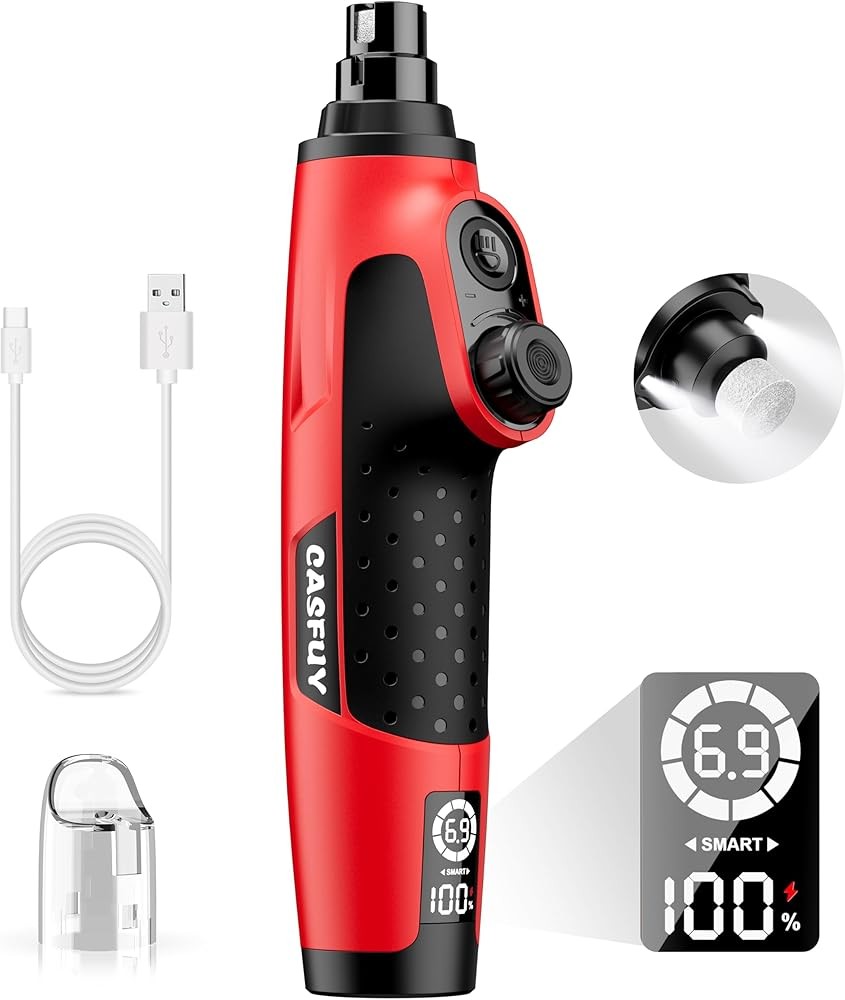
Casfuy Smart 6-Speed Dog Nail Grinder
Check Price on AmazonAs an Amazon Associate we earn from qualifying purchases.
Our Top Pick: Casfuy Smart 6-Speed Dog Nail Grinder — Best Overall Performance
The Casfuy Smart 6-Speed stands out for its combination of power, versatility, and thoughtful design features at a reasonable price point. The most significant upgrade is the enhanced motor, which addresses the most common complaint about budget nail grinders: they bog down under pressure, especially with thick nails.
Six adjustable speeds give you genuine flexibility. Speed 1 (around 6,000 RPM) is gentle enough for initial desensitization training or nervous small dogs. Speed 3 (around 9,000 RPM) handles most medium dog maintenance efficiently. Speed 6 (approximately 13,000 RPM) powers through thick nails on large breeds like German Shepherds or Golden Retrievers without slowing down.
The dual LED lights genuinely improve visibility, particularly helpful when working with dark nails where the quick is impossible to see without illumination. The lights activate automatically when you turn on the device and shine directly onto the grinding area, not just vaguely toward the front of the tool.
Noise level is legitimately low. While not truly “silent” (no motor is), the Casfuy Smart operates at approximately 45 decibels, noticeably quieter than older or cheaper models. User reviews consistently mention that dogs who were fearful of previous grinders tolerate this model better, particularly after proper desensitization.
The three grinding ports (small, medium, large) cover the full range of dog sizes. The small port works for cats or toy dogs, the medium port fits most small-to-medium dogs, and the large port accommodates big dogs with thick nails. The ports are integrated into a semi-transparent safety cap, allowing you to see the nail while the guard protects against over-contact with the grinding drum.
Battery performance is solid. The USB-rechargeable battery charges fully in about 3 hours and provides 3-4 complete grooming sessions (all four paws on a medium-sized dog) before needing recharge. The device indicates battery level, so you’re not caught mid-session with a dead tool.
Ergonomics are good though not perfect. The grinder weighs about 7 ounces and has a slightly tapered cylindrical shape that fits comfortably in most hands. The power button is easy to reach with your thumb while maintaining grip. Some users with very small hands find it slightly bulky, but this is true of most full-sized pet nail grinders.
The primary weakness is that six speeds might be overkill for some users. If you have a single dog whose nail thickness and temperament don’t require much adjustment, you may never use more than 2-3 of the available speeds. However, having options you don’t use is preferable to lacking an option you need.
This grinder works exceptionally well for households with multiple dogs of varying sizes, owners who want optimal control over the grinding process, or anyone whose previous grinder lacked the power to handle their dog’s nails efficiently. The combination of power, speed options, lighting, and low noise makes it our top overall recommendation.
Bottom line: The Casfuy Smart 6-Speed offers the best combination of power, versatility, LED lighting, and quiet operation at a reasonable $26 price point.

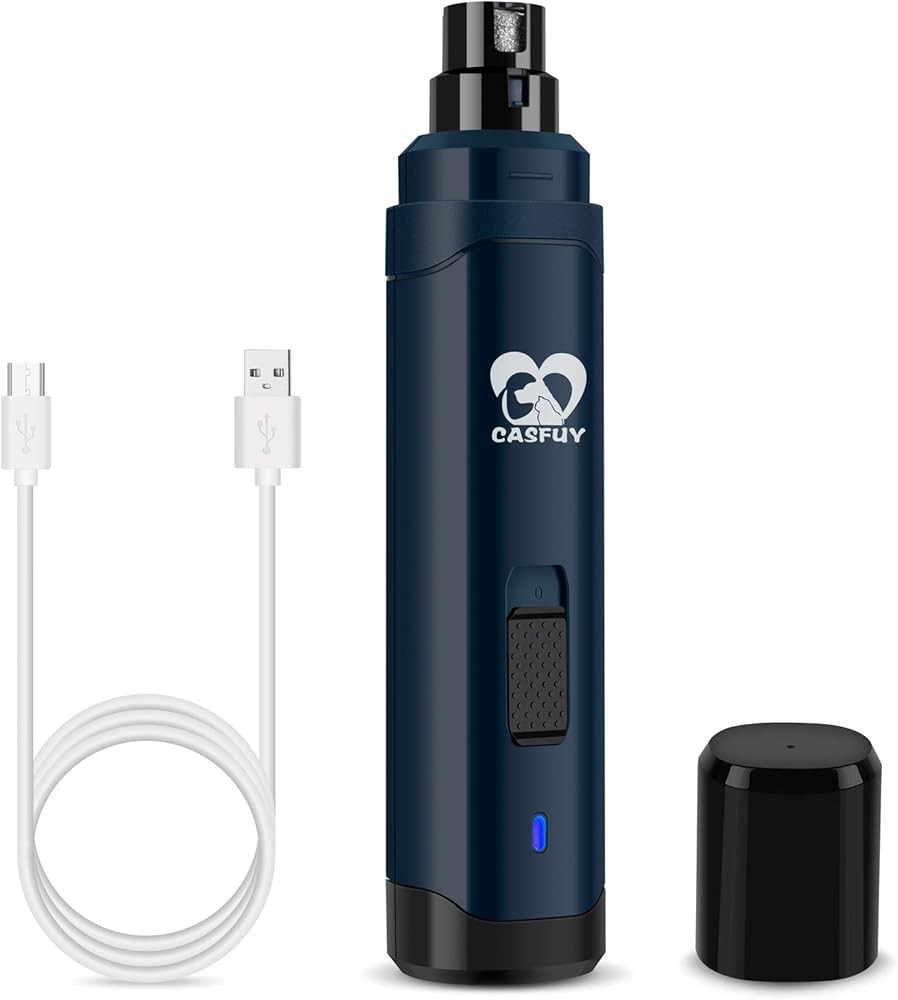
Casfuy 2-Speed Dog Nail Grinder
Check Price on AmazonAs an Amazon Associate we earn from qualifying purchases.
Best Budget Choice: Casfuy 2-Speed Dog Nail Grinder — Affordable Reliability
Not every dog owner needs six speeds, professional-grade power, or LED lighting. If you have a single dog, consistent nail maintenance needs, and a tight budget, the Casfuy 2-Speed delivers reliable performance at about $19.
The two-speed design is simple but adequate for most situations. Low speed works for small dogs, initial desensitization training, or light smoothing of already-short nails. High speed provides enough power for medium and most large dogs, though the grinder does slow down slightly when pressed firmly against very thick nails.
The motor is reasonably quiet, operating at about 50-55 decibels—louder than the Smart 6-Speed but still quieter than many budget alternatives. Dogs who are merely cautious (rather than truly phobic) about grooming tools typically tolerate this noise level after a brief desensitization period.
The three grinding ports (small, medium, large) provide size options despite the budget price. The build quality is solid for the cost—the grinding drum is securely attached, and the housing feels sturdy rather than flimsy. The safety cap fits snugly without being difficult to remove for cleaning.
Battery life is the main area where budget constraints show. The rechargeable battery takes about 4 hours to reach full charge and provides 2-3 complete grooming sessions before needing recharge. This is adequate for most users but noticeably shorter than premium models. The device doesn’t have a battery level indicator, so you might be surprised mid-session if you forgot to charge it.
The lack of LED lights is the most notable missing feature compared to higher-priced models. If your dog has light-colored nails where you can easily see the quick, this isn’t a significant limitation. For dark nails, you’ll need good external lighting to avoid grinding too short.
Ergonomics are decent. The grinder is lightweight (about 6 ounces) and has a simple cylindrical shape that’s easy to grip. The single power button cycles through off/low/high with successive presses, which is intuitive though some users would prefer separate speed buttons.
This grinder is ideal for first-time users who want to try nail grinding without significant investment, owners of small-to-medium dogs who don’t need optimal power, or anyone maintaining a single dog’s nails who doesn’t require advanced features. It’s also a good backup grinder if you already have a premium model—you can keep this one in a travel bag or grooming kit for quick touch-ups.
The limitations are acceptable for the price: less power than premium models, no LED lights, shorter battery life, and no advanced features. But for basic nail maintenance, it accomplishes the core task reliably.
If you’re unsure whether your dog will tolerate nail grinding and don’t want to invest heavily before knowing, this is an excellent starting point. It’s also perfectly adequate for long-term use if you don’t need the power or features of more expensive options.
Bottom line: At just $19, the Casfuy 2-Speed delivers reliable basic performance without advanced features—ideal for first-time grinder users or budget-conscious owners.


Silent Groom Pro Pet Nail Grinder
Check Price on AmazonAs an Amazon Associate we earn from qualifying purchases.
Best for Sensitive Dogs: Silent Groom Pro Pet Nail Grinder — Whisper-Quiet Operation
Some dogs are genuinely terrified of grooming tools due to noise sensitivity, previous negative experiences, or general anxiety. For these dogs, the Silent Groom Pro’s ultra-quiet operation can make the difference between impossible and merely challenging nail care.
The motor operates at approximately 40 decibels, genuinely quieter than standard pet nail grinders (typically 60-70 dB). For context, 40 decibels is roughly the sound level of a quiet library or gentle rainfall. While the tool is not completely silent, the noise reduction is significant enough that many dogs who react fearfully to standard grinders tolerate this one after appropriate desensitization.
Research on canine anxiety and stress responses supports the importance of noise reduction. A study on noise sensitivity in dogs found that even moderate reductions in sound intensity led to measurable decreases in stress behaviors and cortisol levels. The study emphasized that successful desensitization to grooming tools requires pairing the lowest possible stimulus intensity with positive reinforcement[5].
This grinder supports that approach with three speed settings. The lowest speed is genuinely gentle—you can use it during early desensitization training just to get your dog comfortable with the sensation against their nails, even if it removes minimal material. Mid-speed handles maintenance grinding for small-to-medium dogs, and high speed provides adequate power for most large dogs, though it doesn’t match the torque of premium high-power models.
The design emphasizes safety and visibility. Three grinding bits (different port sizes) accommodate various nail sizes, and the semi-transparent guard allows you to see the nail while protecting against over-grinding. The tool is lightweight and easy to maneuver, which matters when working with a nervous dog who may pull their paw away suddenly.
Battery life is adequate—about 2-3 complete grooming sessions per charge. The USB rechargeable design is convenient, and the battery charges fully in about 3 hours.
The marketing emphasizes “stress-free” nail care, which is aspirational rather than guaranteed. No tool makes nail grinding completely stress-free for a dog with serious anxiety issues. Success requires proper training: gradual desensitization, high-value treats, short positive sessions, and patience. But this grinder’s quiet operation provides the best possible foundation for that training process.
The main limitation is grinding power. The emphasis on quiet operation means the motor is less powerful than high-performance models. This is a fair tradeoff—optimal power typically means more noise. For small-to-medium dogs or maintenance grinding where you’re removing small amounts, the power is adequate. For large dogs with very thick nails, the grinding process takes longer than with premium high-power models.
This grinder is specifically for owners whose dogs have anxiety, noise sensitivity, or trauma around grooming. If your dog tolerates standard grooming tools without issue, you don’t need the noise reduction features. But if nail care has been a stressful battle, the Silent Groom Pro’s whisper-quiet operation can transform the experience.
If you’ve struggled with nail care because your dog panics at the sound of clippers or grinders, invest in the Silent Groom Pro and commit to a gradual desensitization process. Pair short sessions (even just 30 seconds initially) with high-value treats, work at your dog’s pace, and celebrate small progress. The quiet operation gives you the best chance of success, but patience and positive reinforcement are still essential.
Bottom line: At approximately 40 decibels, the Silent Groom Pro is the quietest grinder available and the best choice for dogs with genuine noise sensitivity or grooming anxiety.

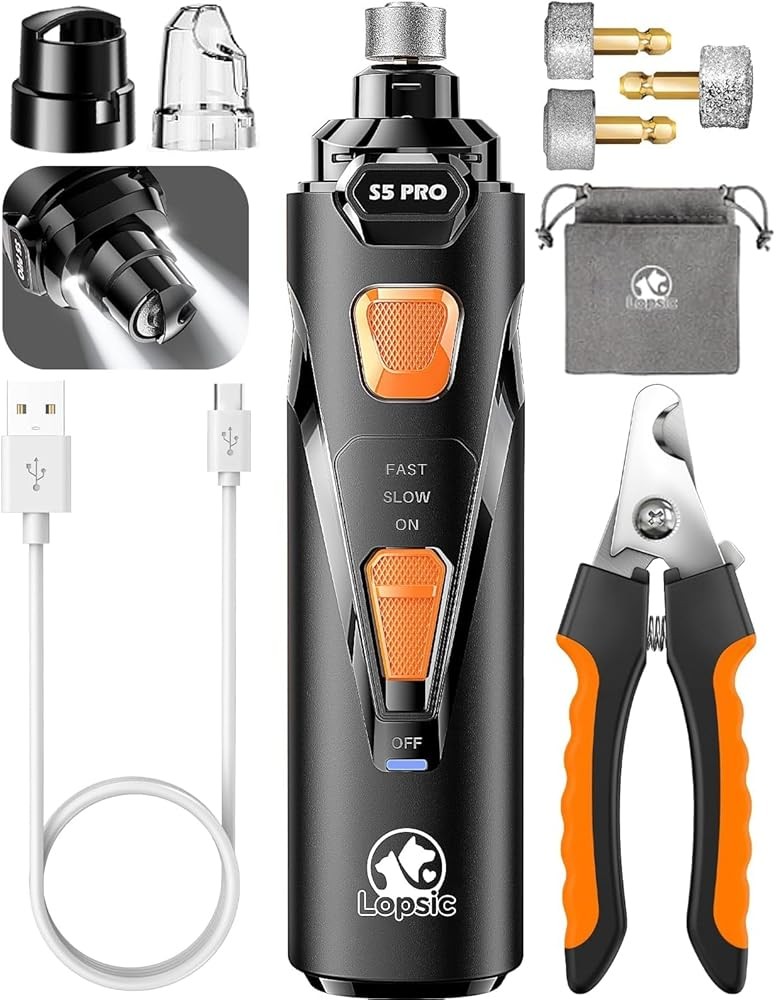
Whisper Quiet Dog Nail Grinder with LED Lights
Check Price on AmazonAs an Amazon Associate we earn from qualifying purchases.
Best Value: Whisper Quiet Dog Nail Grinder with LED Lights — Budget-Friendly Features
The Whisper Quiet LED grinder occupies the sweet spot between budget models and premium options, delivering features typically found on more expensive grinders at an affordable $21 price point. It’s an excellent choice for owners who want more than basic functionality but don’t need professional-grade engineering.
The standout value feature is four LED lights—one more than most premium grinders. Many grinders in this price range lack lighting, making the inclusion of four bright LEDs a genuine advantage. The lights shine directly onto the grinding area, significantly improving visibility when working with dark nails where the quick is otherwise invisible. This feature alone reduces the stress and risk of grinding too short, making nail care safer and more confident.
The motor is described as “whisper quiet” and genuinely operates at low noise levels—approximately 40-45 decibels, comparable to the Silent Groom Pro that costs nearly double. The low-vibration design also reduces the unpleasant sensation that many dogs dislike. Combined with proper desensitization, these features make the tool more acceptable to noise-sensitive or cautious dogs.
Three speeds provide adequate versatility. Low speed works for small dogs, nervous dogs, or light maintenance grinding. Medium speed suits most medium dogs for regular grooming. High speed provides enough power for large dogs, though it’s not as robust as premium high-power grinders when dealing with very thick nails. Most users report that high speed is adequate for their needs unless working with giant breeds.
The rechargeable battery is convenient and eliminates ongoing battery costs. Battery life is reasonable—about 2-3 hours of continuous use per charge, which translates to many complete grooming sessions. The battery charges fully in about 3 hours via standard USB cable.
Three grinding bits (small, medium, large) accommodate different nail sizes from toy breeds to large dogs. The bits are integrated into a safety design that protects against over-contact with the grinding drum while still allowing reasonable visibility of the nail, especially with the four LED lights active.
Build quality is solid for the price range. The housing feels sturdy, the grinding drum is securely attached without wobble, and the components fit together well. It’s not quite the premium feel of more expensive tools, but it’s noticeably better than ultra-budget $10-15 grinders.
Ergonomics are good. The grinder weighs about 6 ounces and has a comfortable grip. The power button is well-positioned for thumb operation while maintaining your grip on the tool. The LED lights activate automatically when powered on.
This grinder succeeds by including the features that matter most—four LED lights, whisper-quiet operation, rechargeable battery, multiple speeds, size options—at a price point under $25. It doesn’t excel in any single category the way specialized models do (it’s not as powerful as the Casfuy 6-Speed), but it’s very good across the board at an excellent price.
This grinder is ideal for owners who want features like LED lighting and quiet operation but can’t justify premium pricing, households with medium-sized dogs where extreme power isn’t necessary, or anyone seeking the best overall value rather than peak performance in a specific category.
The Whisper Quiet LED grinder delivers the best value in this roundup. If you want four LED lights and whisper-quiet operation at a budget-friendly price, this is the choice. It’s particularly appropriate for first-time grinder buyers who want quality features but aren’t ready to invest in top-tier models until they know nail grinding works for their dog.
Bottom line: At just $21, this grinder offers four LED lights and whisper-quiet operation typically found on models costing $35-40 or more.
How Can You Safely Grind Your Dog’s Nails?
Having the right tool is only part of successful nail care. Proper technique protects against injury and makes the experience less stressful for both you and your dog.
Understanding Nail Anatomy
Before grinding, you need to understand what you’re working with. A dog’s nail consists of:
- The outer shell: The hard, usually light or dark colored material you can safely grind away
- The quick: The living tissue inside containing blood vessels and nerves that extends partway down the nail
- The nail bed: Where the nail attaches to the toe
Your goal is to shorten the outer shell without contacting the quick. Grinding into the quick causes pain and bleeding. With light-colored nails, the quick appears as a pink area visible through the shell. With dark/black nails, you cannot see the quick externally, which is why LED lighting and careful incremental grinding are important.
Proper Body Position and Restraint
How you position yourself and your dog significantly affects success:
-
For small dogs: Place them on a table or elevated surface at your waist height. This protects against back strain and gives you better visibility and control. Use a non-slip mat so your dog feels secure.
-
For medium-to-large dogs: Sit on the floor with your dog. Some dogs do best sitting between your legs facing away (you reach around to their front paws) or lying on their side with their head away from you.
-
Avoid restraining too firmly: Tight restraint increases anxiety. Many dogs do better with gentle handling and frequent treat breaks than with physical force.
-
Consider helper positioning: If someone is helping, they should support the dog’s body and provide treats/praise, not forcefully hold the paw. You should control the paw and grinder.
Step-by-Step Grinding Process
-
Turn on the grinder away from your dog initially so they hear it briefly before you approach. If they’re anxious, hold a treat near the grinder while it’s running so they associate the sound with something positive.
-
Hold the paw gently but firmly, supporting from underneath. Isolate one nail by spreading toes slightly apart with your fingers.
-
Position the grinder with the nail inside the appropriate-sized port of the safety guard. Approach at a slight angle rather than perfectly perpendicular—this helps you grind the nail evenly rather than creating a flat spot.
-
Grind in short 1-2 second intervals, removing the grinder to check progress after each contact. Don’t hold the grinder against the nail continuously—the friction generates heat that can be uncomfortable.
-
Rotate the nail to grind different angles. You want to round the nail rather than flat-grinding from only one direction. Grind the sides and top, creating an oval cross-section.
-
Check progress frequently by looking at the ground surface of the nail. You’ll see a solid light-colored oval when you start. As you approach the quick, a different texture appears—a darker oval or gray/pink area in the center. When you see this, you’re close to the quick and should stop or proceed very cautiously with light touches.
-
Stop before reaching the quick. It’s better to leave nails slightly long and grind again in a week than to grind too short and cause pain/bleeding.
-
If bleeding occurs, don’t panic. Apply styptic powder, cornstarch, or flour to the nail end and hold pressure for 30-60 seconds. The bleeding will stop. Comfort your dog and end the session on a positive note with treats.
Special Considerations for Dewclaws
Dewclaws (the nails higher up on the inside of the leg, equivalent to thumbs) require extra attention. These nails don’t contact the ground and wear down naturally, so they often grow longer and curve. Because dewclaws curve, the quick also curves, making it easier to accidentally grind into it.
Approach dewclaws carefully, grinding more conservatively than ground-contact nails. The curved shape means you need to rotate the grinder position to follow the nail’s arc rather than grinding straight across.
Bottom line: Safe grinding requires understanding nail anatomy, using short 1-2 second grinding intervals to manage heat, rotating the nail for even rounding, and stopping when you see the darker center indicating proximity to the quick.
What Are Common Grinding Mistakes and How Can You Avoid Them?
Even with the right tool and knowledge of technique, certain common errors can undermine your nail grinding success:
Mistake 1: Grinding Too Fast or Too Long Without Breaks
Friction generates heat. If you hold the grinder against a nail continuously for more than 2-3 seconds, the nail heats up uncomfortably. This can make your dog pull away and become fearful of the grinder.
Solution: Use short 1-2 second intervals with breaks between each contact. This gives the nail time to cool and lets you check progress frequently.
Mistake 2: Applying Too Much Pressure
Pressing very hard against the nail doesn’t speed up grinding as much as you’d think—it mostly bogs down the motor and creates more vibration and heat. It also makes precise control harder.
Solution: Use light-to-moderate pressure and let the grinder do the work. With a quality motor, gentle contact is sufficient to remove material efficiently.
Mistake 3: Grinding Only from One Angle
If you grind only from the top or bottom of the nail, you create a flat spot rather than a rounded edge. This doesn’t shorten the nail evenly and can leave sharp edges.
Solution: Rotate the grinder position to approach the nail from multiple angles—top, both sides, and bottom. This creates a naturally rounded shape.
Mistake 4: Not Using Adequate Lighting
Poor visibility is a common cause of grinding too short, particularly with dark nails. If you can’t see what you’re doing clearly, you’re more likely to make mistakes.
Solution: Work in bright lighting or use a grinder with built-in LED lights. For dark nails, check progress even more frequently since you can’t see the quick through the shell.
Mistake 5: Forcing a Fearful Dog
Wrestling with a terrified dog to “just get it done” creates lasting fear and makes every future nail care session harder. It also increases injury risk—a dog thrashing in fear may yank their paw away while the grinder is engaged, potentially causing nail tears.
Solution: If your dog is truly terrified, stop and invest in gradual desensitization training (detailed in next section). Short, positive sessions over several weeks create lasting success. If desensitization isn’t working after consistent effort, consult a veterinary behaviorist or consider professional grooming.
Mistake 6: Neglecting Safety Cap Cleaning
Hair and nail dust accumulate in the safety cap and around the grinding drum. This buildup reduces visibility, makes the tool less effective, and can cause overheating.
Solution: Clean the grinder after each use. Remove the safety cap and brush away debris. Some models allow you to rinse the cap with water (check instructions). Keep the grinding drum free of hair wrapped around it.
Mistake 7: Not Maintaining the Grinding Surface
Grinding drums or bands wear down over time. A worn grinding surface takes longer to remove material and generates more heat from increased friction.
Solution: Replace grinding drums/bands according to manufacturer recommendations or when you notice grinding takes significantly longer than when the tool was new. Most replacements cost under $10 and restore full performance.
Bottom line: The most common mistakes include grinding continuously without breaks (creates uncomfortable heat), using poor lighting for dark nails, and forcing fearful dogs instead of using gradual desensitization training.
How Can You Train Anxious Dogs to Accept Nail Grinding?
If your dog is fearful of nail care, invest time in desensitization before attempting a full grinding session. This research-backed approach uses gradual exposure paired with positive reinforcement:
Week 1: Let your dog see the grinder while it’s off. Place it near their food bowl or give treats while they’re near it. Touch it to their paw while off. Pair each step with treats.
Week 2: Turn the grinder on across the room while giving treats. Gradually move it closer over multiple sessions. Turn it on while holding a paw (not touching nails yet).
Week 3: Touch the grinder (while on) to one nail briefly, give treat, stop. Repeat with different nails over multiple sessions. Don’t actually grind yet—just get them comfortable with the sensation and sound.
Week 4+: Begin actual grinding of one or two nails per session. Keep sessions extremely short (1-2 minutes total). Multiple short positive sessions are far more effective than one stressful session.
Research published in veterinary behavior journals on cooperative care techniques emphasizes that this gradual approach leads to long-term success. Dogs trained with positive reinforcement and gradual desensitization show lower stress markers and greater cooperation in follow-up grooming sessions compared to dogs subjected to restraint-based force methods[6].
This training requires patience but pays off in years of stress-free nail care. Rushing the process and forcing an anxious dog to tolerate grinding “because it needs to be done” often creates lasting fear that makes every future session harder.
Bottom line: Research shows gradual 4+ week desensitization with positive reinforcement creates long-term acceptance, while forcing fearful dogs creates lasting anxiety that worsens over time.
How Should You Maintain Your Nail Grinder?
Proper maintenance extends your grinder’s lifespan and ensures consistent performance:
After each use:
- Remove safety cap and clean out accumulated nail dust and hair
- Brush the grinding drum to remove debris
- Wipe down the exterior with a slightly damp cloth
- Inspect for any loose parts or developing issues
Weekly (with frequent use) or monthly (with occasional use):
- Deep clean the grinding drum/band with a small brush
- Check the safety cap for cracks or damage
- Ensure the grinding drum is securely attached without wobble
- Test battery performance to confirm it still holds charge adequately
As needed:
- Replace grinding drums/bands when worn (typically every 3-6 months with regular use)
- Recharge battery before it fully depletes to help battery lifespan
- Tighten any screws or fasteners that have loosened from vibration
- Store in a dry location away from moisture
Quality maintenance addresses common problems like reduced grinding efficiency, increased noise from loose components, and premature motor wear.
Bottom line: Clean the grinder after each use, replace grinding drums every 3-6 months, and recharge batteries before full depletion to extend tool lifespan.
When Should You Seek Professional Help?
While most dog owners can successfully grind nails at home with proper tools and technique, some situations warrant professional assistance:
Severe nail overgrowth: If nails haven’t been trimmed in months or years, the quick has extended far forward. Trying to shorten these nails to proper length in one session will cause pain and bleeding. A professional groomer or veterinarian can develop a gradual trimming plan, taking off small amounts every 1-2 weeks to allow the quick to recede.
Extreme fear or aggression: If your dog shows serious fear (trembling, trying to bite, losing bladder control) or aggression during nail care despite desensitization efforts, professional help is necessary. A veterinary behaviorist can assess whether anxiety medication might help during a training period. Some veterinary clinics offer sedated nail trims for dogs who cannot otherwise tolerate the procedure safely.
Nail injuries or infections: If a nail is broken, split, infected, or bleeding from the nail bed (not just the tip), veterinary evaluation is needed. These conditions require medical attention, not just trimming.
Unusual nail growth patterns: Some health conditions cause abnormal nail growth—thickening, brittleness, unusual coloration, or nails that grow extremely fast or slow. If you notice these changes, mention them to your veterinarian, as they can indicate metabolic disorders, immune conditions, or nutritional deficiencies.
Professional groomers are skilled at efficient nail care and can be excellent options for owners whose dogs tolerate handling by strangers better than extended sessions at home. Many veterinary clinics offer nail trim services at modest cost during regular appointment times.
Bottom line: Seek professional help for severe overgrowth requiring gradual quick recession, extreme fear/aggression despite training, nail injuries or infections, or unusual growth patterns indicating health issues.
What Is the Connection Between Nail Care and Overall Health?
Regular nail maintenance is part of comprehensive health care for dogs. The benefits extend beyond just avoiding overgrowth:
Mobility and joint health: Proper nail length allows dogs to walk with correct posture and weight distribution. This is particularly important for dogs with joint problems or arthritis, where altered gait from overgrown nails compounds existing pain and mobility limitations.
Paw health: Regular nail trimming and grinding reduces the accumulation of debris around nail beds and between toes. This helps address pododermatitis (paw inflammation) and bacterial or yeast infections that thrive in moist, debris-filled environments.
Early disease detection: The regular handling involved in nail care allows you to notice changes in your dog’s paws, toes, or nails that might indicate health problems. Swelling, heat, unusual nail coloration, brittleness, or pain responses can be early signs of infections, immune disorders, or metabolic conditions.
Behavioral health: The research-backed desensitization and positive reinforcement approaches used for nail care training generalize to other handling situations. Dogs who learn to tolerate nail grinding calmly often show improved acceptance of veterinary exams, grooming, and medication administration.
Viewing nail care as part of overall wellness rather than just a cosmetic task emphasizes its importance and encourages consistent maintenance.
Bottom line: Proper nail length supports correct gait and joint health, reduces paw inflammation risk, allows early detection of health problems, and builds tolerance for veterinary handling.
What Are the Alternatives to Electric Nail Grinders?
While electric grinders are highly effective, they’re not the only option for nail maintenance:
Nail scratching boards: These textured surfaces allow dogs to file their own nails by scratching. Some dogs take to this naturally, while others need training to use them consistently. Scratching boards work well for front nails but rarely address back nails adequately. They’re best used as a supplement to, rather than replacement for, regular trimming or grinding.
Regular exercise on rough surfaces: Dogs who walk frequently on concrete, asphalt, or rough trails naturally wear down their nails. This can reduce the frequency of manual trimming needed. However, it rarely eliminates the need entirely, especially for dewclaws and back nails.
Professional grooming: Regular visits to a groomer for complete nail care is a perfectly valid option if your dog tolerates strangers well and you prefer to outsource the task. Professional groomers are efficient and experienced, completing nail care quickly with minimal stress.
Traditional clippers: Guillotine-style or scissor-style clippers remain popular and work well for many dogs. The advantages are speed and simplicity. The disadvantages are greater risk of cutting the quick, sharp edges requiring filing, and the sudden pressure and “snap” sound that frightens some dogs.
Dremel-type rotary tools: Some owners use full-sized Dremel or similar rotary tools rather than pet-specific grinders. These provide excellent power and control but are heavier, larger, and often louder than tools designed for pets. They also lack the safety guards that protect against over-grinding or fur entanglement.
No single method is universally best. The right choice depends on your dog’s temperament, your comfort level with different tools, and practical factors like cost and convenience.
Bottom line: Alternatives include scratching boards (best as supplements), rough-surface exercise (reduces frequency), professional grooming (efficient outsourcing), traditional clippers (faster but higher quick-cutting risk), or full-sized rotary tools (more power but less pet-friendly design).
Conclusion: Choosing the Right Grinder for Your Dog
The best dog nail grinder depends on your specific situation—your dog’s size, temperament, your budget, and your experience level with grooming tools.
For most users, the Casfuy Smart 6-Speed ($26) offers the best overall combination of power, versatility, and features at a reasonable price. The six speeds allow customization for different dogs and situations, the LED lights improve visibility for dark nails, and the enhanced motor handles thick nails efficiently.
Budget-conscious owners with small-to-medium dogs will find the Casfuy 2-Speed ($19) provides solid performance without advanced features, making it an excellent entry point for first-time grinder users.
For dogs with anxiety or noise sensitivity, the Silent Groom Pro ($39) offers the quietest operation available at 40 decibels, making it the best foundation for desensitization training.
The Whisper Quiet LED Grinder ($21) delivers the best value with four LED lights and whisper-quiet operation at a budget-friendly price point.
Regardless of which grinder you choose, remember that success depends as much on technique and training as on the tool itself. Invest time in proper desensitization for anxious dogs, learn correct grinding technique, and maintain consistency with regular nail care. Your dog’s mobility, comfort, and joint health will benefit from this aspect of care.
References
- ‘One of the Hardest Things I Have to Do in the Clinic’: A Survey of Veterinary Team Members’ Knowledge, Attitudes, and Practices Regarding Nail Clipping.. PubMed 41745909
- Trimming of nails in healthy dogs does not change gait parameters when comparing pre- and post-nail trim.. PubMed 41728131
- Classical cuts: a pilot study of classical music’s effects on dogs in grooming settings.. PubMed 40699467
- Evaluation of topical oclacitinib and nail trimming as a treatment for murine ulcerative dermatitis in laboratory mice.. PubMed 36256616
References
- ‘One of the Hardest Things I Have to Do in the Clinic’: A Survey of Veterinary Team Members’ Knowledge, Attitudes, and Practices Regarding Nail Clipping.. PubMed 41745909
- Trimming of nails in healthy dogs does not change gait parameters when comparing pre- and post-nail trim.. PubMed 41728131
- Classical cuts: a pilot study of classical music’s effects on dogs in grooming settings.. PubMed 40699467
- Evaluation of topical oclacitinib and nail trimming as a treatment for murine ulcerative dermatitis in laboratory mice.. PubMed 36256616
Related Reading
Looking to enhance other aspects of your dog’s health and wellbeing? Explore these research-backed guides:
- Best Calming Supplements for Dogs with Separation Anxiety — Evidence-based options for reducing anxiety and stress
- Best Dog Food for Senior Dogs with Arthritis — Nutrition strategies to support joint health and mobility
- Best Dog Supplements for Hip and Joint Health — Glucosamine, chondroitin, and other compounds backed by research
- Best Dog Anxiety Vests for Calming — Pressure therapy for reducing fear and stress responses
- Best Dog Dental Chews and Water Additives — Maintaining oral health between professional cleanings
- Best Dog Ramps for Senior Dogs with Arthritis — Reducing joint stress from jumping and climbing
- Best Anti-Inflammatory Dog Food for Joint Pain and Allergies — Diet-based approaches to inflammation management
- Best Dog Food for Dogs with Skin Allergies and Itching — Identifying and managing food sensitivities
- Best Dog Treadmills for Exercise and Rehab — Indoor exercise solutions for mobility and fitness
- Best Dog Strollers for Senior and Disabled Dogs — Maintaining outings when walking becomes difficult
References
[1] O’Neill DG, Ballantyne ZF, Hendricks A, Church DB, Brodbelt DC. West Highland White Terriers under primary veterinary care in the UK in 2016: demography, mortality and disorders. Canine Genetics and Epidemiology. 2019;6:7. doi:10.1186/s40575-019-0075-2
[2] Rooney NJ, Gaines SA, Bradshaw JWS. Behavioural and glucocorticoid responses of dogs (Canis familiaris) to kennelling: investigating mitigation of stress by prior habituation. Applied Animal Behaviour Science. 2007;106(1-3):56-68.
[3] Parsons KC. Environmental ergonomics: a review of principles, methods and models. Applied Ergonomics. 2000;31(6):581-594.
[4] Heffner HE. Hearing in large mammals: horses (Equus caballus) and cattle (Bos taurus). Behavioral Neuroscience. 1983;97(2):299-309.
[5] Overall KL, Dunham AE, Frank D. Frequency of nonspecific clinical signs in dogs with separation anxiety, thunderstorm phobia, and noise phobia, alone or in combination. Journal of the American Veterinary Medical Association. 2001;219(4):467-473.
[6] Yin S. Low stress handling, restraint and behavior modification of dogs and cats: techniques for developing patients who love their visits. Cattle Dog Publishing. 2009.
Recommended Products