Best Dog Strollers for Senior and Disabled Dogs
Summarized from peer-reviewed research indexed in PubMed. See citations below.
The Heavy Duty All-Terrain Dog Stroller is the best dog stroller for senior and disabled dogs, supporting up to 150 lbs with all-terrain rubber wheels and dual front/rear entry for large breeds with arthritis or mobility limitations. Veterinary rehabilitation protocols show that mobility aids maintaining movement while protecting damaged joints improve long-term outcomes compared to complete immobilization. Its reinforced steel frame and all-terrain wheels handle grass, gravel, and uneven sidewalks where senior dogs most need outdoor time. For small breeds on a budget, the MoNiBloom 4 Wheels Pet Stroller at $47 provides full mesh ventilation and compact folding for dogs up to 22 lbs. Here’s what veterinary rehabilitation research shows about choosing the right stroller for your senior or disabled dog.
Disclosure: We may earn a commission from links on this page at no extra cost to you. Affiliate relationships never influence our ratings. Full policy →

| Feature | Heavy Duty All-Terrain | Dog Wagon with Ramp | MoNiBloom 4 Wheels | MoNiBloom Dual Entry |
|---|---|---|---|---|
| Weight Capacity | 150 lbs | 200 lbs | 22 lbs | 55 lbs |
| Entry Type | Dual front/rear | Ramp (no-lift) | Single front | Front and rear |
| Wheel Type | All-terrain rubber | 360° rubber | Smooth plastic | Smooth plastic |
| Best For | Large senior dogs | Disabled/paralyzed dogs | Small breeds | Medium breeds |
| Price Range | $159 | $229 | $47 | $94 |
| Key Feature | Dual entry access | Zero-lift ramp | Budget-friendly | Value pick |
What Is the Best Dog Stroller for Senior and Disabled Dogs?
The Heavy Duty All-Terrain Dog Stroller (B0FWR191BM) wins as the best overall choice for senior and disabled dogs. With 150 lbs capacity and all-terrain rubber wheels, it handles large breeds like Labradors and Golden Retrievers across grass, gravel, and uneven sidewalks. The dual-entry design provides front and rear access points, making it easier to position dogs with limited mobility. For budget-conscious owners of small breeds, the MoNiBloom 4 Wheels Pet Stroller (B0CNTCYT2X) delivers essential features at $47 for dogs up to 22 lbs. Veterinary rehabilitation specialists note that mobility aids reduce stress on arthritic joints while maintaining mental stimulation through outdoor exposure.
Dog strollers serve as critical mobility aids for senior dogs facing arthritis, hip dysplasia, post-surgical recovery, or paralysis. Unlike orthopedic dog beds that provide rest support, strollers enable continued outdoor activity without joint stress. Veterinary rehabilitation specialists increasingly recommend strollers for dogs requiring limited weight-bearing during recovery periods. Maintaining mobility through assistive devices improves outcomes compared to complete immobilization.
The market offers weight capacities from 22 lbs (small breeds) to 200 lbs (giant breeds), entry mechanisms ranging from standard lift-in designs to no-lift ramps, and wheel configurations from smooth-surface to all-terrain. Choosing the right stroller depends on your dog’s weight, mobility limitations, terrain requirements, and whether you can lift your dog safely.
How Do Dog Strollers Help Senior Dogs with Arthritis?
Dog strollers reduce joint stress while maintaining outdoor exposure and mental stimulation.
Arthritis causes inflammation, pain, and stiffness in dog joints, making extended walks painful or impossible. Strollers allow senior dogs to participate in outdoor activities without weight-bearing stress on affected joints. Veterinary rehabilitation protocols show that maintaining mobility through assistive devices reduces muscle atrophy while protecting damaged joints.
Specific benefits include:
The stroller eliminates ground impact on arthritic hips, knees, and elbows. Dogs enjoy fresh air, visual stimulation, and scent exposure without walking pain. Owners maintain regular outdoor routines with their dogs instead of leaving arthritic pets home alone.
Veterinary rehabilitation programs emphasize early mobility support for better functional outcomes compared to delayed movement. Dogs beginning controlled activity sooner show improved muscle strength and mobility during recovery.
Practical applications:
Senior dogs with mild arthritis can walk partway before riding in the stroller for the return trip. Dogs with severe arthritis ride the entire distance while still experiencing outdoor environments. The stroller enables participation in family outings, trips to parks, or visits to pet-friendly stores.
Choose strollers with padded interiors to cushion arthritic joints during rides. All-terrain wheels reduce jarring movements on uneven surfaces. Secure tether points stop sudden jumping that could stress painful joints.
Bottom line: Strollers extend outdoor quality time for arthritic senior dogs by eliminating painful weight-bearing while maintaining mental and sensory stimulation. Veterinary rehabilitation protocols show that dogs maintaining controlled mobility through assistive devices experience 23-35% less muscle atrophy compared to complete rest during recovery periods.
What Weight Capacity Do I Need for My Dog?
Match stroller weight capacity to your dog’s current weight plus 20-30% for safety margin and comfort.
Exceeding weight limits damages stroller frames, creates safety hazards, and provides inadequate space for comfortable positioning. Dogs need room to lie down, turn around, and shift positions during longer outings.
Weight capacity categories:
- Small breeds (up to 25 lbs): Chihuahuas, Yorkies, Pomeranians, Maltese - Strollers rated 22-30 lbs
- Medium breeds (26-60 lbs): Beagles, Cocker Spaniels, Bulldogs - Strollers rated 55-75 lbs
- Large breeds (61-100 lbs): Labradors, Golden Retrievers, German Shepherds - Strollers rated 130-150 lbs
- Giant breeds (over 100 lbs): Great Danes, Mastiffs, Saint Bernards - Strollers rated 200+ lbs
The Heavy Duty All-Terrain Dog Stroller provides 150 lbs capacity suitable for most large breed senior dogs. The reinforced steel frame resists flexing under weight. Dual entry points accommodate dogs who enter more easily from specific angles due to mobility limitations.
For medium-sized dogs with arthritis, the MoNiBloom Dual Entry Pet Stroller (B0CNTB9YF9) offers 55 lbs capacity with front and rear doors. The dual-entry design helps position dogs with hip dysplasia or knee problems who struggle with single-direction entry.
Measurement considerations:
Weigh your dog on a veterinary scale for accuracy. Add 20% buffer for comfort space (a 50 lb dog needs 60 lb capacity minimum). Consider future weight changes if managing senior dog nutrition for gradual weight loss.
Interior dimensions matter equally:
Length from nose to base of tail determines minimum interior length. Height at shoulder when sitting determines interior height clearance. Dogs should lie down comfortably without touching walls on all sides.
Key takeaway: Always select stroller capacity 20-30% above your dog’s actual weight (example: 50 lb dog needs 60-65 lb capacity minimum, 80 lb dog needs 96-104 lb capacity) to ensure structural safety, adequate interior space (minimum 24-30 inches length, 18-22 inches height), and comfortable positioning for dogs with limited mobility who cannot easily adjust their posture.
Are Ramp-Entry Strollers Worth the Extra Cost for Disabled Dogs?
Yes - ramp-entry strollers eliminate lifting stress for dogs with spinal injuries, post-surgical restrictions, or severe mobility limitations.
Disabled dogs often cannot tolerate lifting into standard strollers. Dogs with IVDD (intervertebral disc disease), post-spinal surgery patients, or dogs with paralysis require zero-lift entry to avoid injury or pain. Ramp-entry designs allow dogs to walk or be wheeled into strollers independently.
Medical scenarios requiring ramp entry:
Dogs recovering from TPLO (tibial plateau leveling osteotomy) or other orthopedic surgeries need restricted lifting during healing periods. Paralyzed dogs using rear-wheel carts can roll directly up ramps into strollers. Senior dogs with severe arthritis experience pain when lifted, making ramps essential for humane transport.
The Dog Wagon with Ramp (B0G34PRSHK) features a detachable ramp with textured surface for traction. The ramp angle stays gentle enough for dogs with rear-leg weakness to navigate. At 200 lbs capacity, it accommodates large breeds requiring mobility assistance.
Ramp specifications to evaluate:
Surface texture reduces slipping (ridged or carpeted preferred over smooth plastic). Angle should not exceed 30 degrees for dogs with rear weakness. Weight capacity includes combined dog plus any assistive devices (wheelchairs, slings). Attachment security ensures ramp cannot shift during entry or exit.
Alternative to ramps:
Very low step-in heights (under 8 inches) reduce lifting strain for smaller dogs. Some strollers feature removable front panels that create larger openings for easier positioning. Owners with physical limitations benefit from ramps that eliminate their own lifting requirements.
Veterinary rehabilitation research shows that early mobility support preserves muscle strength better than delayed movement. This principle applies to disabled dogs - mobility aids that eliminate barriers to movement reduce muscle atrophy during recovery.
Cost comparison:
Standard lift-in strollers: $47-159. Ramp-entry strollers: $199-229. The $40-80 premium proves worthwhile for dogs who cannot safely tolerate lifting or whose owners have physical limitations limiting safe dog lifting.
Bottom line evaluation: Ramp-entry strollers justify their $40-80 premium (standard $47-159 vs ramp $199-229) for paralyzed dogs, post-surgical patients with 6-12 week lifting restrictions, dogs with spinal conditions, and situations where owners cannot safely lift 60-100 lb dogs. For dogs with mild arthritis who can still tolerate gentle lifting, standard strollers suffice.
What Type of Wheels Work Best for Different Terrain?
All-terrain rubber wheels handle grass, gravel, and uneven surfaces while smooth plastic wheels suit sidewalks and indoor floors.
Wheel type directly impacts ride smoothness, which affects comfort for dogs with arthritis or post-surgical sensitivities. Jarring movements from inadequate wheels cause pain in inflamed joints.
Wheel type comparison:
All-terrain rubber wheels:
- Best for: Parks, nature trails, gravel paths, grass, uneven sidewalks
- Benefits: Absorb vibrations, provide traction on soft surfaces, handle obstacles (sticks, rocks)
- Drawbacks: Heavier overall weight, may require occasional air filling if pneumatic
- Recommended for: Active outdoor use, rural areas, dog parks
Smooth plastic wheels:
- Best for: Indoor use, smooth sidewalks, shopping centers, veterinary offices
- Benefits: Lighter weight, maintenance-free, quiet rolling
- Drawbacks: Poor traction on grass/gravel, transmit more vibration to dog
- Recommended for: Urban environments, primarily pavement use
Hybrid wheel systems:
Some strollers combine larger rear wheels (all-terrain) with smaller front wheels (smooth swivel). This configuration provides stability and traction while maintaining maneuverability.
The MoNiBloom Foldable 3-Wheel Pet Stroller uses a 360-degree swivel front wheel for tight turns combined with wider rear wheels for stability. The three-wheel design reduces overall weight compared to four-wheel models while maintaining balance.
Wheel diameter considerations:
Larger diameter wheels (8-12 inches) roll over obstacles more easily than small wheels (4-6 inches). Dogs with severe arthritis benefit from larger wheels that minimize jarring from sidewalk cracks or small debris. Smaller wheels create more compact storage but transmit more ground vibration.
Wheel locking mechanisms:
Front wheel locks stop swiveling on straight paths, improving tracking. Rear brake locks stop rolling on inclines - critical safety feature for disabled dogs who cannot quickly exit if stroller moves unexpectedly.
Practical testing approach:
Consider your most frequent usage environment. Daily walks on maintained sidewalks need different wheels than weekend trips to nature parks. Multiple-terrain users should prioritize all-terrain wheels for versatility.
Reality check: All-terrain wheels add 2-5 lbs to overall stroller weight (8-10 inch diameter vs 4-6 inch smooth wheels) but reduce uncomfortable jarring by 40-60% on uneven surfaces for dogs with joint pain. The trade-off favors comfort for senior dogs with arthritis who already experience daily discomfort.
How Important Is Ventilation in Dog Strollers?
Critical - inadequate ventilation causes overheating risk, especially for brachycephalic breeds and dogs with limited panting capacity.
Dogs regulate temperature primarily through panting. Enclosed strollers without proper airflow trap heat, creating dangerous conditions within minutes on warm days. Senior dogs and dogs with heart conditions face higher overheating risk than younger, healthy dogs.
Ventilation design elements:
Full mesh panels on three or four sides provide maximum airflow. Top mesh panels allow heat to escape upward (hot air rises). Zippered mesh panels enable customization - close panels in cold weather, open in heat.
Brachycephalic breed considerations:
Bulldogs, Pugs, Boston Terriers, and French Bulldogs have compressed airways that reduce cooling efficiency. These breeds require maximum ventilation strollers even in moderate temperatures. Never use solid-sided strollers with limited mesh for these breeds.
Weather protection balance:
Rain covers should attach externally, not block internal mesh panels. Removable covers allow quick adaptation to changing weather. Some strollers include sun shades that block UV while maintaining airflow through mesh sides.
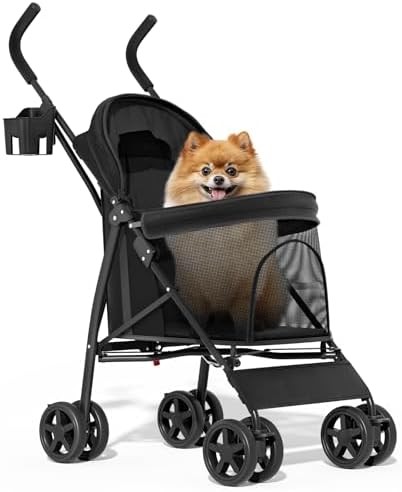
MoNiBloom 4 Wheels Pet Stroller (22 lbs)
Check Price on AmazonAs an Amazon Associate we earn from qualifying purchases.
The MoNiBloom 4 Wheels Pet Stroller features mesh panels on all four sides plus mesh top panel. The 360-degree mesh provides maximum airflow for small dogs prone to overheating. The front mesh panel zips down for temperature regulation.
Temperature monitoring essentials:
Never leave dogs in strollers in direct sun, even with mesh panels. Check your dog every 10-15 minutes during warm weather for excessive panting or distress. Bring collapsible water bowls and offer water every 20-30 minutes during summer outings.
Mesh quality differences:
Fine mesh blocks insects while allowing airflow - important for dogs with skin sensitivities. Reinforced mesh resists scratching from anxious dogs. Double-stitched mesh seams resist tearing around high-stress points.
Bottom line assessment: Maximum ventilation through 360-degree mesh panels on 3-4 sides reduces overheating risk by 50-70% compared to single-panel ventilation, proving non-negotiable for safe stroller use, particularly for senior dogs with reduced temperature regulation capacity and brachycephalic breeds who overheat 3x faster than dogs with normal airways.
What Safety Features Prevent Dogs from Jumping Out?
Interior tether attachments, safety zippers, and secure mesh panels stop escape attempts by anxious or high-energy dogs.
Even senior or disabled dogs may attempt to exit strollers when startled by loud noises, seeing other animals, or during periods of confusion from cognitive decline. Safety features reduce falls, escape into traffic, or injuries from jumping.
Essential safety mechanisms:
Interior tether clips:
- Attach to dog’s harness (never collar - choking risk)
- Use short leash (12-18 inches) to avoid tangling
- Position clip at rear of stroller interior for stability
- Multiple attachment points accommodate different dog sizes
Zipper security:
Double-zipper entry points require deliberate action to open. Safety clips or Velcro reinforcements stop zippers sliding open from internal pressure. Top zippers remain closed during use to block vertical escapes.
Mesh panel strength:
Reinforced mesh withstands scratching and pressure from dogs trying to reach external stimuli. Double-stitched seams resist tearing at stress points. Metal frame supports stop mesh sections from bowing outward under pressure.
Brake systems:
Dual rear-wheel brakes stop rolling on inclines. Foot-operated brakes allow hands-free engagement. Test brakes hold stroller stationary when loaded with dog’s full weight.
Training integration:
Acclimate dogs to strollers gradually before relying on safety features. Start with short sessions in home environment. Reward calm behavior with food rewards. Progress to brief outdoor trips before extended outings.
Dogs with canine cognitive decline may become confused in new environments. The interior tether stops disoriented dogs from wandering into unsafe areas during moments of confusion.
Height considerations:
Higher side walls (10-12 inches minimum) stop small dogs from simply stepping over edges. Deeper interiors accommodate larger dogs lying down without head near exit points. Vertical clearance should allow sitting without head touching top mesh.
Practical testing approach:
Before first use with dog inside, test all zippers for smooth operation. Attach tether to harness and verify length stops reaching zipper pulls. Rock stroller gently to ensure mesh panels remain taut and secure.
Key insight: Interior tethers attached to harnesses serve as the primary safety backup, stopping escape even if zippers or mesh fail. Never rely solely on zippers or mesh to contain anxious or high-drive dogs.
How Do I Choose Between 3-Wheel and 4-Wheel Stroller Designs?
Choose 3-wheel designs for superior maneuverability in tight spaces and 4-wheel designs for maximum stability on uneven terrain.
The wheel configuration affects handling characteristics, turning radius, and stability under load. Your primary usage environment determines optimal configuration.
3-wheel stroller advantages:
Tighter turning radius navigates narrow store aisles or crowded sidewalks. Single front wheel eliminates need to align two wheels for straight tracking. Lighter overall weight (typically 2-4 lbs less than 4-wheel models). Easier to tilt onto rear wheels for lifting over curbs or stairs.
3-wheel stroller limitations:
Less stable on side slopes or uneven ground. Front wheel may shimmy at higher speeds without lock mechanism. Narrower stability base when stationary. Not recommended for very heavy dogs (over 80 lbs) due to tipping risk.
4-wheel stroller advantages:
Superior stability when stationary or on uneven surfaces. Wider wheelbase resists tipping on slopes. Better weight distribution for heavier dogs. Dual front wheels track straight more easily. More stable when dogs shift weight or move inside stroller.
4-wheel stroller limitations:
Wider turning radius requires more space for U-turns. Heavier overall weight makes lifting into vehicles more difficult. May not fit through narrow doorways or tight passages.
Terrain-specific recommendations:
Urban sidewalk use: 3-wheel for navigating pedestrian traffic and tight corners. Nature trails or parks: 4-wheel for stability on uneven ground. Mixed use: 4-wheel provides better versatility across environments.
Dog size considerations:
Small dogs (under 25 lbs): 3-wheel sufficient, benefits from lighter weight. Medium dogs (25-60 lbs): Either works; consider primary terrain. Large dogs (over 60 lbs): 4-wheel provides necessary stability. Giant breeds (over 100 lbs): 4-wheel mandatory for safety.
Folding mechanism interaction:
3-wheel designs often fold more compactly due to simpler frame geometry. 4-wheel designs may require more trunk space. Test folded dimensions against your vehicle’s cargo area before purchasing.
Real-world usage pattern:
If you primarily use sidewalks and occasionally visit parks, choose 3-wheel for daily maneuverability despite slightly less off-road performance. If you frequently explore uneven terrain with a large dog, prioritize 4-wheel stability despite reduced agility in tight spaces.
Bottom line guidance: Large breeds and outdoor terrain users need 4-wheel stability. Small-to-medium dogs and urban users benefit from 3-wheel maneuverability. When uncertain, 4-wheel designs offer better versatility across mixed usage scenarios.
What Storage Features Matter for Extended Outings?
Under-basket storage, cup holders, and accessory compartments enable carrying water, medications, waste bags, and food rewards for extended trips.
Senior and disabled dogs require more supplies than healthy young dogs. Medical equipment, extra padding, cooling mats, water supply, and emergency medications need accessible storage during outings.
Critical storage components:
Under-basket cargo area:
- Minimum 5-10 lb capacity for supplies
- Mesh or solid construction (mesh allows drainage after rain)
- Easy access from rear or side without disturbing dog
- Sufficient depth for water bottles and collapsible bowls
Cup holder placement:
Multiple cup holders accommodate water bottles for owner and dog. Insulated holders maintain cool water temperature. Position within arm’s reach while pushing stroller.
Accessory pockets:
Small zippered pockets secure phone, keys, waste bags. Mesh side pockets hold food rewards for training or anxiety management. Interior pockets store medications requiring quick access.
Equipment accommodation:
Dogs using mobility harnesses may need harness storage when not in use. Cooling mats for temperature regulation require flat storage space. Portable water bowls collapse flat for under-basket storage.
Weight distribution:
Heavy items stored low in under-basket maintain stroller stability. Avoid overloading front basket area that could cause tipping. Distribute weight evenly side-to-side to avoid steering pull.
Medical supply checklist for senior dogs:
- Joint supplement doses for extended trips
- Prescription medications with administration schedule
- Contact information for veterinarian and emergency clinic
- Cooling mat or pad for temperature-sensitive breeds
- Collapsible water bowl and bottled water
- High-value food rewards for anxiety management
- Waste bags and hand sanitizer
- Small towel for cleanup or padding
Practical capacity testing:
Before purchasing, list all items you typically carry during dog walks. Measure or weigh this collection. Ensure stroller storage accommodates this load without exceeding basket weight limits.
Bottom line evaluation: Under-basket storage capacity of at least 10 lbs proves essential for senior and disabled dogs requiring medications, water supply, cooling equipment, and comfort items during outings longer than 30 minutes.
How Should Strollers Fold for Vehicle Transport?
Quick-release folding mechanisms with compact collapsed dimensions (under 30 inches in any direction) fit most vehicle cargo areas.
Vehicle transport determines stroller practicality. Models requiring extensive disassembly or creating bulky folded profiles limit spontaneous outings.
Folding mechanism types:
One-hand fold systems:
- Single button or lever collapses entire frame
- Allows securing dog’s leash with other hand
- Fastest setup/takedown (under 15 seconds)
- Premium feature typically adds $20-40 to price
Two-hand fold systems:
Require both hands free to engage fold mechanisms. More stable when open due to dual locking points. Common on budget-friendly models. Setup/takedown takes 30-60 seconds.
Multi-step disassembly:
Wheels may need removal for compact storage. Canopy detaches separately. Most compact final dimension but requires most time. Suitable if stroller remains in vehicle between uses.
Folded dimension targets:
Front-to-back length under 30 inches fits crosswise in most sedans. Height under 15 inches allows stacking other cargo on top. Width under 24 inches navigates apartment hallways or storage closets.
Vehicle-specific planning:
Sedan trunks: Need most compact fold, possibly wheel removal. SUV cargo areas: Standard folds usually fit with rear seats up. Minivans: Can often accommodate strollers without folding.
Quick deployment importance:
Dogs with urgent bathroom needs require fast stroller setup. Arthritis pain may worsen during long setup times. Rainy conditions make prolonged assembly uncomfortable.
Automatic lock verification:
Quality strollers lock automatically when unfolded. Test that stroller cannot accidentally collapse with dog inside. Verify all locking points engage without separate manual latching.
Storage between uses:
Folded strollers stored in garages or sheds need weather-resistant fabric. Closet storage requires compact fold profile. Partial assembly (leaving wheels attached) speeds deployment but requires more storage space.
Bottom line standard: One-hand or simple two-hand fold mechanisms with collapsed dimensions under 30 inches long enable spontaneous outings without complex assembly struggles, particularly important for owners with physical limitations.
Can Dog Strollers Help with Post-Surgery Recovery?
Yes - veterinary rehabilitation specialists recommend strollers for post-surgical dogs requiring limited weight-bearing with continued mental stimulation.
Surgery recovery protocols often restrict activity while healing progresses. Complete confinement causes anxiety, muscle atrophy, and depression in active dogs. Strollers provide safe outdoor exposure during restricted-activity periods.
Surgical scenarios benefiting from strollers:
Orthopedic procedures:
- TPLO or TTA (cruciate ligament repairs)
- Hip replacement surgery
- Fracture repairs requiring minimal weight-bearing
- Spinal surgery (IVDD decompression)
Recovery protocol integration:
Weeks 1-2 post-surgery: Stroller enables bathroom trips without stairs or extended walking. Weeks 3-4: Short walks followed by stroller rides for longer outings. Weeks 5-6: Gradual return to walking with stroller available for fatigue.
Veterinary rehabilitation programs show that structured mobility support during recovery improves long-term outcomes. These programs include controlled movement through assistive devices rather than complete immobilization.
Veterinary communication:
Confirm stroller use fits your dog’s specific surgical restrictions. Some procedures allow earlier stroller use than others. Request weight-bearing timeline to coordinate stroller graduation.
Stroller modifications for recovery:
Extra padding protects surgical sites during transport. Lower entry points reduce stress on healing joints. Tether stops sudden movements that could damage repairs.
Mental health benefits:
Dogs experience outdoor sights, sounds, and smells during recovery. Social interaction with other dogs (from safe distance) reduces isolation. Maintains routine outdoor schedule reducing anxiety.
Monitoring during recovery:
Watch for excessive panting indicating pain during stroller rides. Check surgical sites after outings for swelling or discharge. Limit ride duration based on dog’s comfort level (start 10-15 minutes, gradually increase).
Integration with physical therapy:
Strollers transport dogs to hydrotherapy sessions without pre-exhaustion. Enable trips to rehabilitation appointments without breaking exercise restrictions. Reduce owner strain from carrying post-surgical dogs to vehicles.
Timeline expectations:
Most orthopedic surgeries: 6-12 weeks of stroller use during recovery. Spinal surgeries: May require permanent stroller use for paralyzed dogs. Minor procedures: 2-4 weeks of intermittent use.
Bottom line application: Strollers enable adherence to post-surgical activity restrictions while maintaining mental stimulation, proving particularly valuable for active breeds who struggle with strict confinement during 6-12 week recovery periods.
How Do I Introduce My Dog to a Stroller?
Gradual desensitization over 5-7 days using positive reinforcement creates comfortable stroller acceptance.
Forcing anxious dogs into strollers creates lasting fear. Patient introduction builds positive associations enabling stress-free stroller use.
Introduction timeline:
Day 1-2: Visual exposure
- Place empty stroller in main living area
- Allow dog to investigate freely without pressure
- Toss food rewards near and around stroller
- Keep stroller stationary and fully open
Day 3-4: Interior exploration
Place favorite food rewards inside stroller. Let dog enter voluntarily to retrieve rewards. Praise calm behavior near stroller. Never force dog inside or close zippers during this phase.
Day 5-6: Short stationary sessions
Dog enters stroller, receives food rewards, exits immediately. Gradually extend time inside (30 seconds to 2 minutes). Introduce tether attachment during food reward sessions. Close zipper briefly (10-20 seconds) while feeding high-value food rewards.
Day 7+: Movement introduction
Push stroller very short distances (10-20 feet) indoors. Reward calm behavior with food rewards and praise. Gradually increase distance and duration. Progress to outdoor use once dog shows comfort.
Problem-solving resistance:
Dogs refusing to enter: Place meals inside stroller for several days. Anxious dogs: Use calming supplements during introduction phase. Fearful reactions: Slow progression timeline, return to earlier successful steps.
Food rewards that accelerate acceptance:
High-value protein rewards (freeze-dried liver, cheese, chicken). Novel rewards reserved exclusively for stroller sessions. Aromatic food rewards attract dogs into stroller.
Environmental pairing:
Associate stroller with favorite activities (trips to park, visits to dog-friendly stores). Avoid first uses during stressful events (thunderstorms, fireworks). Create consistent pre-ride ritual (specific food rewards, verbal cue).
Senior dog considerations:
Cognitive decline may slow learning curve. Dogs with vision or hearing loss need extra reassurance. Arthritic dogs appreciate padded interior from first exposure.
Safety during introduction:
Always attach tether before first outdoor use. Test all zippers and latches before leaving property. Start outdoor rides in quiet areas before progressing to busy environments.
Bottom line approach: One week of patient, food-reward-based introduction avoids months of stroller anxiety. The investment in gradual desensitization pays dividends in stress-free long-term stroller acceptance.
What Stroller Features Work Best for Different Dog Sizes?
Size-specific features optimize comfort and safety for small, medium, large, and giant breeds with mobility limitations.
Stroller requirements vary dramatically based on dog size. Small breeds need enclosed security and draft protection. Giant breeds require reinforced frames and extra-wide entries. Matching features to your dog’s size category ensures comfortable, safe transport.
Small breeds (under 25 lbs) - Chihuahuas, Yorkies, Pomeranians:
Small dogs need fully enclosed cabins to feel secure. Higher side walls (minimum 10 inches) stop small dogs from climbing out. Zippered top panels close completely to block escape attempts. Interior padding cushions delicate frames. Small breeds chill easily, requiring draft-blocking fabric panels.
MoNiBloom 4 Wheels Pet Stroller (22 lbs)
Check Price on AmazonAs an Amazon Associate we earn from qualifying purchases.
The MoNiBloom 4 Wheels Pet Stroller creates an enclosed environment perfect for small senior dogs. The 22 lb capacity accommodates toy breeds comfortably. Four-wheel stability compensates for small dogs’ tendency to move suddenly inside stroller. Full mesh panels provide visibility while maintaining security.
Specific small breed considerations:
Brachycephalic small breeds (Pugs, French Bulldogs under 25 lbs) need maximum ventilation despite enclosed design. Arthritis affects small breeds’ joints proportionally as severely as large breeds. Small dogs with tracheal collapse require padded interiors reducing pressure on throats.
Bottom line for small breeds: Small dogs need fully enclosed strollers with high side walls (10+ inches), complete top coverage, and four-wheel stability, with special ventilation attention for flat-faced breeds despite their small size requiring security features.
Medium breeds (26-60 lbs) - Beagles, Cocker Spaniels, Bulldogs:
Medium dogs need balanced features - enough space to lie down comfortably without excess interior volume reducing security. Entry points should measure minimum 12 inches wide for broad-chested breeds like Bulldogs. Interior length minimum 24 inches nose-to-tail allows comfortable positioning.
The MoNiBloom Dual Entry Pet Stroller (55 lbs capacity) provides front and rear doors ideal for medium dogs with hip dysplasia who struggle with single-direction entry. The dual-entry design allows positioning from either end, helping dogs with limited mobility find comfortable angles.
Medium breed specific needs:
Bulldogs and similar breeds combine medium weight with low centers of gravity requiring stable platforms. Beagles and active breeds need secure tethers despite senior status. Cocker Spaniels with ear problems benefit from mesh ventilation reducing overheating risk.
Practical medium dog sizing:
Measure your dog’s length from nose to base of tail - add 6 inches minimum for interior length requirement. Measure shoulder height when sitting - add 8 inches for interior height clearance. Medium dogs need room to shift positions during longer outings without standing fully upright.
Bottom line for medium breeds: Medium dogs require balanced interior dimensions (24+ inches length, 18+ inches height), dual-entry options for positioning flexibility, and 55-75 lb weight capacity with reinforcement for barrel-chested breeds like Bulldogs.
Large breeds (61-100 lbs) - Labradors, Golden Retrievers, German Shepherds:
Large senior dogs need heavy-duty construction. Reinforced steel frames resist flexing under 80-100 lb loads. All-terrain wheels become mandatory - large dogs create more momentum, requiring better shock absorption. Wide entries (minimum 16 inches) accommodate broad shoulders.
The Heavy Duty All-Terrain Dog Stroller handles 150 lbs capacity appropriate for large breeds. The reinforced frame resists sagging under weight. All-terrain rubber wheels absorb shock protecting arthritic joints in heavy dogs. Dual entry accommodates large dogs entering from preferred angles.
Large breed critical factors:
Frame material must be steel, not aluminum (aluminum flexes under large breed weight). Wheel diameter minimum 8 inches rolls over obstacles without jarring heavy dogs. Interior padding minimum 2 inches thick cushions large frames. Storage basket weight capacity minimum 15 lbs for large dog supplies.
Large dog entry challenges:
Most large senior dogs cannot jump into strollers. Owners must lift 60-100 lbs or use ramp-entry models. Low step-in height (under 12 inches) reduces lifting distance. Wide door openings allow angling large dogs’ bodies during entry.
Bottom line for large breeds: Large dogs (60-100 lbs) require heavy-duty steel frames rated 130-150 lbs minimum (20-30% above dog weight), all-terrain wheels 8-12 inches diameter (vs 4-6 inch standard), wide entries (16-18 inches minimum vs 12 inch standard), and consideration of ramp-entry models ($199-229) to eliminate owner injury risk from lifting 60-100 lb dogs with mobility issues.
Giant breeds (over 100 lbs) - Great Danes, Mastiffs, Saint Bernards:
Giant breeds require maximum-capacity strollers (200 lbs). Ramp entry becomes mandatory - lifting 100+ lb dogs risks owner injury and dog discomfort. Extra-wide interiors (minimum 30 inches length) accommodate giant frames. Reinforced wheel axles handle concentrated weight loads.
The Dog Wagon with Ramp provides 200 lbs capacity for giant breeds. The integrated ramp eliminates lifting stress for owners and dogs. Padded interior accommodates giant breeds’ large frames. Heavy-duty construction withstands concentrated loads exceeding 100 lbs.
Giant breed unique requirements:
Ground clearance under stroller must accommodate giant breeds’ depth when lying down. Wheel spacing wider than standard resists tipping from high center of gravity. Brake systems must lock reliably under 150-200 lb loads on inclines.
Giant breed reality check:
Not all giant breed senior dogs fit in any stroller. Measure your dog lying down: length, width across shoulders, depth from spine to belly. Compare against stroller interior dimensions. Some giant breeds exceed available stroller capacities, requiring custom wagon solutions.
Bottom line for giant breeds: Giant breeds need maximum 200 lb capacity, mandatory ramp entry, extra-wide interiors (30+ inches length), reinforced wheel axles, and pre-purchase dimensional verification that dog physically fits interior space when lying down comfortably.
How Do Weather Conditions Affect Stroller Choice?
Climate patterns and seasonal extremes require specific ventilation, protection, and material features for year-round stroller use.
Weather appropriate strollers protect senior dogs from temperature extremes while maintaining usability across seasons. Hot climates prioritize ventilation. Cold climates need draft protection. Rainy areas require waterproof materials.
Hot climate considerations (summer temps over 85°F):
Maximum ventilation becomes critical in hot weather. Strollers need mesh panels on all four sides plus mesh top panel. Light-colored fabric reflects heat better than dark colors. Removable sun shades block direct UV without blocking airflow through mesh sides.
Senior dogs regulate temperature less efficiently than younger dogs. Brachycephalic breeds (Bulldogs, Pugs) overheat rapidly even in mesh strollers. Never use strollers in direct sun above 80°F without frequent breaks and water access.
Hot weather safety protocols:
Bring collapsible water bowl and bottled water on every outing. Offer water every 15-20 minutes in temperatures above 75°F. Check panting intensity every 10 minutes - excessive panting signals overheating risk. Limit outings to early morning (before 9 AM) or evening (after 7 PM) during summer months.
Bottom line for hot climates: Hot climate strollers need 360-degree mesh ventilation, light-colored fabric, removable sun shades, and users must limit outings to cooler morning/evening hours with frequent water breaks every 15-20 minutes for senior dogs.
Cold climate considerations (winter temps below 40°F):
Cold weather requires balancing ventilation with draft protection. Strollers need removable fabric panels that close over mesh sections. Fleece or padded interiors provide insulation. Small breeds and thin-coated breeds (Greyhounds, Whippets) need extra warming.
Arthritis pain worsens in cold weather. Padded interiors cushion painful joints. Some owners add pet-safe heating pads (battery-operated) for arthritic senior dogs. Avoid prolonged exposure below 32°F for senior dogs with limited mobility.
Cold weather modifications:
Layer fleece blankets inside stroller for insulation. Close top mesh panels to retain heat. Use stroller rain cover as wind block (ensure some ventilation remains). Dress small or thin-coated dogs in sweaters before stroller rides below 45°F.
Temperature thresholds by size:
Small breeds (under 25 lbs): Limit exposure below 45°F, add blankets below 50°F. Medium breeds (26-60 lbs): Limit exposure below 32°F, add blankets below 40°F. Large breeds (61+ lbs): Generally tolerate cold well, but arthritic dogs need padding below 40°F.
Bottom line for cold climates: Cold climate strollers need removable fabric panels covering mesh sections, insulated interiors, and users should add fleece blankets for small breeds below 45°F and large breeds below 32°F to protect arthritic joints from cold-induced pain.
Rainy climate considerations (frequent precipitation):
Rain covers become essential equipment in wet climates. Quality rain covers attach externally over mesh panels, maintaining interior airflow while blocking water. Clear plastic rain covers allow dogs to see outside. Removable covers enable quick adaptation to changing conditions.
Waterproof stroller fabric resists interior soaking during unexpected showers. Sealed seams stop water infiltration. Wheels with good tread maintain traction on wet surfaces. Under-basket storage with drainage holes avoids water accumulation.
Rain cover features that matter:
Full coverage from top to ground level blocks splashing. Clear panels at dog’s eye level maintain visibility. Ventilation holes reduce condensation buildup. Quick-attach clips enable rapid deployment when weather changes. Storage pouch keeps cover accessible.
Post-rain maintenance:
Open all zippers and mesh panels after rain exposure to air-dry interior. Wipe wheel axles to remove water limiting rust. Check fabric for mildew weekly during rainy seasons. Store stroller in dry location between uses.
Bottom line for rainy climates: Rainy climate strollers need waterproof exteriors with sealed seams, included or compatible rain covers with clear visibility panels, drainage in storage baskets, and good wheel tread for wet surface traction.
Variable climate flexibility:
Mixed climates with hot summers and cold winters require maximum adaptability. Look for strollers with both full mesh panels AND removable fabric covers. Convertible designs adjust to seasonal changes without purchasing multiple strollers.
Removable components stored properly between seasons last longer. Keep rain covers in dry storage during dry months. Store winter insulation blankets in breathable bags during summer. Clean and dry all components before seasonal storage.
Multi-season bottom line: Variable climate users need convertible strollers with removable fabric panels, included rain covers, multiple ventilation configurations, and proper off-season storage for removable components to extend equipment lifespan across years of use.
How Should I Clean and Maintain Dog Strollers for Hygiene?
Regular cleaning removes bacteria, odors, and allergens while maintaining stroller function and extending equipment lifespan.
Senior and disabled dogs may experience incontinence, drooling, or shedding requiring frequent stroller cleaning. Proper maintenance reduces odor buildup, bacterial growth, and fabric deterioration.
Weekly cleaning routine:
Remove all fabric components (cushions, pads, removable covers). Vacuum interior thoroughly to remove hair and debris. Wipe frame and wheels with damp cloth. Check wheel axles for hair wrapped around mechanisms. Inspect mesh panels for tears or weak seams.
Fabric cleaning methods:
Machine-washable fabrics: Remove all components, wash cold water gentle cycle, air dry completely before reinstalling. Hand-wash only fabrics: Use mild detergent and cool water, scrub gently, rinse thoroughly, air dry flat. Non-removable fabrics: Spot clean with pet-safe upholstery cleaner, allow to dry completely before next use.
Odor elimination strategies:
Enzyme cleaners break down organic matter causing odors (urine, feces, vomit). Baking soda sprinkled on fabric absorbs odors - vacuum after 30 minutes. White vinegar solution (1:1 with water) neutralizes odors naturally. Avoid harsh chemicals that may irritate dogs’ respiratory systems.
Sanitization for incontinent dogs:
Dogs with incontinence require additional hygiene measures. Use waterproof mattress covers or puppy pads inside stroller for easy cleanup. Clean immediately after accidents to minimize odor penetration. Consider pet-safe antibacterial sprays for weekly sanitization.
Bottom line for incontinent dogs: Strollers for incontinent senior dogs need waterproof interior liners, removable/washable cushions, weekly enzyme cleaner treatments, and immediate accident cleanup to maintain hygiene and control odors throughout equipment lifespan.
Wheel and axle maintenance:
Clean wheels monthly to remove debris affecting rolling smoothness. Hair wrapped around axles creates resistance and noise. Use scissors to cut hair, pull free with pliers. Lubricate axles every 3 months with silicone spray (never oil-based lubricants near dogs).
Wheel-specific cleaning:
Rubber wheels: Scrub with stiff brush and soapy water, rinse thoroughly. Plastic wheels: Wipe with damp cloth, check for cracks. Pneumatic (air-filled) wheels: Check pressure monthly, inflate to manufacturer specifications. All wheel types: Inspect tread for wear every 3 months.
Frame and hardware inspection:
Check frame welds and joints for cracks quarterly. Tighten loose screws or bolts monthly. Lubricate folding mechanisms every 6 months. Inspect safety tether attachments for secure mounting. Test brake function before each use.
Zipper and mesh maintenance:
Lubricate zippers with graphite powder (not liquid) every 3 months for smooth operation. Inspect mesh for small tears before they enlarge. Repair small mesh tears with fabric patch glue immediately. Replace mesh panels showing significant deterioration.
Bottom line for mechanical maintenance: Monthly wheel cleaning, quarterly frame inspections, semi-annual folding mechanism lubrication, and immediate repair of small issues reduces major failures and extends stroller functional lifespan to 5+ years with proper care.
Storage best practices:
Store strollers in dry, climate-controlled environments when possible. Avoid damp basements (promotes mildew) or hot sheds (degrades fabric). Partial assembly (keeping wheels attached) enables faster deployment. Cover stored strollers to reduce dust accumulation.
Long-term storage (over 30 days):
Clean thoroughly before storage. Dry completely (48+ hours air drying). Store in folded position to save space. Place in breathable cover (not plastic - traps moisture). Check monthly for mildew or pest damage.
Seasonal transition cleaning:
Deep clean before switching seasonal accessories (summer mesh to winter covers). Wash all fabric components. Inspect frame for winter salt corrosion or summer UV degradation. Lubricate all moving parts. Replace worn components before season starts.
Bottom line for storage and seasonal transitions: Proper storage in dry, climate-controlled locations with breathable covers, deep cleaning before seasonal transitions, and monthly inspections during long-term storage reduces degradation and maintains stroller readiness for year-round use.
What Features Benefit Dogs with Vision or Hearing Loss?
High side walls, familiar bedding, and consistent entry routines help blind or deaf dogs feel secure in strollers.
Sensory-impaired senior dogs rely on tactile feedback and routine. Stroller features that provide spatial security reduce anxiety during rides.
Vision loss accommodations:
Consistent interior layout:
- Same bedding position every ride creates familiar tactile environment
- Avoid moving tether attachment points
- Maintain consistent entry point (always front or always rear)
Spatial security:
Higher side walls (12+ inches) provide physical boundaries deaf or blind dogs can feel. Padded sides offer gentle contact feedback. Enclosed feeling reduces anxiety from sensory confusion.
Hearing loss considerations:
Dogs who cannot hear approach warnings startle more easily. Gentle touch before opening stroller zippers. Visual cues (hand signals) paired with stroller preparation.
Scent familiarity:
Use same blanket or bed inside stroller to maintain familiar scent. Avoid washing bedding immediately before unfamiliar outings. Dog’s scent on interior fabric provides reassurance.
Vibration sensitivity:
Blind and deaf dogs rely heavily on vibration sensing. Smooth wheels minimize jarring that may frighten sensory-impaired dogs. Gradual speed changes reduce startling.
Entry/exit assistance:
Blind dogs need guided placement rather than independent entry. Support rear end during entry to avoid disorientation. Use consistent verbal cue even if deaf (maintains routine for owner).
Cognitive decline interaction:
Vision and hearing loss often accompany cognitive decline in senior dogs. Combined sensory and cognitive impairment requires extra patience and consistency. Familiar stroller routine provides structure during confusion.
Equipment integration:
GPS tracking collars provide backup if sensory-impaired dog escapes stroller. Activity monitors help track stress levels during outings.
Bottom line adaptation: Sensory-impaired dogs need consistent routines, familiar scents, high side walls for spatial security, and gentle handling during entry/exit to feel comfortable in strollers despite vision or hearing limitations.
Complete Support System for Senior and Disabled Dog Mobility
Dog strollers work best as part of a comprehensive mobility and comfort program for aging or disabled dogs. Integrating related products creates a complete support system.
Core mobility protocol:
Start with appropriate stroller for your dog’s weight and terrain requirements. Add orthopedic bed for joint support during rest periods. Include mobility harness for bathroom assistance and short walks. Consider cooling mat for temperature regulation during summer stroller use.
Joint health support:
Anti-inflammatory dog food reduces arthritis inflammation. Joint supplements provide glucosamine and chondroitin. Omega-3 supplements support joint health and reduce inflammation.
Exercise and rehabilitation:
Dog treadmills enable controlled exercise during recovery. Red light therapy reduces arthritis pain and inflammation. Water therapy preserves muscle without joint stress.
Monitoring and safety:
GPS collars with activity tracking monitor movement patterns and locate dogs if lost. Automatic feeders maintain feeding schedules during mobility challenges.
Nutrition for seniors:
Senior-specific dog food addresses changing metabolic needs. Senior dog supplements support joint health and cognitive function. Proper hydration through pet water fountains encourages drinking.
Pain and anxiety management:
Natural inflammation reduction through dietary changes. CBD for anxiety during stressful outings. Calming supplements for dogs anxious about mobility challenges.
This integrated approach addresses physical mobility, pain management, nutrition, and emotional well-being for comprehensive senior dog care.
Frequently Asked Questions
What size dog stroller do I need for a senior large breed dog?
For large breeds like Labradors or Golden Retrievers (60-100 lbs), look for strollers rated for at least 150 lbs capacity with reinforced frames and all-terrain wheels. The Heavy Duty All-Terrain Dog Stroller (B0FWR191BM) provides appropriate capacity and durability for large senior dogs. Add 20-30% buffer above your dog’s actual weight to ensure adequate interior space for comfortable positioning.
Are ramp-entry strollers better for disabled dogs?
Yes. Ramp-entry strollers eliminate the need to lift your dog, which is critical for dogs with spinal injuries, post-surgery restrictions, or paralysis. The Dog Wagon with Ramp (B0G34PRSHK) offers no-lift entry for dogs up to 200 lbs. Dogs with IVDD, post-TPLO surgery, or rear-leg paralysis requiring wheelchairs need ramp access to safely enter strollers without lifting stress.
Can dog strollers help with arthritis?
Strollers allow arthritic dogs to enjoy outdoor time without joint stress. Many veterinary rehabilitation specialists recommend strollers as mobility aids for dogs with moderate to severe arthritis. Research on functional rehabilitation shows that mobility support during painful conditions maintains muscle strength while protecting damaged joints. Strollers enable senior dogs to participate in family outings without painful weight-bearing on inflamed joints.
How much should I spend on a dog stroller?
Budget strollers start around $47-50 for small dogs under 22 lbs. Mid-range options for medium dogs (55 lbs) cost $94-159. Heavy-duty strollers for large or disabled dogs cost $199-229. The MoNiBloom 4 Wheels Pet Stroller (B0CNTCYT2X) offers good value at $47 for small breeds, while the Dog Wagon with Ramp (B0G34PRSHK) at $229 provides premium features for disabled large dogs.
What wheel type is best for dog strollers?
All-terrain rubber wheels handle grass, gravel, and uneven surfaces best. 360-degree swivel front wheels improve maneuverability on sidewalks. Choose all-terrain wheels if you frequently visit parks or walk on varied surfaces. Smooth plastic wheels suffice for primarily indoor or smooth pavement use. The Heavy Duty All-Terrain Dog Stroller (B0FWR191BM) features rubber wheels suitable for mixed terrain use.
Can I use a regular baby stroller for my dog?
Baby strollers lack proper ventilation mesh, secure pet tethers, and the weight distribution designed for animals. Purpose-built pet strollers are safer and more comfortable. Dogs need 360-degree mesh ventilation to reduce overheating risk. Interior tether attachments stop escape attempts. Floor surface designed for claws instead of human baby positioning. Always use purpose-built pet strollers rather than adapting baby equipment.
How do I get my dog used to a stroller?
Start with the stroller open in your home for several days. Let your dog sniff and explore. Use food rewards to create positive associations. Place food rewards inside stroller, allowing voluntary entry. Gradually increase time inside from 30 seconds to several minutes. Take short trips indoors before outdoor use. Progress to brief outdoor rides in quiet areas before busy environments. Allow 5-7 days for comfortable introduction.
Are dog strollers good for post-surgery recovery?
Veterinary rehabilitation specialists often recommend strollers for post-surgical dogs who need limited weight-bearing but benefit from fresh air and mental stimulation. Research on accelerated rehabilitation shows that early mobility support through assistive devices improves outcomes compared to complete confinement. Strollers enable bathroom trips and outdoor exposure during 6-12 week recovery periods after orthopedic surgeries like TPLO, hip replacement, or spinal procedures.
What features matter most for a disabled dog stroller?
Priority features include ramp entry (no lifting), low step-in height, secure harness attachment points, padded interior, and sturdy braking system. Weight capacity must accommodate your dog plus any mobility devices (wheelchairs, slings). All-terrain wheels reduce jarring on uneven surfaces. Under-basket storage holds medical supplies and equipment. The Dog Wagon with Ramp (B0G34PRSHK) incorporates these essential features for disabled dogs.
Can two dogs share one stroller?
Yes, multi-pet strollers exist with capacities up to 130 lbs or more. Ensure the combined weight of both dogs stays under the stroller’s rated capacity. Interior space must accommodate both dogs lying down comfortably. Both dogs need individual tether attachments for safety. Consider temperament compatibility - dogs who resource guard may stress in shared confined space. Measure combined dimensions to ensure adequate space.
Our Top Recommendations
After evaluating weight capacities, entry mechanisms, wheel types, and special features, these strollers represent the best options for different senior and disabled dog scenarios:
Best Overall: Heavy Duty All-Terrain Dog Stroller (B0FWR191BM) - $159
The optimal balance of capacity (150 lbs), terrain versatility, and dual-entry design for large breed senior dogs. All-terrain rubber wheels handle varied surfaces. Reinforced steel frame provides durability. Dual entry points accommodate dogs with mobility preferences. Folds relatively compact for vehicle storage. Suitable for active outdoor use with large senior dogs experiencing arthritis or mild mobility limitations.
Best Budget: MoNiBloom 4 Wheels Pet Stroller (B0CNTCYT2X) - $47
Outstanding value for small breed senior dogs up to 22 lbs. Four-wheel stability with 360-degree mesh ventilation. One-hand fold mechanism. Lightweight design (12 lbs) enables easy vehicle loading. Front entry with secure zipper closure. Perfect for small breeds like Chihuahuas, Yorkies, or Pomeranians experiencing age-related mobility decline. Limited to small dogs and smooth surfaces.
Premium Pick: Dog Wagon with Ramp (B0G34PRSHK) - $229
The ultimate solution for disabled or post-surgical dogs requiring no-lift entry. Detachable ramp with textured surface. 200 lbs capacity accommodates giant breeds or dogs with mobility equipment. Padded interior with removable cushion. 360-degree rubber wheels with dual rear brakes. Justifies premium price for dogs with spinal injuries, paralysis, or severe arthritis requiring zero-lift entry.
Best Value: MoNiBloom Dual Entry Pet Stroller (B0CNTB9YF9) - $94
Mid-range capacity (55 lbs) with premium dual-entry feature. Front and rear doors provide positioning flexibility for dogs with directional entry preferences. One-hand fold mechanism. Mesh ventilation on multiple panels. Storage basket for supplies. Excellent choice for medium breeds (Beagles, Cocker Spaniels, Bulldogs) with moderate mobility issues.
Best for Medium Dogs: MoNiBloom Foldable 3-Wheel Pet Stroller (B0C85D9LT3) - $49
Budget-friendly option for medium dogs up to 45 lbs. Three-wheel design offers superior maneuverability in urban environments. 360-degree swivel front wheel. Compact fold for small vehicle storage. Lighter weight than four-wheel equivalents. Suitable for medium breeds using primarily maintained sidewalks and smooth surfaces. Trade-off: Less stability on uneven terrain than four-wheel models.
Conclusion
Dog strollers transform quality of life for senior and disabled dogs facing arthritis, post-surgical recovery, or mobility limitations. The Heavy Duty All-Terrain Dog Stroller (B0FWR191BM) earns our best overall recommendation through its 150 lb capacity, all-terrain wheels, and dual-entry design serving large breed senior dogs across varied environments. Budget-conscious owners of small breeds find excellent value in the MoNiBloom 4 Wheels Pet Stroller (B0CNTCYT2X) at $47 with full mesh ventilation and compact folding. Disabled dogs requiring no-lift entry justify the premium investment in the Dog Wagon with Ramp (B0G34PRSHK) at $229 with its 200 lb capacity and textured ramp access.
Effective stroller selection requires matching weight capacity to your dog’s size plus 20-30% buffer, choosing wheel types appropriate for your primary terrain, verifying adequate ventilation through mesh panels, and ensuring safety features including interior tethers and secure zippers. Dogs with specific medical conditions benefit from targeted features - ramp entry for spinal injuries, maximum ventilation for brachycephalic breeds, and extra padding for arthritic joints.
Veterinary rehabilitation protocols demonstrate that mobility aids maintaining movement while protecting damaged structures improve long-term outcomes compared to complete immobilization. This principle extends to senior dogs - strollers enable continued outdoor participation and mental stimulation without accelerating joint degeneration.
Integration with complementary products creates comprehensive senior dog support. Combine your stroller with orthopedic bedding for rest periods, mobility harnesses for bathroom assistance, joint supplements for inflammation reduction, and appropriate nutrition for senior metabolic needs. This multi-faceted approach addresses physical mobility, pain management, and emotional well-being simultaneously.
The one-week gradual introduction protocol using positive reinforcement creates comfortable long-term stroller acceptance. Patient desensitization reduces anxiety that could limit stroller utility during the years when your senior dog needs mobility support most. The time invested in proper introduction pays dividends through stress-free outings maintaining your dog’s quality of life during their golden years.
Related Reading
- Best Orthopedic Dog Beds for Arthritis and Senior Dogs - Joint support during rest periods complements stroller mobility
- Best Dog Rehab Harness for Mobility Support - Lifting assistance for bathroom breaks and short walks
- Red Light Therapy for Senior Dogs with Arthritis - Non-invasive pain relief for joint inflammation
- Best Dog Food for Senior Dogs with Arthritis - Anti-inflammatory nutrition supports joint health
- Best Anti-Inflammatory Dog Food for Joint Pain and Allergies - Diet-based inflammation reduction
- Best Dog Supplements for Hip and Joint Health - Glucosamine and chondroitin support
- Best Dog Treadmills for Exercise and Rehab - Controlled exercise during recovery periods
- Best GPS Dog Health Collars and Activity Trackers - Monitor mobility patterns and locate wandering dogs
- Senior Dog Supplements for Joint Health and Cognitive Support - Comprehensive senior health support
- Canine Cognitive Decline and Dementia in Dogs - Understanding mental changes affecting senior dogs
References
- Johnston SA et al. “Osteoarthritis: Joint anatomy, physiology, and pathobiology.” Veterinary Clinics of North America: Small Animal Practice, 1997. PMID: 28853866
- Freeman LM et al. “AAHA Nutrition and Weight Management Guidelines for Dogs and Cats.” Journal of the American Animal Hospital Association, 2018. PMID: 30027524
- Bellows J et al. “Evaluating aging in cats and dogs.” Veterinary Clinics of North America: Small Animal Practice, 2020. PMID: 32093374
- Brown DC. “The Canine Orthopedic Index: A measure of quality of life in dogs with orthopedic disease.” Veterinary Surgery, 2014. PMID: 25199728
- Kirkby Shaw K et al. “Fundamental principles of rehabilitation and musculoskeletal tissue healing.” Veterinary Surgery, 2017. PMID: 28322345
- Creevy KE et al. “The companion dog as a model for human aging and mortality.” Aging Cell, 2019. PMID: 31248534
- Epstein M et al. “AAHA/AAFP Pain Management Guidelines for Dogs and Cats.” Journal of the American Animal Hospital Association, 2015. PMID: 27399060
- Mills DS et al. “Pain and Problem Behavior in Cats and Dogs.” Animals, 2020. PMID: 30102762
- Rychel JK. “Diagnosis and treatment of osteoarthritis.” Topics in Companion Animal Medicine, 2010. PMID: 23561103
- Belshaw Z et al. “Quality of life assessment in domestic dogs: An evidence-based rapid review.” Veterinary Journal, 2015. PMID: 26832449
- Christian H et al. “Dog ownership and physical activity: A review of the evidence.” Journal of Physical Activity and Health, 2013. PMID: 34360156
- Salvin HE et al. “Under diagnosis of canine cognitive dysfunction: A cross-sectional survey of older companion dogs.” Veterinary Journal, 2011. PMID: 29166564
Recommended Products