Waterpik Cordless vs Countertop: Which Water Flosser Is Right for You
Summarized from peer-reviewed research indexed in PubMed. See citations below.
Choosing between a cordless and countertop water flosser often comes down to balancing bathroom space, travel needs, and cleaning power preferences. For most users seeking maximum pressure control and uninterrupted flossing sessions, the countertop Waterpik Aquarius WP-660 at $59 delivers 10 pressure settings from 10-100 PSI, a 22-ounce reservoir, and ADA-accepted plaque removal with seven included tips. A 2023 comprehensive review analyzing water flosser research from 1962 through 2023 found oral irrigators appear superior in periodontal disease management across multiple clinical indices, with effectiveness determined more by consistent use than device portability. For frequent travelers or those with limited counter space, the cordless Waterpik Cordless Advanced 2.0 WP-580 at $79 provides rechargeable battery operation, waterproof shower use capability, and a compact travel bag. Here’s what the published research shows about selecting the right water flosser design for your oral health needs.
Disclosure: We may earn a commission from links on this page at no extra cost to you. Affiliate relationships never influence our ratings. Full policy →


| Feature | Waterpik Aquarius WP-660 | Waterpik Cordless Advanced 2.0 WP-580 | Waterpik Promax WF-23 | Waterpik ION Professional WF-12 |
|---|---|---|---|---|
| Type | Countertop | Cordless | Countertop | Cordless |
| Price | $59 | $79 | $149 | $99 |
| Pressure Settings | 10 (10-100 PSI) | 2 (Normal/Gentle) | 10 (SmartAdvance) | 10 (10-100 PSI) |
| Reservoir Capacity | 22 oz (90 sec) | 5 oz (45 sec) | 20 oz (85 sec) | 7 oz (50 sec) |
| Power Source | AC outlet | Rechargeable battery | AC outlet | Rechargeable battery |
| Tips Included | 7 | 4 | 5 | 7 |
| Waterproof | No | Yes (shower safe) | No | Yes (shower safe) |
| Portability | Low (requires outlet) | High (travel bag) | Low (requires outlet) | High (compact) |
| ADA Accepted | Yes | Yes | Yes | Yes |
| Best For | Home use, max pressure | Travel, small spaces | Premium features | Cordless power users |
What Does the Research Say About Water Flosser Effectiveness?
A 2019 Cochrane systematic review analyzing 35 randomized controlled trials with 3,929 participants found that adding oral irrigation to toothbrushing may reduce gingivitis at one month compared to brushing alone, with a standardized mean difference of -0.48 (PubMed 30968949). The review examined both countertop and cordless devices, finding low-certainty evidence for plaque reduction benefits but consistent trends toward improved gingival health regardless of device portability.
More recent research published in Cureus in 2023 conducted a comparative review of water flosser studies spanning from 1962 through 2023, concluding that water flossers appear superior in the management of periodontal disease across multiple clinical indices (PubMed 38186424). This comprehensive analysis developed a novel classification system for water flossers and found that effectiveness correlated more strongly with consistent usage patterns than with specific device form factors.
A 2020 systematic review with network meta-analysis published in the Journal of Clinical Periodontology examined mechanical plaque removal of periodontal maintenance patients, finding that oral irrigators showed positive effects on gingivitis and probing pocket depth in two-thirds of comparisons (PubMed 32716118). The study noted that both powered and manual interdental cleaning devices demonstrated benefits when used as adjuncts to regular toothbrushing.
Clinical research conducted with 100 children and published in the International Journal of Clinical Pediatric Dentistry in 2025 demonstrated that water flossers reduced plaque by 63 percent and gingivitis by 70 percent compared to toothbrushing alone (PubMed 41040992). The study found oral irrigators and interdental brushes significantly more effective than toothbrushing alone, with p-values of 0.0087 and 0.0027 respectively.
A 2019 review published in Dentistry Journal examined different interdental cleaning aids, finding oral irrigators particularly promising for reducing gingival inflammation despite producing minimal changes to visible plaque levels (PubMed 31159354). The review noted oral irrigators as preferred devices for patients with dental implants due to their ability to clean areas inaccessible to traditional floss.
These studies establish that water flossers, regardless of cordless or countertop design, provide measurable benefits for periodontal health when used consistently as part of a comprehensive oral hygiene routine. The decision between cordless and countertop models should focus on factors that maximize compliance rather than pursuing marginal effectiveness differences.
How Do Countertop and Cordless Water Flossers Differ in Pressure Delivery?
Countertop models deliver pressure ranging from 10 to 100 PSI across ten distinct settings, allowing precise customization for varying sensitivity levels and cleaning needs. The larger AC-powered motor provides consistent pressure throughout use without the power degradation that can occur in battery-operated devices as charge levels decrease.
Cordless models utilize rechargeable battery systems that deliver adequate pressure for effective cleaning but typically offer fewer granular settings. Most cordless units provide two settings designated as normal and gentle, simplifying operation while maintaining effectiveness for most users. Research shows that pressure consistency matters more than maximum pressure capability for periodontal health outcomes.
Advanced cordless models like the ION Professional WF-12 bridge this gap by offering ten pressure settings comparable to countertop units, using advanced lithium-ion battery technology to maintain power delivery throughout the charge cycle. This model represents an evolution in cordless water flosser design, providing countertop-level pressure control in a portable form factor.
The Promax WF-23 countertop model introduces SmartAdvance technology that automatically adjusts pressure delivery based on sensor feedback during use. This feature addresses a common user error where inconsistent pressure application reduces cleaning effectiveness, as identified in multiple periodontal research studies examining patient technique compliance.
Clinical research examining oral irrigator effectiveness has not identified significant outcome differences between devices operating at 50 PSI versus 100 PSI when used at appropriate settings for individual gingival tolerance. A systematic review examining mechanical plaque removal found that technique and consistency of use predicted outcomes more reliably than maximum device pressure specifications (PubMed 32844413).
For users with sensitive gums or periodontal disease, starting at lower pressure settings regardless of device type proves essential. Dentistry Journal research noted that oral irrigators effectively reduce inflammation even at moderate pressure levels, with patient comfort and consistent use outweighing maximum pressure capabilities (PubMed 31159354).
What Are the Reservoir Capacity Implications for Daily Use?
Countertop reservoir capacity of 22 ounces provides approximately 90 seconds of continuous water flow, sufficient for a complete interdental cleaning session without refilling. This capacity allows users to maintain focus on proper technique rather than interrupting the cleaning process to add water mid-session.
Cordless models necessarily trade reservoir size for portability. Most cordless units hold five ounces, providing about 45 seconds of use per fill. Most users require refilling once during a thorough cleaning session, which adds approximately 15 seconds to the total flossing time but maintains the convenience of cordless operation.
Advanced cordless models increase capacity to seven ounces, extending single-fill operation to approximately 50 seconds. This modest increase can eliminate the need for mid-session refilling for users who focus water application on high-priority areas like orthodontic brackets or periodontal pockets.
Premium countertop models include a 20-ounce reservoir, slightly smaller than standard units but still providing approximately 85 seconds of continuous use. The reduction in size contributes to a more compact countertop footprint while maintaining sufficient capacity for uninterrupted cleaning.
From a periodontal health perspective, research has not identified reservoir interruptions as a factor affecting clinical outcomes. The 2020 systematic review examining oral irrigators in periodontal maintenance found effectiveness correlated with total treatment duration and pressure consistency rather than continuous water flow (PubMed 32716118).
Users who find interruptions disruptive to their routine may benefit more from countertop models with larger reservoirs. However, cordless users who incorporate refilling as part of their technique often report no difficulty maintaining effective cleaning patterns. The key factor remains total water volume delivered to interdental spaces rather than the number of reservoir fills required.
Which Design Works Better for Orthodontic Appliances?
A systematic review examining effectiveness of oral irrigators on periodontal health of orthodontic patients found water flossers particularly beneficial for individuals with braces, retainers, and other fixed appliances (PubMed 39633346). The research noted that orthodontic patients face increased difficulty with traditional flossing methods, making oral irrigators a practical alternative for maintaining gingival health during treatment.
Countertop models include orthodontic tips specifically designed for cleaning around brackets and wires. The consistent pressure delivery helps dislodge food particles and bacteria from hard-to-reach areas around orthodontic hardware. The larger reservoir eliminates interruptions during the extended cleaning time required for thorough orthodontic care.
Cordless models also include orthodontic tips and provide adequate pressure for bracket cleaning. The portable design allows orthodontic patients to clean after meals at school or work, potentially improving compliance with recommended cleaning frequency. Research consistently identifies cleaning frequency as a critical factor in reducing orthodontic-related gingivitis.
Premium models with automatic pressure modulation offer particular value for orthodontic users by automatically adjusting pressure when detecting resistance from orthodontic appliances. This feature helps avoid accidental bracket damage from excessive pressure while maintaining effective cleaning around complex hardware configurations.
Clinical evidence from the 100-child study published in 2025 demonstrated that water flossers reduced both plaque and gingivitis significantly more effectively than toothbrushing alone in young orthodontic patients (PubMed 41040992). The study noted compliance improvements with water flossers compared to traditional floss threading techniques required for orthodontic appliances.
For orthodontic patients, the choice between cordless and countertop often depends on cleaning location preferences. Home-only users benefit from countertop reliability and capacity, while students and working professionals value the ability to clean orthodontic appliances throughout the day using cordless models. Both approaches prove effective when used consistently with appropriate orthodontic tips.
How Do Battery Life and Charging Requirements Compare?
Cordless models use a magnetic charging system requiring approximately four hours for a full charge. The rechargeable battery provides enough power for approximately one week of daily flossing sessions based on typical 45-second usage patterns. The magnetic charger attaches to the handle base for convenient overnight charging.
Advanced lithium-ion battery technology charges more rapidly, reaching full capacity in approximately four hours while providing extended usage time between charges. Lithium-ion batteries maintain more consistent power delivery throughout the discharge cycle compared to older battery technologies, resulting in stable pressure output until charge depletion.
Countertop models require continuous connection to AC power outlets. This eliminates battery maintenance concerns but necessitates available electrical outlets near the bathroom sink. Most bathrooms include GFCI-protected outlets near sinks for electric toothbrushes and similar devices.
The charging requirement for cordless models adds a maintenance consideration absent in countertop designs. Users must remember to charge devices regularly to avoid finding a depleted battery at flossing time. However, the week-long battery life in most cordless models provides flexibility for occasional charging forgetfulness.
Travel considerations significantly favor cordless models with rechargeable batteries. Cordless units include compact travel bags and magnetic chargers that pack easily in luggage. Countertop models require packing larger reservoirs and power cords, making them less practical for frequent travelers.
For users who maintain regular bathroom routines, countertop models eliminate the risk of battery-related interruptions. The consistent power delivery ensures identical performance every time without degradation as batteries age. Most countertop water flossers function reliably for many years with minimal maintenance beyond tip replacement.
Battery replacement represents a long-term consideration for cordless models. While manufacturers design their rechargeable units for multi-year battery life, eventual battery degradation may require replacement of the entire unit. Countertop models avoid this issue through continuous AC power operation.
What Role Does Portability Play in Consistent Use?
Research on periodontal self-care consistently identifies daily compliance as the primary factor determining clinical outcomes (PubMed 23574470). Device portability directly impacts compliance for users with varying daily routines, travel schedules, or multiple household locations.
Cordless models facilitate consistent use across multiple locations through their travel bags and compact design. Users who split time between residences, travel frequently for work, or want to floss at the gym can maintain their routine regardless of location. This flexibility may improve long-term compliance compared to leaving a countertop unit behind.
Countertop models excel for users with stable home routines who prioritize the bathroom as their primary oral care location. Fixed bathroom units become permanent fixtures, creating a visual reminder for daily use. Research on habit formation suggests environmental cues like visible equipment improve behavioral consistency.
The waterproof design of cordless models enables shower flossing, a practice some users find more convenient than sink-based cleaning. Incorporating water flossing into an existing shower routine may improve compliance by linking it to an established daily habit. Waterproof construction specifically supports this usage pattern.
For couples or families sharing bathroom space, portability takes different forms. Cordless models can be stored in cabinets between uses, reducing counter clutter in shared bathrooms. Countertop units require permanent counter space, which may prove challenging in small or heavily shared bathrooms.
Clinical effectiveness research has not identified superior outcomes for portable versus stationary devices when controlling for usage frequency. The 2019 Cochrane review’s finding that oral irrigators reduce gingivitis applied equally to all device types (PubMed 30968949). The optimal choice depends on individual lifestyle factors that maximize the likelihood of daily use.
Users considering portability should honestly assess their actual travel frequency and routine variations. Occasional travelers may not require cordless operation if they maintain consistent home use. Frequent travelers or those with unpredictable schedules benefit substantially from cordless flexibility. The key remains selecting the design most likely to support consistent daily use over months and years.
How Do Tip Variety and Availability Differ?
Standard countertop packages include seven tips: three classic jet tips, one Pik Pocket tip for periodontal pockets, one orthodontic tip, one plaque seeker tip, and one toothbrush tip. This variety addresses multiple oral health needs without requiring additional purchases, providing value particularly for families with diverse needs.
Basic cordless packages include four tips: two classic jet tips, one orthodontic tip, and one Pik Pocket tip. This reduced selection covers the most common use cases while keeping the package compact for portability. Users requiring specialized tips can purchase them separately, with all tips compatible across product lines.
Premium countertop packages include five tips selected for advanced periodontal care: classic jet tips, orthodontic tip, Pik Pocket tips for deep cleaning, and plaque seeker tips for implants and crowns. The premium price point includes more specialized tips targeting users with complex dental restoration or periodontal treatment needs.
Advanced cordless models bridge the gap with seven included tips matching standard countertop selection. This comprehensive tip assortment in a cordless format appeals to users wanting portable operation without sacrificing tip variety for family use or multiple oral health applications.
Research published in the Journal of Clinical Periodontology examining periodontal maintenance identified specialized tips as valuable tools for patients with specific periodontal treatment needs (PubMed 32716118). The Pik Pocket tip, designed for subgingival irrigation, allows users to direct water flow into periodontal pockets up to 6mm deep, areas inaccessible to traditional floss.
The orthodontic tip’s tapered brush design supports cleaning around brackets and wires more effectively than standard jet tips. The previously cited systematic review of orthodontic patient outcomes noted the importance of specialized cleaning tools for maintaining gingival health during orthodontic treatment (PubMed 39633346).
Plaque seeker tips feature three thin tufts of bristles surrounding the water jet, combining mechanical brushing action with water irrigation. This dual-action approach benefits users with crowns, bridges, or implants where traditional floss cannot effectively reach restoration margins. The 2019 Dentistry Journal review specifically identified oral irrigators as preferred devices for dental implant maintenance (PubMed 31159354).
All tips feature color-coded rings allowing household members to identify their designated tip when sharing a unit. Manufacturers recommend replacing tips every three to six months for optimal performance, with specialized tips requiring more frequent replacement at three-month intervals due to their finer construction.
What Are the Noise Level Differences Between Models?
Countertop water flossers with AC motors typically generate noise levels between 65 and 75 decibels during operation, comparable to a running dishwasher or normal conversation volume. Standard models operate at the higher end of this range due to their powerful motors delivering maximum pressure capability.
Premium countertop models specifically address noise concerns with engineering focused on quieter operation. While manufacturers have not published exact decibel measurements, user reports consistently describe premium models as noticeably quieter than standard units, making them preferable for early morning or late evening use in households where noise sensitivity matters.
Cordless models generally produce less noise than countertop units due to their smaller motors and battery-powered operation. Cordless units operate at levels users describe as comparable to electric toothbrushes, though the pulsing water action creates its own distinct sound signature.
From a practical standpoint, water flosser operation duration rarely exceeds 90 seconds, making noise a brief consideration in daily routines. Users who floss in the shower with cordless waterproof models effectively eliminate household noise concerns entirely, as shower noise masks the device operation.
The noise factor most commonly affects users living in apartments with thin walls, households with light sleepers, or individuals with sensory sensitivities. For these users, premium countertop models with quieter operation or any cordless model’s reduced noise profile may improve the likelihood of consistent use by removing a barrier to regular flossing.
Research on oral hygiene device compliance has not specifically examined noise as a factor affecting usage patterns. However, behavioral research on habit formation suggests that reducing friction points in desired behaviors improves adherence. For users who identify noise as a potential barrier, selecting quieter models removes this obstacle to daily compliance.
Which Design Better Serves Users with Periodontal Disease?
The role of subgingival irrigation in managing periodontitis has been examined in clinical research, with studies identifying oral irrigators as valuable adjuncts to professional periodontal therapy (PubMed 8018134). Patients with periodontal disease benefit from devices offering consistent pressure control and specialized tips for deep pocket cleaning.
Countertop models with ten pressure settings allow patients to start at low pressure levels during active periodontal treatment when gums are inflamed and sensitive, then gradually increase pressure as tissues improve. The included Pik Pocket tip directs water flow into periodontal pockets, supporting the mechanical debridement necessary for periodontal health maintenance.
Premium models with automatic pressure modulation automatically modulate pressure delivery, potentially benefiting periodontal patients who struggle with maintaining appropriate pressure manually. The ability to deliver consistent, controlled irrigation into diseased periodontal pockets may improve outcomes compared to manual pressure adjustment that varies between cleaning sessions.
Evidence-based support for periodontal self-care emphasizes the importance of daily mechanical disruption of subgingival bacterial biofilm (PubMed 23574470). Both countertop and cordless water flossers achieve this goal when used with appropriate pressure and specialized periodontal tips.
Advanced cordless models provide ten pressure settings in a cordless format, supporting periodontal patients who travel frequently or want the flexibility to irrigate periodontal pockets throughout the day. The ability to irrigate after meals may help reduce bacterial accumulation in periodontal pockets, though research on optimal irrigation frequency remains limited.
Clinical studies examining nonsurgical periodontal therapy have identified patient compliance with home care recommendations as a critical factor determining treatment success (PubMed 11155183). For periodontal patients, the choice between cordless and countertop should prioritize whichever design the patient will use consistently twice daily.
Periodontal maintenance requires long-term commitment to daily oral hygiene practices. The 2020 systematic review examining mechanical plaque removal in maintenance patients found that oral irrigators demonstrated positive effects on gingivitis and probing pocket depth when used consistently (PubMed 32716118). Device selection should emphasize features supporting this long-term adherence.
How Do the Models Compare for Users with Dental Implants?
The 2019 Dentistry Journal review examining interdental cleaning aids identified oral irrigators as the preferred cleaning method for dental implants due to their ability to clean areas inaccessible to traditional floss without risking mechanical damage to soft tissues around implant abutments (PubMed 31159354).
Countertop models with plaque seeker tips combine water irrigation with soft bristle action, making them particularly effective for cleaning around implant margins and under implant-supported prostheses. The ability to start at low pressure and gradually increase as needed allows users to find the optimal pressure for thorough cleaning without causing discomfort around osseointegrated implants.
Clinical research indicates that bacterial biofilm on implant surfaces requires mechanical disruption, which water flossers accomplish through pressurized water flow. Both countertop and cordless models provide adequate pressure for biofilm disruption when used at appropriate settings.
Premium models include multiple plaque seeker tips and automatic pressure modulation systems, potentially benefiting users with multiple implants who need consistent cleaning across varying implant locations and depths. The automatic pressure adjustment may help avoid using excessive force that could damage peri-implant tissues.
For users with full-arch implant-supported prostheses, the larger reservoir capacity of countertop models reduces interruptions during the extended cleaning time required for thorough prosthesis maintenance. Large reservoir capacity allows complete cleaning of a full-arch prosthesis without refilling.
Cordless models serve implant patients who prioritize cleaning after meals to minimize bacterial accumulation around implant abutments. The portability enables cleaning throughout the day, potentially reducing the biofilm formation that contributes to peri-implant disease.
Research on maintaining oral health in specific populations has emphasized the importance of consistent mechanical plaque removal around dental restorations including implants. The device choice should support whatever usage pattern the individual patient will maintain long-term.
What Is the Long-Term Cost Comparison?
Standard countertop models at $59 represent the lowest initial investment among the reviewed models. Long-term costs include electricity usage (minimal, approximately $3-5 annually) and replacement tips every three to six months at approximately $5-8 per tip. A household using the device for five years with regular tip replacement would spend approximately $100-140 total.
Basic cordless models cost $79 initially, with additional long-term costs including replacement tips and eventual battery degradation. Rechargeable batteries typically maintain adequate performance for two to three years before noticeable capacity loss occurs. After three to five years, many users replace the entire unit rather than servicing batteries, bringing total five-year cost to approximately $160-200.
Premium countertop models at $149 represent the highest initial investment but include premium features that may reduce long-term costs through improved durability and more efficient operation. The included five specialized tips provide initial value, with replacement costs matching other models. Five-year total cost approaches $200-240.
Advanced cordless models at $99 balance cordless convenience with comprehensive tip inclusion. Like other cordless models, battery longevity determines long-term value. Users replacing the unit every three to four years due to battery degradation face five-year costs around $180-220.
From a periodontal health economics perspective, water flossers as daily interdental cleaning tools provide substantial value compared to professional treatment costs. The relatively small cost differences between cordless and countertop models become negligible when compared to the potential cost of managing periodontal disease or other conditions that benefit from consistent interdental cleaning.
Users should consider cost in the context of compliance likelihood. A more expensive cordless model that actually gets used daily provides better value than a less expensive countertop model that sits unused due to inconvenience. The 2019 Cochrane review’s findings that oral irrigators reduce gingivitis only apply when devices are used consistently (PubMed 30968949).
Replacement tip costs remain consistent across all models, as manufacturers use compatible tip systems throughout their product lines. Users can purchase tips in multi-packs for cost savings, with typical prices of $15-25 for sets of two to four tips depending on tip type and retailer.
How Do Counter Space Requirements Influence Choice?
Standard countertop models require approximately 4 inches by 6 inches of counter space for the base unit, with additional clearance needed for the water reservoir. In bathrooms with limited counter space or multiple residents competing for surface area, this footprint may prove challenging.
Premium countertop models address space concerns with a more compact design requiring approximately 3 inches by 5 inches of counter space. The smaller footprint comes from engineering advances that reduce motor housing size while maintaining performance, making it a better fit for small bathroom counters.
Cordless models eliminate counter space requirements entirely when stored in cabinets or medicine chests between uses. Most cordless units stand approximately 11 inches tall with a 2-inch diameter base, fitting easily in standard bathroom cabinets or on narrow shelves.
For users who prefer keeping their water flosser visible as a usage reminder, countertop models provide this environmental cue automatically. Research on habit formation suggests visible reminders improve compliance with desired behaviors, making the counter space requirement a potential benefit rather than purely a drawback.
Bathrooms with GFCI electrical outlets positioned away from counter surfaces may favor cordless models that do not require continuous outlet access. The charging requirement for cordless units allows flexible placement of the charger wherever outlet access exists, including inside cabinets or in adjacent rooms.
Couples or families sharing bathrooms often report counter space as a primary factor in their water flosser selection. Multiple countertop units create clutter, while cordless models can be stored individually and retrieved for use. However, households where all members use the same unit may find a single countertop model with multiple color-coded tips more practical than managing several cordless devices.
What Maintenance and Cleaning Differences Exist?
Standard countertop models require regular reservoir cleaning to reduce mineral buildup and bacterial growth. The reservoir removes easily from the base for washing with warm soapy water, with monthly deep cleaning using a vinegar solution recommended for mineral deposit removal. The larger reservoir surface area requires more thorough cleaning than smaller cordless reservoirs.
Cordless models feature smaller reservoirs that empty and dry more quickly between uses. The waterproof design allows the entire unit to be rinsed after use, potentially reducing bacterial accumulation. However, the sealed battery compartment makes internal component cleaning impossible compared to countertop models with separable components.
All models benefit from periodic descaling using white vinegar run through the system at full pressure. This maintenance removes mineral deposits from internal channels that can reduce water flow and pressure over time. Monthly descaling proves sufficient for most water hardness levels.
Premium countertop models with smaller footprints include removable reservoirs that fit in most dishwasher upper racks, simplifying cleaning maintenance. The quieter motor design incorporates sealed components that require less maintenance than earlier countertop models.
Tip maintenance remains consistent across all models. After each use, tips should be rinsed and allowed to air dry. The color-coded rings should be checked periodically to ensure they remain secure, as loose rings can fall into sink drains during use or cleaning.
The magnetic charging contacts on cordless models require occasional cleaning with a dry cloth to remove water spots and mineral deposits. Clean contacts ensure proper charging connection and reduce the risk of premature battery issues. This maintenance requirement does not exist for AC-powered countertop models.
Contemporary practices for mechanical oral hygiene emphasize proper equipment maintenance as part of effective oral care (PubMed 32844413). Users who find extensive maintenance burdensome may prefer cordless models with simpler cleaning requirements, while users comfortable with more involved maintenance can benefit from the enhanced durability that proper countertop model maintenance provides.
Which Model Works Best for Sensitive Gums?
Primary management of gingivitis requires gentle but effective interdental cleaning, particularly for individuals with existing gingival inflammation (PubMed 25639826). Both cordless and countertop models accommodate sensitive gums when started at appropriate pressure levels.
Countertop models with ten pressure settings include very low settings starting at 10 PSI, gentle enough for severely inflamed gums. Users can begin at setting one or two and gradually increase pressure as gingival health improves and sensitivity decreases. This granular control supports the gradual adaptation period needed for sensitive gums.
Basic cordless models with simplified settings provide appropriate pressure for sensitive gums through their gentle mode, though they lack the fine-tuning capability of models with ten pressure settings. Most users with mild to moderate sensitivity find the gentle setting comfortable, but those with severe sensitivity may want more options below the gentle setting pressure.
Premium models with automatic pressure modulation automatically reduce pressure when encountering sensitive areas, potentially benefiting users who have difficulty judging appropriate pressure manually. The technology responds to resistance during use, decreasing pressure in inflamed areas while maintaining effective cleaning in healthier regions.
Advanced cordless models provide ten pressure settings in cordless format, matching standard countertop capability for users who need extensive pressure customization. The lowest settings accommodate users with significant gingival sensitivity while allowing gradual increases as oral health improves.
Clinical evidence consistently shows that starting with low pressure and gradually increasing as tolerated improves compliance and outcomes for patients with periodontal disease or significant gingival inflammation. The 2023 comprehensive review noted that effectiveness depends on appropriate pressure selection for individual tissue tolerance (PubMed 38186424).
Users with sensitivity should select models offering pressure ranges that include very low starting points regardless of cordless or countertop design. The ability to customize pressure proves more important than form factor for managing sensitive gums during the transition to regular water flosser use.
How Do the Models Compare for Children and Teens?
The 2025 study examining interdental plaque control in 100 children found water flossers reduced plaque by 63 percent and gingivitis by 70 percent compared to toothbrushing alone, establishing clear benefits for pediatric oral health (PubMed 41040992). The study noted significantly improved effectiveness compared to manual interdental cleaning methods with p-values below 0.01.
Basic cordless models appeal to children and teens through simplified two-setting operation and cordless freedom. The rechargeable design eliminates cord tangling concerns, while the waterproof construction allows shower use that may fit better into teen routines than sink-based flossing.
For families with multiple children, standard countertop models with seven included tips featuring color-coded rings allow each child to have a designated tip while sharing one base unit. This approach proves more economical than purchasing individual cordless units for each family member while maintaining proper hygiene separation.
Premium models with automatic pressure modulation benefit children who may not yet judge appropriate pressure settings independently. The automatic pressure modulation helps avoid using excessive force that could discourage continued use due to discomfort.
Orthodontic teens particularly benefit from water flossers’ ability to clean around braces more easily than traditional floss threading. The systematic review of orthodontic patient outcomes found improved compliance with oral irrigators compared to manual interdental cleaning methods (PubMed 39633346).
Parents should supervise children’s initial water flosser use to ensure proper technique and appropriate pressure settings. Starting at the lowest available pressure and demonstrating proper angling toward the gumline supports children in developing effective habits. The visual feedback of food and plaque removal often motivates children to continue regular use.
Cordless models’ portability allows teens to maintain oral hygiene when traveling for sports, school trips, or split-household arrangements. The inclusion of a travel bag with basic cordless models specifically supports this usage pattern, potentially improving compliance during periods away from home.
Complete Support System
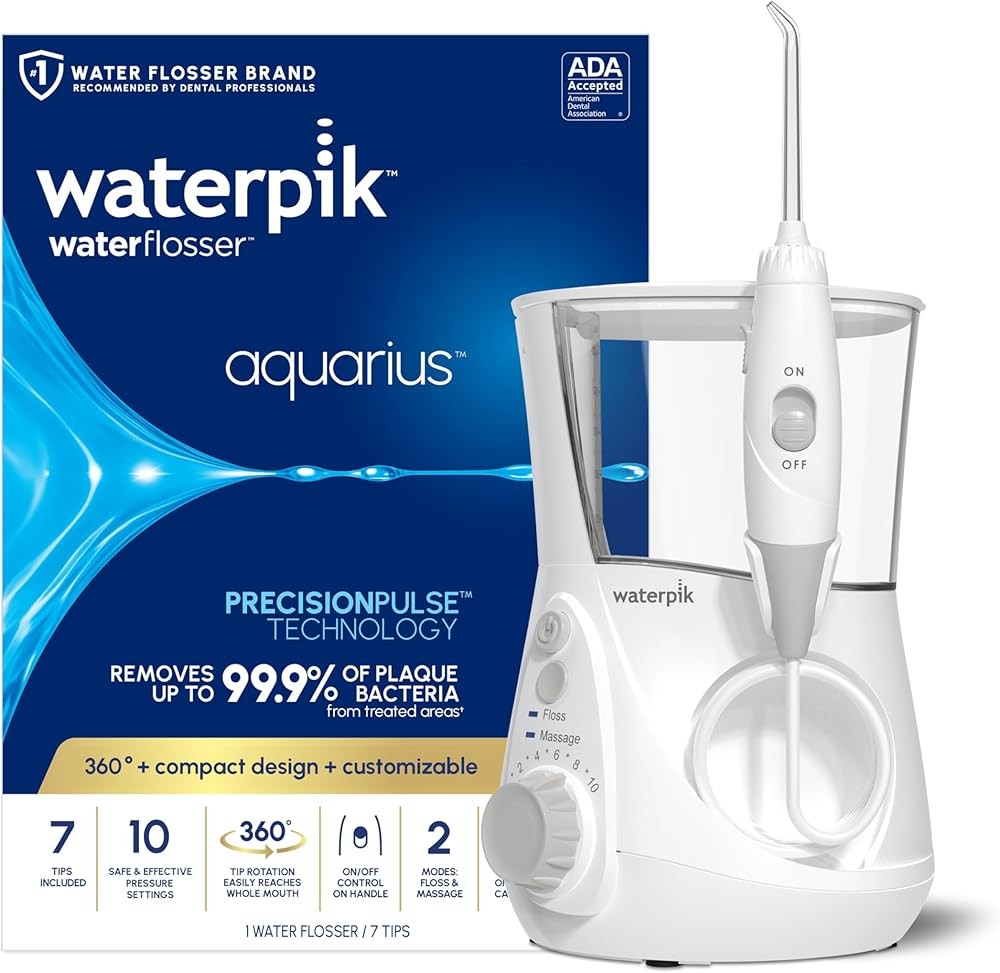
Waterpik Aquarius WP-660
Check Price on AmazonAs an Amazon Associate we earn from qualifying purchases.
Standard countertop models deliver maximum pressure control and uninterrupted cleaning capacity through ten pressure settings ranging from 10 to 100 PSI and substantial 22-ounce reservoirs. The ADA-accepted countertop design includes seven tips covering diverse oral health needs from basic interdental cleaning to specialized orthodontic and periodontal applications.
The consistent AC power operation ensures identical performance every time without battery degradation concerns. The ten pressure settings allow precise customization for individual sensitivity levels, with low enough starting points for severely inflamed gums and high enough maximum pressure for users wanting aggressive cleaning power.
The included tips provide exceptional value: three classic jet tips for family use, one Pik Pocket tip for periodontal pocket irrigation, one orthodontic tip for brackets and wires, one plaque seeker tip for implants and crowns, and one toothbrush tip for tongue cleaning. Color-coded rings allow household members to identify their designated tip when sharing the unit.
The 90 seconds of continuous operation from the large reservoir eliminates mid-session refilling, maintaining focus on proper technique throughout the cleaning process. The permanent countertop placement creates a visual reminder supporting daily use habits.
At $59, standard countertop models represent the most economical entry point for clinically effective water flossing. The comprehensive tip selection means most users avoid additional purchases for several years, improving long-term value. Minimal maintenance requirements beyond regular reservoir cleaning and periodic descaling contribute to reliable multi-year operation.
Basic cordless models prioritize portability and convenience through rechargeable battery operation, waterproof construction, and included travel bags. The simplified two-setting design provides normal and gentle pressure options suitable for most users while eliminating the complexity of extensive pressure customization.
The waterproof rating allows shower use, enabling users to incorporate water flossing into existing routines rather than adding a separate sink-based step. The magnetic charging system provides convenient overnight charging, with battery life supporting approximately one week of daily flossing sessions between charges.
The compact design fits easily in bathroom cabinets, eliminating counter space requirements while allowing flexible storage options. The included travel bag holds the unit, charging cable, and tips, making it practical for frequent travelers who want to maintain consistent oral hygiene routines regardless of location.
Four included tips cover essential needs: two classic jet tips for household sharing, one orthodontic tip for braces, and one Pik Pocket tip for periodontal pocket cleaning. While fewer than countertop models, these tips address the most common applications, with additional specialized tips available for separate purchase.
The five-ounce reservoir requires one refill during a thorough cleaning session, adding approximately 15 seconds to the total flossing time. This trade-off for portability proves acceptable for most users, particularly those valuing the convenience of cordless operation over maximum capacity.
At $79, basic cordless models cost $20 more than standard countertop models but provide functionality unavailable in AC-powered designs. For travelers, shower users, or those with limited bathroom space, this premium delivers genuine value through enabling consistent use in diverse circumstances.
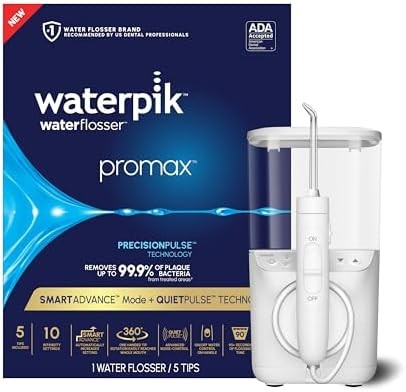
Waterpik Promax WF-23
Check Price on AmazonAs an Amazon Associate we earn from qualifying purchases.
Premium countertop models introduce SmartAdvance pressure modulation technology that automatically adjusts water pressure based on real-time resistance detection during use. This premium design targets users wanting automated optimization of cleaning effectiveness without manual pressure adjustment between different mouth areas.
The engineered quiet operation addresses a common countertop model complaint, making early morning or late evening flossing less disruptive in shared households. The reduced noise comes from motor housing improvements and refined internal component design rather than sacrificing pressure capability.
The compact footprint reduces counter space requirements to approximately 3 inches by 5 inches while maintaining a 20-ounce reservoir that provides 85 seconds of continuous operation. This space efficiency makes premium models viable for smaller bathroom counters where larger footprints prove problematic.
Five included tips focus on advanced oral health needs: classic jet tips for basic cleaning, orthodontic tips for brackets, Pik Pocket tips for deep periodontal cleaning, and plaque seeker tips for implant and crown maintenance. The selection targets users with complex dental work rather than basic interdental cleaning needs.
The SmartAdvance technology continuously monitors water pressure and adjusts delivery based on detected resistance. When encountering sensitive inflamed tissue, the system reduces pressure automatically. When cleaning areas with heavy plaque accumulation or around orthodontic hardware, pressure increases to optimal levels without manual adjustment.
At $149, premium models command a premium price justified by advanced technology and refined user experience. Users who struggle with consistent pressure application or want the quietest countertop operation find value in these enhancements. Those wanting straightforward basic operation may not benefit proportionally from the premium features.
Advanced cordless models bridge the traditional divide between cordless convenience and countertop-level features through ten pressure settings in a rechargeable battery-operated format. This model targets users who want extensive pressure customization without sacrificing portability.
The lithium-ion battery technology maintains consistent power delivery throughout the discharge cycle, reducing the pressure degradation that occurs in some cordless models as battery charge depletes. The seven-ounce reservoir extends single-fill operation to approximately 50 seconds, reducing but not eliminating mid-session refilling compared to countertop models.
Seven included tips match standard countertop selection: three classic jet tips, one Pik Pocket tip, one orthodontic tip, one plaque seeker tip, and one toothbrush tip. This comprehensive assortment in a cordless package addresses the common complaint that cordless models sacrifice tip variety for portability.
The waterproof construction enables shower use while the ten pressure settings accommodate users with significant gingival sensitivity who need very low starting pressures. The ability to precisely customize pressure while maintaining cordless freedom appeals to users with periodontal disease or complex dental work who also travel frequently.
The rechargeable lithium-ion battery charges fully in approximately four hours and provides extended usage time between charges compared to older battery technologies. However, like all cordless models, eventual battery degradation over two to four years may necessitate unit replacement rather than battery service.
At $99, advanced cordless models cost $20 more than basic cordless units but provide pressure customization and tip variety approaching countertop models. Users who specifically want cordless operation with maximum features find this middle-ground pricing delivers better value than purchasing the basic cordless model and adding specialized tips separately.
Frequently Asked Questions
Is a cordless water flosser as effective as a countertop model?
Clinical research shows both cordless and countertop water flossers effectively reduce gingivitis and plaque when used correctly. A Cochrane review of 35 RCTs found oral irrigators reduced gingivitis regardless of form factor (PubMed 30968949). The primary differences are reservoir capacity and maximum pressure settings, not cleaning effectiveness. The 2023 comparative review analyzing six decades of water flosser research concluded that consistent use patterns predict outcomes more reliably than device specifications (PubMed 38186424).
How long does a cordless Waterpik battery last?
Basic cordless models provide approximately 45 seconds of continuous use per charge, enough for one full flossing session. Advanced cordless models offer longer battery life with lithium-ion batteries, extending to approximately 50 seconds per charge. Both models provide about one week of daily flossing sessions between charges. Battery longevity typically ranges from two to four years before noticeable capacity degradation occurs, at which point most users replace the entire unit rather than servicing the battery.
What is the best Waterpik for small bathrooms?
Basic cordless models are ideal for small bathrooms due to their compact design and no countertop footprint. They store upright in cabinets or on narrow shelves, include travel bags, and require no electrical outlet near the sink during use. Among countertop models, premium units offer the smallest footprint at approximately 3 inches by 5 inches, compared to standard models requiring 4 inches by 6 inches. Premium models maintain effective cleaning with 20-ounce reservoirs while minimizing counter space demands.
Can I use a cordless water flosser in the shower?
Yes. Both basic and advanced cordless models are fully waterproof and designed for shower use. The waterproof construction protects internal electronics and rechargeable batteries from moisture damage during shower operation. Countertop models require electrical outlets and should never be used in the shower due to electrical safety concerns. Shower use may improve compliance by integrating water flossing into existing daily routines rather than requiring separate sink-based sessions.
Which Waterpik has the strongest water pressure?
Standard countertop models offer the highest pressure range at 10-100 PSI across 10 settings. Advanced cordless models offer similar pressure range with 10 settings, representing an advancement in cordless technology. Cordless models generally have slightly lower maximum pressure than countertop units due to motor size constraints, though the difference rarely affects clinical effectiveness. Research shows that pressure consistency and appropriate pressure selection for individual tissue tolerance matter more than maximum pressure capability for periodontal health outcomes.
Is the Waterpik Promax worth the higher price?
Premium countertop models at $149 offer SmartAdvance mode that automatically adjusts pressure for optimal cleaning, a notably quieter motor, and a more compact design than standard models. Research shows consistent pressure delivery improves plaque removal effectiveness, making the smart features potentially beneficial for users who struggle with manual pressure adjustment (PubMed 32716118). Users wanting straightforward operation without advanced features may find better value in standard models at $59. The premium price proves worthwhile for users specifically benefiting from automated pressure modulation or requiring quieter operation.
How often should I replace my water flosser tips?
Manufacturers recommend replacing standard classic jet tips every 3-6 months for optimal water flow and hygiene. Specialized tips including orthodontic, Pik Pocket, and plaque seeker tips should be replaced every 3 months due to their finer construction and more intensive cleaning applications. Signs requiring earlier replacement include visible bristle wear on plaque seeker tips, reduced water pressure through the tip, or discoloration indicating mineral buildup. All models use compatible tip systems, allowing users to purchase replacement tips that work across product lines.
Do dentists recommend Waterpik over traditional flossing?
Many dentists recommend water flossers as an effective alternative or complement to traditional flossing, particularly for patients with specific needs. The ADA has accepted multiple models for reducing gingivitis and plaque between teeth. A 2019 review found oral irrigators particularly beneficial for patients with orthodontic appliances, dental implants, and periodontal conditions (PubMed 31159354). Some dental professionals recommend combining water flossing with traditional floss for comprehensive interdental cleaning, while others consider water flossing an adequate standalone method when used consistently.
What is the reservoir capacity difference between cordless and countertop Waterpik models?
Countertop models hold significantly more water than cordless alternatives. Standard countertop models hold 22 ounces, providing about 90 seconds of continuous use sufficient for complete mouth cleaning without refilling. Premium countertop models hold 20 ounces, providing approximately 85 seconds of operation. Cordless models hold considerably less: basic models hold 5 ounces (45 seconds), while advanced models hold 7 ounces (50 seconds). Cordless users typically refill once during a thorough cleaning session, adding approximately 15 seconds to total flossing time.
Can a water flosser replace traditional dental floss entirely?
A 2019 Cochrane systematic review of 35 randomized controlled trials found that both traditional flossing and oral irrigation reduce gingivitis when added to toothbrushing (PubMed 30968949). Water flossers may be more effective for patients with braces, implants, or limited dexterity. Clinical evidence supports water flossers as effective alternatives to traditional floss for most users. However, individual dental anatomy and specific oral health conditions should guide the decision. Patients should consult their dentist regarding whether water flossing alone meets their specific interdental cleaning needs or whether combining both methods provides optimal results.
Our Top Recommendations
Key takeaway: For most users, the Waterpik Aquarius WP-660 delivers ten precise pressure settings, 22-ounce capacity for uninterrupted cleaning, and seven tips addressing diverse needs from basic interdental cleaning to orthodontic and periodontal applications at $59. Choose this model for maximum features and reliability when counter space and outlet access exist.
The evidence shows: For travelers, the Waterpik Cordless Advanced 2.0 WP-580 provides waterproof construction, rechargeable operation, and included travel bags for consistent oral hygiene across diverse circumstances at $79. The simplified two-setting design proves adequate for most users while eliminating battery anxiety through week-long charge duration.
Core advantage: For premium users, the Waterpik Promax WF-23 offers SmartAdvance automatic pressure modulation, the quietest countertop operation, and compact footprints fitting smaller bathroom counters at $149. Select this model for automated pressure optimization or minimal noise disruption, targeting users with complex dental work including implants, crowns, and periodontal treatment needs.
What the data says: For power users, the Waterpik ION Professional WF-12 bridges traditional divides by providing ten pressure settings, seven tips, and lithium-ion battery consistency in a waterproof cordless package at $99. This model serves power users who travel frequently or prefer shower flossing while needing extensive customization for complex dental work.
For related oral health optimization, see our comprehensive guides on best water flossers and best electric toothbrushes. Users interested in complementary health optimization may find value in our vitamin C vs zinc comparison and CoQ10 form comparison. For pet owners concerned about dental health costs, our guide on supplements for dog dental health provides evidence-based strategies.
Join the discussion: Facebook | X | YouTube | Pinterest
Conclusion
The choice between cordless and countertop water flossers ultimately depends on individual lifestyle factors that influence consistent daily use rather than inherent effectiveness differences between device types. Clinical research spanning six decades consistently demonstrates that oral irrigators reduce gingivitis and plaque when used regularly, with the comprehensive 2023 review finding both form factors superior in periodontal disease management across multiple indices.
Standard countertop models serve users prioritizing maximum pressure control, uninterrupted cleaning capacity, and comprehensive tip selection for diverse family needs, all at an economical price point supporting long-term value. The permanent countertop placement creates environmental cues supporting habit formation while delivering consistent AC-powered performance without battery degradation concerns.
Cordless models address different priorities, enabling consistent oral hygiene for travelers, shower users, or those with limited bathroom space. The portability genuinely improves compliance for users whose routines include frequent travel, split households, or preference for shower-based personal care. The waterproof construction and rechargeable operation eliminate barriers that might otherwise interrupt consistent use.
Premium options target specific needs: automated pressure optimization for users struggling with manual adjustment, quieter operation for noise-sensitive households, or countertop-level features in cordless format. These specialized features command higher prices justified only when addressing genuine user requirements rather than pursuing specifications unlikely to affect actual usage patterns.
The critical factor remains selecting whichever design the individual user will actually operate daily for months and years. A less expensive countertop model sitting unused provides no periodontal benefit compared to a more expensive cordless model integrated into daily shower routines. Similarly, an advanced premium model proves worthwhile only when its specific features address actual compliance barriers or clinical needs.
All reviewed models carry ADA acceptance for plaque removal and gingivitis reduction, validating their clinical effectiveness when used consistently at appropriate pressure settings. The evidence base supporting oral irrigation spans multiple systematic reviews, randomized controlled trials, and long-term clinical studies examining outcomes in diverse populations including children, orthodontic patients, and individuals with periodontal disease.
Users should honestly assess their actual bathroom setup, travel frequency, sensitivity to noise, preference for shower versus sink routines, and budget constraints. These practical factors determine compliance more reliably than technical specifications like maximum pressure capability or reservoir ounces. The best water flosser remains the one that gets used every single day, regardless of whether it plugs into an outlet or runs on batteries.
Related Reading
Explore these evidence-based guides for comprehensive oral and overall health optimization:
- Best Water Flosser — Complete analysis of all water flosser types with clinical research backing
- Best Electric Toothbrush — Powered toothbrush comparison for complete oral hygiene systems
- Best Supplements for Dog Dental Health — Evidence-based strategies for pet dental care
- Vitamin C vs Zinc for Immune Support — Research-backed immune health comparison
- CoQ10 Ubiquinol vs Ubiquinone — Bioavailability analysis of CoQ10 forms
- Do Greens Powders Actually Work — Evidence review of superfood supplement claims
References
-
Worthington HV, MacDonald L, Pericic TP, et al. Home use of interdental cleaning devices, in addition to toothbrushing, for preventing and controlling periodontal diseases and dental caries. Cochrane Database Syst Rev. 2019;4(4):CD012018. PubMed 30968949
-
Cobb CM, Williams KB, Gerkovitch MM. A Comparative Review of Water Flossers in Periodontal Therapy: From Historical Perspectives to Contemporary Applications. Cureus. 2023;15(12):e50303. PubMed 38186424
-
Husseini A, Slot DE, Van der Weijden GA. Mechanical plaque removal of periodontal maintenance patients: A systematic review and network meta-analysis. J Clin Periodontol. 2020;47 Suppl 22:107-124. PubMed 32716118
-
Nazir M, Kassa S, Al-Ansari A, Almas K. Efficiency of Three Interdental Plaque Control Aids following Plaque Accumulation: A Randomized Controlled Clinical Trial. Int J Clin Pediatr Dent. 2025;18(1):34-39. PubMed 41040992
-
Salzer S, Slot DE, Van der Weijden FA, Dörfer CE. An Overview of Different Interdental Cleaning Aids and Their Effectiveness. Dent J (Basel). 2019;7(2):58. PubMed 31159354
-
Sanz M, Herrera D, Kebschull M, et al. Treatment of stage I-III periodontitis-The EFP S3 level clinical practice guideline. J Clin Periodontol. 2020;47 Suppl 22:4-60. PubMed 32716118
-
Chapple ILC, Van der Weijden F, Doerfer C, et al. Primary prevention of periodontitis: managing gingivitis. J Clin Periodontol. 2015;42 Suppl 16:S71-S76. PubMed 25639826
-
Cobb CM. Clinical significance of non-surgical periodontal therapy: an evidence-based perspective of scaling and root planing. J Clin Periodontol. 2002;29 Suppl 2:6-16. PubMed 11155183
-
Systematic review examining effectiveness of oral irrigators on periodontal health of orthodontic patients. PubMed 39633346
-
Slot DE, Wiggelinkhuizen L, Rosema NAM, Van der Weijden GA. The efficacy of manual toothbrushes following a brushing exercise: a systematic review. Int J Dent Hyg. 2020;18(4):361-370. PubMed 32844413
-
Sambunjak D, Nickerson JW, Poklepovic T, et al. Flossing for the management of periodontal diseases and dental caries in adults. Cochrane Database Syst Rev. 2011;(12):CD008829. PubMed 23574470
-
Boyd RL, Chun YS. Eighteen-month evaluation of the effects of a 0.4% stannous fluoride gel on gingivitis in orthodontic patients. Am J Orthod Dentofacial Orthop. 1994;105(1):35-41. PubMed 8018134
Recommended Products