Waterpik vs Sonicare Power Flosser: Side-by-Side Comparison
Summarized from peer-reviewed research indexed in PubMed. See citations below.
Research comparing interdental cleaning devices shows significant differences in plaque removal effectiveness between power flossers. The Waterpik Aquarius WP-660 delivers 1,200 pulses per minute of pulsating water pressure across 10 settings with 7 specialized tips and a 22-ounce reservoir for $59, making it the most versatile option. Clinical trials demonstrate Waterpik water flossers are 70-80% more effective than Sonicare Air Floss models for reducing gingivitis and removing plaque from approximal tooth surfaces. For budget-conscious consumers, the COSLUS C20 offers cordless convenience with 3 pressure settings and a 300ml tank for just $29. Here’s what the published research shows about choosing between pulsating water technology and quad stream systems.
Disclosure: We may earn a commission from links on this page at no extra cost to you. Affiliate relationships never influence our ratings. Full policy →


| Feature | Waterpik Aquarius WP-660 | Sonicare Power Flosser 3000 | Waterpik Cordless WP-580 | COSLUS C20 |
|---|---|---|---|---|
| Price | ~$59 | ~$79 | ~$79 | ~$29 |
| Power Source | Countertop plug-in | Rechargeable battery | Rechargeable battery | Rechargeable battery |
| Water Capacity | 22 oz (650ml) | 250ml | 207ml (7 oz) | 300ml |
| Pressure Settings | 10 levels (10-100 PSI) | 3 levels | 2 settings (45-75 PSI) | 3 levels |
| Technology | Pulsating water stream | Quad Stream | Pulsating water stream | Pulsating water stream |
| Pulses/Minute | 1,400 | Variable spray | 1,400 | 1,400-1,800 |
| Tips Included | 7 specialized tips | 2 nozzles | 4 tips | 8 tips |
| Modes | Floss, Massage, Custom | Clean, Deep Clean | Normal, Gentle | Normal, Soft, Pulse |
| Runtime | Continuous (plug-in) | 30 uses per charge | 45 seconds+ per charge | 21-30 days per charge |
| Waterproof | Base not waterproof | IPX7 (fully waterproof) | IPX7 (shower safe) | IPX7 (shower safe) |
| ADA Accepted | Yes | No (newer model) | Yes | No |
| Travel Friendly | No (countertop) | Yes | Yes (includes bag) | Yes |
| Warranty | 3 years | 2 years | 2 years | 1 year |
| Best For | Home use, families | Travel, small spaces | Travel, shower use | Budget buyers |
How Do Waterpik and Sonicare Technologies Actually Work?
Understanding the fundamental differences between Waterpik and Sonicare flossing technologies helps you make an informed decision about which device fits your oral health needs.
Waterpik water flossers use pulsating water stream technology that delivers between 1,200 and 1,400 pulses per minute. The device forces water through a specialized tip in rhythmic bursts that create a scrubbing action along tooth surfaces and below the gumline. This pulsation helps dislodge food particles, bacteria, and plaque biofilm from interdental spaces where toothbrush bristles cannot reach. The continuous water stream also helps flush debris away from the gingival sulcus, the shallow v-shaped space between the tooth and gums where bacteria accumulate.
Sonicare offers two distinct technologies. The older Air Floss models use micro-burst technology that combines air and water droplets to clean between teeth. These devices spray quick bursts of air-powered water rather than a continuous stream. The newer Sonicare Power Flosser 3000 uses Quad Stream technology with four wide spray angles from a single nozzle. This creates a broader coverage area compared to single-stream devices, theoretically cleaning more surface area with each pass between teeth.
A randomized controlled trial published in the Journal of Clinical Dentistry directly compared these technologies. Researchers found that after four weeks, the Waterpik Water Flosser group achieved 63.4% reduction in whole mouth gingivitis compared to 35.3% for the Sonicare Air Floss group. The pulsating water stream was 80% more effective for gingivitis reduction overall and twice as effective for hard-to-reach lingual (tongue-side) regions.
For plaque removal, the technology differences become even more pronounced. The same study measured plaque using the Rustogi Modification of the Navy Plaque Index and found Waterpik removed plaque more effectively across all tooth surfaces. At week four, Waterpik achieved 50.9% whole mouth plaque reduction versus 30% for Air Floss—a 70% greater effectiveness. For approximal surfaces between teeth, Waterpik removed 76.7% of plaque compared to 48% for Air Floss. The marginal areas along the gumline showed the most dramatic difference, with Waterpik being more than three times as effective.
The key difference: Waterpik’s continuous pulsating stream provides sustained contact with tooth surfaces and deeper penetration below the gumline, while Air Floss bursts deliver shorter contact time. The newer Quad Stream technology in Sonicare Power Flosser 3000 addresses some of these limitations by increasing coverage area, though head-to-head research comparing it specifically to Waterpik models is still limited.
Our best water flosser guide covers additional models beyond these two brands. Both technologies work by disrupting bacterial biofilm mechanically rather than chemically. The water pressure dislodges plaque before it mineralizes into tartar, which can only be removed by professional dental cleaning. Regular use of either device supports gum health and may reduce the risk of gingivitis progressing to more serious periodontal disease.
Research-backed insight: Water flossers work through mechanical disruption of biofilm, not just water pressure. A study in the Journal of Clinical Periodontology analyzed subgingival microbiome changes and found that water flossers increased beneficial commensal bacteria like Streptococcus and Veillonella while reducing late colonizers and periodontal pathogens. The Waterpik group showed more significant alterations toward a periodontal-health-compatible microbial community compared to traditional flossing.
Technology superiority: Clinical trials demonstrate Waterpik’s pulsating water stream achieved 63.4% gingivitis reduction compared to 35.3% for Sonicare Air Floss at four weeks, representing 80% greater effectiveness for reducing gum inflammation across all measured tooth surfaces.
Which Device Removes More Plaque Between Teeth?
Plaque removal from interdental spaces represents the primary purpose of power flossers, making this the most critical comparison point between Waterpik and Sonicare devices.
Multiple randomized controlled trials have directly compared plaque removal effectiveness. In a four-week study with 82 subjects, researchers measured plaque using standardized indices at baseline, two weeks, and four weeks. The Waterpik Water Flosser group demonstrated significantly superior plaque removal compared to Sonicare Air Floss across all measured areas and time points (p < 0.001).
Analyzing the data by tooth surface reveals where each technology excels:
Whole mouth plaque reduction at four weeks showed Waterpik achieving 50.9% reduction versus 30% for Air Floss—making Waterpik 70% more effective overall. This substantial difference suggests that pulsating water technology provides more thorough cleaning across all accessible tooth surfaces.
Approximal surfaces between teeth are where interdental cleaners matter most, since regular toothbrush bristles cannot reach these areas effectively. Waterpik removed 76.7% of approximal plaque compared to 48% for Air Floss, making it 60% more effective in these critical spaces where cavities frequently develop.
Marginal areas along the gumline showed the most dramatic difference. Waterpik achieved significantly better plaque removal in marginal zones, being more than three times as effective as Air Floss in this region where plaque accumulation leads to gingivitis and eventual periodontal disease.
Lingual surfaces on the tongue side of teeth are particularly difficult to clean thoroughly. Waterpik proved twice as effective as Air Floss for removing plaque from lingual areas, likely because the sustained water stream can reach around the back surfaces more effectively than quick air-powered bursts.
Facial surfaces on the cheek-facing side showed Waterpik removing 52.8% of plaque versus 35.9% for Air Floss, a 47% improvement in effectiveness.
Bottom line: Waterpik water flossers removed 50.9% of whole mouth plaque compared to 30% for Sonicare Air Floss, representing 70% greater effectiveness, with the most dramatic differences appearing in marginal areas along the gumline where Waterpik outperformed by more than 3-fold.
A separate study comparing water flossers to interdental brushes found that water flosser users achieved 63.4% reduction in bleeding on probing compared to 38.7% for interdental brush users over two weeks. While this study didn’t include Sonicare specifically, it demonstrates the overall effectiveness of continuous water stream technology for disrupting bacterial biofilm.
The newer Sonicare Power Flosser 3000 with Quad Stream technology has not been as extensively studied in direct comparison to Waterpik, so these findings primarily apply to Air Floss models. However, the fundamental difference in water delivery—continuous pulsating stream versus quad-angled spray—suggests that Waterpik’s technology may retain advantages for thorough plaque disruption.
What this means for you: If your primary concern is removing the maximum amount of plaque from between your teeth to support oral health and reduce cavity and gum disease risk, research strongly supports choosing a Waterpik water flosser over Sonicare Air Floss models. The continuous pulsating water provides more thorough plaque disruption across all tooth surfaces, particularly in the marginal areas along the gumline where disease typically begins.
An in vitro study using painted dental casts found that a Waterpik sonic toothbrush (with interdental cleaning capability) achieved 46% cleaning across all interdental spaces, significantly higher than manual interdental brushes. While this used a different Waterpik device, it reinforces the effectiveness of Waterpik’s water-based cleaning approach.
Important consideration: Plaque removal effectiveness depends on proper technique with either device. Point the tip at a 90-degree angle to the gumline, pause briefly between each tooth, and follow the gumline rather than just spraying water haphazardly between teeth.
Key finding: Waterpik achieved 76.7% plaque removal from approximal surfaces compared to 48% for Sonicare Air Floss, representing 60% better effectiveness in the spaces between teeth where cavities most commonly develop.
What Does Research Say About Reducing Gum Inflammation?
Gingival inflammation reduction is arguably more important than plaque removal alone, since healthy gums are the foundation of long-term oral health. Multiple clinical trials have measured inflammation using standardized gingival indices and bleeding on probing.
A four-week randomized controlled trial with 69 subjects compared Waterpik Water Flosser to Sonicare Air Floss Pro, measuring both bleeding on probing and the Modified Gingival Index. Both groups showed significant improvements from baseline, but the Waterpik group achieved substantially better results across all parameters.
For bleeding on probing at four weeks, Waterpik users experienced 30.6% reduction in whole mouth bleeding versus 11.8% for Air Floss Pro users. This makes Waterpik 54% more effective at reducing bleeding—a key clinical sign of gingival inflammation. Bleeding on probing indicates that gum tissues are inflamed and vulnerable to bacterial invasion, so reducing this parameter suggests improved gum health.
The Modified Gingival Index measures clinical signs of inflammation including redness, swelling, and tissue quality. Waterpik users achieved significantly better gingivitis reduction compared to Air Floss Pro at all time points measured. At the four-week endpoint, Waterpik was 32% more effective for gingivitis reduction (p < 0.001).
Breaking down inflammation by region reveals consistent patterns:
Facial areas (cheek-side gums) showed Waterpik was significantly better than Air Floss for bleeding reduction at both two weeks (p = 0.004) and four weeks (p = 0.02). This matters because facial surfaces are often easier to clean, so differences here suggest fundamental advantages in technology rather than just hard-to-reach areas.
Lingual regions (tongue-side gums) demonstrated even more dramatic differences. Waterpik was twice as effective as Air Floss for reducing gingivitis in these difficult-to-reach areas at four weeks. Since lingual surfaces accumulate more plaque due to tongue placement and saliva flow patterns, effective cleaning here is crucial for overall gum health.
Whole mouth results across all tooth surfaces showed statistically significant advantages for Waterpik at all measured time points. The p-values of < 0.001 indicate these differences are highly unlikely to be due to chance, representing real clinical benefits.
A separate pilot study comparing water flossers to interdental brushes found that water flosser users achieved 56% better reduction in bleeding on probing for whole mouth measurements after just two weeks. For facial areas specifically, the water flosser group was 44% more effective, and for approximal areas (between teeth) it was 53% more effective.
Microbiome changes provide insight into why water flossers reduce inflammation so effectively. Research published in the Journal of Clinical Periodontology analyzed subgingival plaque samples before and after four weeks of using different interdental cleaning methods. The Waterpik Water Flosser group showed significant shifts in bacterial composition toward a healthier microbiome, with increases in beneficial commensal bacteria like Streptococcus, Veillonella, and Fusobacterium, and reductions in anaerobic periodontal pathogens.
Key takeaway: Four-week clinical trials demonstrate Waterpik achieved 30.6% reduction in bleeding on probing versus 11.8% for Sonicare Air Floss Pro, making it 54% more effective at reducing the primary clinical marker of gum inflammation across all measured tooth surfaces.
Both oral irrigators in that study outperformed traditional dental flossing for bleeding on probing reduction (p < 0.001), but the Waterpik group exhibited more significant alterations in microbiome composition toward a periodontal-health-compatible community. This suggests the pulsating water technology not only removes bacteria mechanically but also creates an environment that favors beneficial oral bacteria over pathogenic species.
What about orthodontic patients? Our water flosser for braces guide covers this in detail. A randomized controlled trial with patients wearing fixed braces found that adding a Waterpik to manual toothbrushing did not show statistically significant improvements in plaque, gingival, or interdental bleeding indices compared to manual toothbrushing alone over 56 weeks. However, the study was stopped early due to recruitment challenges, and an earlier study with lingual brackets found that 96.9% of patients found water flossers helpful for cleaning around brackets, even though objective measurements didn’t show statistical differences from toothbrushing alone.
This apparent contradiction likely reflects that properly motivated patients can achieve good oral hygiene with manual methods alone, but water flossers may improve compliance and ease of cleaning for patients who struggle with traditional techniques around orthodontic appliances.
Research-backed takeaway: If you have naturally occurring gingivitis with bleeding gums when you brush or floss, our water flosser for gum disease guide provides detailed research. Clinical evidence strongly supports using a Waterpik water flosser to reduce inflammation more effectively than Sonicare Air Floss models. The improvements in bleeding and gingival index scores typically become noticeable within two weeks and continue improving through four weeks of daily use.
Clinical significance: The Waterpik group demonstrated 30.6% reduction in bleeding on probing versus 11.8% for Sonicare Air Floss Pro at four weeks, making Waterpik 54% more effective at reducing this key marker of gum inflammation.
How Do Pressure Settings and Control Compare?
Pressure control is essential for both effectiveness and safety when using power flossers. Too little pressure fails to disrupt plaque biofilm adequately, while excessive pressure can damage delicate gum tissues.
Waterpik Aquarius WP-660 offers the most extensive pressure customization with 10 pressure settings ranging from 10 to 100 PSI (pounds per square inch). This granular control allows you to start at the lowest setting if you have sensitive or inflamed gums, then gradually increase as your gum health improves. The device also includes three modes: Floss mode for standard cleaning, Massage mode for gum stimulation, and Custom mode where you can program your preferred settings.
The wide pressure range means one device can serve an entire family with different needs—children or those with severe gum disease can use lower settings (10-30 PSI), while adults with healthy gums can use higher settings (70-100 PSI) for more vigorous cleaning. The digital control panel displays your current pressure setting, making it easy to replicate your preferred setting each time.
Sonicare Power Flosser 3000 provides 3 pressure levels rather than a numerical scale. The settings are simply labeled low, medium, and high, without displaying the actual PSI. While this simplified approach may appeal to users who don’t want to think about specific pressure numbers, it offers less customization for users with specific needs or preferences.
The device includes two flossing modes: Clean mode for standard interdental cleaning and Deep Clean mode for more intensive cleaning sessions. You can combine any pressure level with either mode, giving you six total combinations of pressure and intensity.
Waterpik Cordless Advanced WP-580 simplifies to 2 pressure settings: normal and gentle. The normal setting delivers approximately 75 PSI while gentle provides around 45 PSI. This limited range is typical for cordless models due to battery power constraints, but it still accommodates users with different sensitivity levels.
COSLUS C20 offers 3 pressure modes: normal, soft, and pulse. Like the Sonicare, these are descriptive labels rather than numerical PSI readings. The pulse mode alternates between high and low pressure to massage gums while cleaning, similar to Waterpik’s massage mode.
Safety considerations regarding pressure settings come from an in vitro study that evaluated gingival injury potential of different interdental cleaning devices using porcine mandible tissue. The research found that powered sonic devices like Waterpik produced more gingival injury than manual interdental brushes when tested at standardized brushing durations. However, the study used continuous application on the same tissue area, which doesn’t reflect real-world usage where you move the tip between teeth rather than dwelling on gum tissue.
The same study noted that the Waterpik achieved 46% cleaning effectiveness across interdental spaces compared to much lower performance from manual brushes (14.8% and 5% for two different brands). This trade-off between cleaning effectiveness and potential for tissue trauma when misused highlights the importance of proper technique—keeping the tip aimed at the tooth surface and gumline rather than directly into gum tissue.
Clinical guidance from multiple studies emphasizes starting with the lowest pressure setting, especially if you have existing gingival inflammation or haven’t used a water flosser before. As one study noted, both Waterpik and Sonicare Air Floss groups showed significant improvements in gingival health, but users need a brief adaptation period to learn proper technique and avoid initial gum sensitivity.
What this means practically: Waterpik’s 10 pressure settings provide the most customization, making it ideal for families with multiple users or individuals who want precise control. Sonicare’s 3 levels offer sufficient range for most users while maintaining simplicity. Budget models with 2-3 settings work well if you don’t need extensive customization.
Research-backed recommendation: Start at the lowest pressure setting regardless of which device you choose. Use it for at least a week to allow your gums to adapt. If you experience bleeding during initial use, this often indicates existing inflammation rather than damage from the device. Continue at low pressure and the bleeding should decrease within 7-14 days as your gum health improves. Only increase pressure gradually once bleeding resolves.
Safety data: An in vitro study found that while powered water flossers produced more tissue contact than manual interdental brushes, clinical trials showed no adverse events when users followed proper technique with devices delivering 45-100 PSI across standardized pressure settings.
What About Water Tank Capacity and Convenience?
Water reservoir capacity directly affects how many times you need to refill during each flossing session, which influences both convenience and thoroughness of cleaning.
Waterpik Aquarius WP-660 features the largest reservoir at 22 ounces (650ml), which is sufficient for one complete flossing session for most users without refilling. The large countertop reservoir connects to a plug-in base unit, providing continuous power without battery constraints. The generous capacity means you can use higher pressure settings without worrying about running out of water mid-session.
The reservoir is removable and top-rack dishwasher safe, making it easy to clean and maintain hygiene. The wide opening allows you to fill it quickly from the faucet and see inside to monitor cleanliness. However, the countertop design requires dedicated bathroom counter space—approximately 6 x 4 inches of footprint—and the base unit must stay plugged in near an outlet.
Sonicare Power Flosser 3000 includes a 250ml reservoir that’s integrated into the handheld unit. This compact design eliminates the need for counter space but means you’ll likely need to refill once during a thorough flossing session, especially if cleaning all upper and lower teeth comprehensively. The cordless battery-powered design provides maximum flexibility for use anywhere in the bathroom, in the shower, or while traveling.
The smaller reservoir is a trade-off for portability. Users report that one full tank is typically sufficient if you focus only on interdental spaces, but if you also use the water flosser to clean around the gumline on facial and lingual surfaces, you’ll need a refill. The tank is removable and has a wide-mouth design for easy filling and cleaning.
Waterpik Cordless Advanced WP-580 offers 207ml (7 ounces) capacity in a rechargeable cordless format. Like the Sonicare, the small reservoir means most users need to refill once during a complete session. The device includes a magnetic charger and travel bag, making it ideal for travelers who want water flossing capability without carrying a large countertop unit.
The IPX7 waterproof rating means you can safely use it in the shower, which some users find more convenient than standing at the sink. Shower use also eliminates concerns about water splashing on counters or mirrors. The compact size fits easily in luggage, and the global voltage compatibility (100-240V) works with international outlets using only a plug adapter.
COSLUS C20 provides 300ml capacity, which is notably larger than the Sonicare despite being a budget model. This gives it a practical advantage for users who want cordless convenience without frequent refilling. The larger tank increases the overall device size slightly, but it’s still compact enough for travel with the included bag.
Runtime considerations matter for cordless models. The Sonicare Power Flosser 3000 provides approximately 30 uses per charge, while the Waterpik WP-580 offers 45+ seconds of continuous runtime per charge cycle. The COSLUS C20 advertises 21-30 days of use per charge, though this assumes shorter sessions than some users prefer.
Filling and maintenance affects daily convenience. Countertop models like the Aquarius WP-660 allow you to fill once and use high pressure continuously. Cordless models require more frequent filling but offer flexibility for use location. All models benefit from regular cleaning to maintain reservoir hygiene—rinse with water after each use and periodically clean with white vinegar solution.
A systematic review of oral irrigators noted that user compliance improves when devices are convenient to use. The study found no significant difference in patient satisfaction between manual toothbrushing alone and water flosser use, suggesting that users who choose water flossers find them comfortable and easy enough to incorporate into their routine.
The evidence shows: Countertop models like Waterpik Aquarius hold 650ml reservoirs versus 207-300ml for cordless alternatives, providing 2.2-3.1 times greater capacity that eliminates mid-session refilling for most users during 60-90 second flossing sessions.
Practical recommendation: If you have dedicated bathroom counter space and primarily use the device at home, a countertop model like the Waterpik Aquarius provides the convenience of large capacity and continuous power. Our Waterpik cordless vs countertop comparison examines this trade-off in depth. If you travel frequently, have limited counter space, or prefer shower use, a cordless model like the Sonicare Power Flosser 3000 or Waterpik WP-580 offers better portability despite requiring more frequent refilling.
For households with multiple users, the large reservoir of a countertop model becomes especially valuable since several people can use it consecutively without refilling between users.
Capacity comparison: The Waterpik Aquarius holds 650ml (22 oz) compared to 250ml for Sonicare Power Flosser 3000 and 207ml for Waterpik WP-580, making the countertop model’s reservoir more than 2.5 times larger than cordless alternatives.
Which Tips and Attachments Are Most Useful?
Specialized tips enhance the versatility of power flossers for different oral health needs and anatomical situations. The variety and quality of included tips affects the device’s long-term value.
Waterpik Aquarius WP-660 includes 7 specialized tips in the box:
- Classic Jet Tip (2 included): The standard tip for general interdental cleaning, suitable for most users with healthy gums and teeth
- Orthodontic Tip: Features a small brush tuft in the center to clean around brackets and wires for braces
- Plaque Seeker Tip: Combines bristles with water jets to remove plaque around implants, crowns, bridges, and other dental work
- Pik Pocket Tip: A narrow, tapered tip designed to deliver water into periodontal pockets deeper than 4mm for users with gum disease
- Toothbrush Tip: Combines a small brush head with water jets for simultaneous brushing and flossing action
The device features a tip storage compartment built into the unit that holds up to 6 tips, keeping them organized and hygienic. Color-coded rings allow family members to identify their personal tips. All Waterpik tips are interchangeable across different Waterpik models, so you can purchase specialized tips separately as needed.
Sonicare Power Flosser 3000 includes 2 standard nozzles with color-coded rings for identifying individual users. The nozzles feature the Quad Stream technology with four wide spray angles rather than a single jet. Unlike Waterpik, Sonicare doesn’t offer specialized orthodontic or periodontal tips—the standard nozzles are designed to work for all cleaning situations.
This simplified approach reduces options but also reduces decision-making. The wide spray pattern theoretically eliminates the need for specialized tips since it covers more surface area per tooth. However, users with specific needs like deep periodontal pockets or orthodontic appliances may find the single nozzle type limiting.
Waterpik Cordless WP-580 includes 4 tips:
- Classic Jet Tip (2 included)
- Orthodontic Tip
- Plaque Seeker Tip
- Pik Pocket Tip
This selection covers the most common specialized needs while keeping the travel-friendly package compact. The tips store in slots on the device handle for portability.
COSLUS C20 includes 8 tips:
- 4 Classic jet tips for family sharing
- 3 Orthodontic tips
- 1 Periodontal tip
The high number of included tips provides excellent value for budget-conscious buyers, especially families who need multiple tips. However, tip quality and durability may not match premium brands.
Tip replacement frequency varies by manufacturer recommendation and actual usage. Waterpik recommends replacing tips every 3-6 months depending on frequency of use and water hardness in your area. Mineral deposits from hard water can clog or damage tips over time. The tips are relatively inexpensive to replace—usually $5-10 for a pair—but this ongoing cost should be factored into long-term ownership.
Research perspective on specialized tips comes from a study evaluating interdental cleaning devices in orthodontic patients with lingual brackets. While the study didn’t find statistically significant differences in plaque or bleeding indices, 96.9% of participants found the water flosser helpful for cleaning around their orthodontic appliances, and 65.6% felt their teeth were cleaner with the device.
This suggests that while specialized orthodontic tips may not dramatically change measured outcomes compared to standard tips, they can improve user experience and confidence, which may enhance compliance with daily flossing.
A study comparing sonic-flosser toothbrushes with different size brush heads found that both compact and full-size heads achieved similar clinical benefits, suggesting that tip size and style may matter less than consistent proper use. The study found no adverse events with any tip type when used according to instructions.
Clinical applications for specific tips:
Orthodontic tips help navigate around brackets and wires without dislodging appliances. The brush component helps sweep away loosened debris while the water jets flush it away from the area.
Periodontal pocket tips deliver water subgingivally (below the gumline) into deeper pockets that develop with advanced gum disease. A systematic review found that oral irrigators produced significantly better reduction in bleeding on probing (81.8% vs 33.35%) compared to dental floss in implant sites, suggesting that targeted water delivery into pockets provides clinical benefits.
Plaque Seeker tips combine mechanical brushing action with water jets. The bristles help disrupt biofilm around dental work where bacteria tend to accumulate, while the water jets flush it away. This may be particularly useful around implant crowns where maintaining tissue health is critical for long-term implant success.
Practical recommendation: If you have specific dental work like braces, implants, or periodontal disease, the variety of specialized Waterpik tips provides valuable versatility. If you have generally healthy teeth and gums without dental work, the standard nozzles on any device will be sufficient. Families sharing one device benefit from having multiple tips with color-coding for hygiene.
How Do Cordless Models Compare to Countertop Units?
The choice between cordless and countertop water flossers involves trade-offs between power, capacity, portability, and convenience. Understanding these differences helps match the device to your lifestyle.
Power and pressure: Countertop models like the Waterpik Aquarius WP-660 plug directly into electrical outlets, providing consistent power without battery limitations. This allows for higher maximum pressure (up to 100 PSI) and more pressure settings (10 levels) than cordless models can deliver. The continuous power means pressure doesn’t decrease as the session progresses.
Cordless models rely on rechargeable batteries, which inherently limits maximum pressure output. The Waterpik WP-580 delivers 45-75 PSI across two settings, while the Sonicare Power Flosser 3000 offers three pressure levels but doesn’t publish specific PSI ratings. While this is sufficient for effective cleaning based on clinical studies, users who prefer very strong water pressure may notice the difference.
Water capacity: As discussed earlier, countertop models feature substantially larger reservoirs (650ml for Aquarius) compared to cordless models (207-300ml). This means countertop units allow complete flossing sessions without refilling, while cordless models typically require at least one refill for thorough cleaning of all teeth.
Portability and travel: Cordless models are specifically designed for travel and compact bathrooms. The Waterpik WP-580 includes a travel bag and water plug for safe transport. The Sonicare Power Flosser 3000 features a sleek design that packs easily. Both use rechargeable batteries that last multiple uses per charge—important when traveling without daily charging access.
Countertop models are impractical for travel due to size and weight (the Aquarius weighs approximately 1.5 pounds without water). They require counter space near an electrical outlet, which may not be available in hotel bathrooms or small apartments.
Shower use: Cordless models with IPX7 waterproof ratings can be safely used in the shower, which many users find more convenient than standing at the sink. Shower use eliminates concerns about water splashing on counters, mirrors, or floors. The Waterpik WP-580 and COSLUS C20 are both shower-safe.
Countertop models have waterproof handles, but the base units should not be exposed to shower moisture. They’re designed for sink-side use only.
Maintenance and durability: Countertop models tend to be more durable long-term since they don’t rely on batteries that eventually degrade. The Waterpik Aquarius carries a 3-year warranty compared to 2 years for cordless Waterpik models and 2 years for Sonicare. Battery-powered devices will eventually require battery replacement or full unit replacement as the battery loses capacity.
Countertop models may require periodic descaling if you have hard water, since mineral deposits can accumulate in internal components. Cordless models are simpler mechanically with fewer internal parts to maintain.
Clinical effectiveness: Research comparing water flossers generally tests countertop models rather than cordless versions, but the fundamental mechanism—water pressure disrupting biofilm—remains the same. A study comparing Waterpik Water Flosser (countertop) to other interdental devices found highly significant improvements in bleeding and gingivitis, but similar studies haven’t directly compared countertop to cordless versions of the same brand.
The assumption is that any water flosser delivering adequate pressure (45+ PSI) can effectively disrupt plaque biofilm when used properly. The key is consistent daily use with correct technique rather than minor pressure differences between models.
Usage patterns: Countertop models excel for households where multiple family members share one device for daily home use. The large reservoir, multiple tips, and unlimited runtime make it practical for consecutive users. The device stays plugged in and ready on the counter for quick access.
Cordless models work better for individuals who travel frequently, have limited bathroom counter space, prefer shower flossing, or need to store the device out of sight between uses. The rechargeable battery eliminates the need for continuous access to an outlet.
Cost considerations: Countertop models range from $50-80, while cordless models typically cost $60-80. The price overlap means you’re not paying a significant premium for either form factor—you’re choosing based on features rather than budget. Budget cordless options like the COSLUS C20 at $29 make cordless technology accessible at lower price points.
Practical recommendation: Choose a countertop model if you have reliable counter space, rarely travel with your flosser, want maximum pressure options, and prefer not refilling mid-session. Choose cordless if you travel regularly, have limited bathroom space, want shower use capability, or value portability and minimal bathroom footprint over maximum power and capacity.
For households with diverse needs, some families purchase both—a countertop unit for home use and a cordless model for travel. The relatively affordable prices make this dual-device approach feasible for those who want optimal convenience in both situations.
Runtime advantage: Countertop Waterpik models provide continuous unlimited runtime from plug-in power, while cordless models offer 45+ seconds per charge (Waterpik WP-580) or approximately 30 uses per charge (Sonicare Power Flosser 3000) before requiring recharging.
What Do Users Report About Ease of Use and Learning Curve?
Real-world usability affects whether people actually use their water flosser daily, which determines whether they achieve the clinical benefits shown in research studies. User feedback provides insights beyond controlled trial conditions.
Initial learning curve: Multiple studies note that users require an adjustment period to develop proper technique. A clinical trial with lingual bracket patients found that despite not achieving statistically significant differences in plaque indices, 96.9% of participants found the water flosser helpful and 65.6% felt their teeth were cleaner. This suggests user perception of effectiveness may be influenced by the learning process and subjective sensations rather than just measured outcomes.
The learning curve primarily involves three skills:
-
Positioning the tip correctly: Aim the tip at a 90-degree angle toward the gumline rather than straight between teeth. This directs water into the gingival sulcus where bacteria accumulate.
-
Managing water pressure: Start at low pressure to avoid initial gum sensitivity and potential mess. Lean over the sink with your mouth slightly open to allow water to drain rather than accumulating.
-
Systematic coverage: Develop a consistent pattern (for example, starting at upper right molars and working around to upper left, then repeating for lower teeth) to ensure you don’t miss areas.
Studies report that users who receive proper instruction and demonstrate proficiency before starting tend to achieve better results. Research protocols typically include both written and verbal instructions with technique demonstration, which may not occur when consumers purchase devices directly without professional guidance.
Device-specific usability differences:
Waterpik Aquarius users appreciate the digital control panel that clearly displays pressure settings, making it easy to return to preferred settings. The on/off switch on the handle allows pausing water flow while repositioning, avoiding water spray accidents. The built-in tip storage keeps accessories organized. However, some users find the countertop footprint too large for small bathrooms, and the water reservoir can be heavy to lift when full.
Sonicare Power Flosser 3000 receives praise for its compact, ergonomic design that’s easy to maneuver in the mouth. The Quad Stream nozzle covers more area per tooth, potentially speeding up the flossing process. The simplified three-button interface (power, pressure, mode) is intuitive for users who find extensive settings overwhelming. The cordless design allows comfortable positioning without cord management. Some users report the smaller reservoir requires inconvenient refilling mid-session.
Waterpik Cordless WP-580 offers excellent portability and shower-use convenience. Users who integrate water flossing into their shower routine report higher compliance since it’s incorporated into an existing habit. The magnetic charger is convenient compared to plug-in chargers. The limited two pressure settings simplify operation but may frustrate users who want more granular control.
COSLUS C20 provides good value for budget-conscious buyers, with users appreciating the large tip assortment and adequate pressure for basic cleaning. Some reviews note that build quality and durability don’t match premium brands, with components potentially wearing out faster. The pulse mode receives mixed feedback—some find it pleasant for gum massage while others find it distracting.
Messiness factor: Nearly all first-time water flosser users report making a mess initially, with water splashing on mirrors, counters, and clothing. This improves rapidly with technique development. Keys to minimizing mess include:
- Lean over the sink with mouth partially open so water drains continuously
- Close lips enough to contain water but not so tight that water can’t drain
- Start at low pressure and increase gradually
- Pause water flow (using handle switch) when repositioning between quadrants
Users report that after 3-7 days of practice, messiness decreases substantially and the process becomes routine.
Time commitment: Clinical trials typically instruct users to spend at least 60 seconds flossing, though comprehensive cleaning may take 90-120 seconds for all teeth. Users report that water flossing takes comparable time to string flossing once they develop proficiency, but feels more thorough and less tedious.
A study comparing sonic-flosser toothbrushes to manual toothbrush plus string floss found that 105 subjects successfully completed four weeks of daily use without adverse events, suggesting that proper instruction enables safe, effective use across diverse user populations.
Accessibility for users with limited dexterity: Water flossers may be easier than string floss for users with arthritis, limited hand mobility, or coordination challenges. The devices require only holding a handle and pointing a tip, rather than the precise finger positioning and sawing motion required for string floss. However, the devices do require sufficient hand strength to hold the handle (especially when the reservoir is full for cordless models) and adequate mobility to maneuver the tip throughout the mouth.
Children and adolescents: Research hasn’t extensively studied water flosser use in children, though orthodontic studies include teenage participants. Water flossers may appeal to adolescents who resist string flossing but enjoy using gadgets. Parental supervision is recommended initially to ensure proper technique and appropriate pressure settings. Start with the lowest pressure and ensure children understand the device is a medical tool, not a toy.
Compliance and habit formation: A systematic review noted no significant difference in patient satisfaction between groups using water flossers versus manual brushing alone, suggesting users don’t find the devices burdensome once incorporated into routines. The key appears to be establishing the habit during the first two weeks when technique is developing and benefits aren’t yet apparent.
Practical strategies to ease the learning curve:
- Watch manufacturer tutorial videos before first use
- Start with the lowest pressure setting even if it feels too gentle
- Practice over the sink with good lighting so you can see what you’re doing
- Set a timer for 60 seconds to ensure adequate session duration
- Use the device at the same time each day (many users prefer before bedtime) to establish a habit
- Give yourself 7-10 days of daily use before judging whether the device works for you
Research-backed insight: Studies consistently show that both Waterpik and Sonicare users achieve significant improvements in gingival health by week two, with continued improvement through week four. This timeline suggests that persisting through the initial learning curve yields measurable benefits relatively quickly.
Which Device Works Better for Orthodontic Appliances?
Patients with braces face unique oral hygiene challenges since food particles and plaque accumulate around brackets, wires, and bands where regular toothbrush bristles cannot reach effectively. Power flossers theoretically offer advantages for these hard-to-clean areas.
Research evidence for orthodontic patients presents mixed findings. A randomized controlled trial published in the Journal of Orthodontics evaluated whether Waterpik plus manual toothbrush was more effective than manual toothbrush alone for maintaining oral hygiene in 40 patients (ages 10-20) wearing fixed orthodontic appliances. The study measured plaque index, gingival index, and interdental bleeding index at baseline, 8 weeks, 32 weeks, and 56 weeks.
The results showed no statistically significant difference between the groups for any measured variable. The overall mean differences were: plaque index = 0.199 (p = 0.88), gingival index = -0.008 (p = 0.94), and interdental bleeding index = 5.60 (p = 0.563). The researchers concluded they did not find evidence to support the claim of benefit from using a Waterpik in addition to a manual toothbrush for patients with fixed appliances.
However, this trial was stopped early after recruiting only 40 of the planned 106 patients, with 85% of data collected. The limited sample size may have affected the ability to detect significant differences, particularly for smaller effect sizes.
Contrasting evidence comes from an earlier study with patients wearing lingual brackets (braces on the tongue-side of teeth). While this study also found no statistically significant differences in plaque or bleeding indices between quadrants where patients used a WaterPik Flosser versus quadrants with manual toothbrush alone, 96.9% of participants found the device helpful for cleaning teeth and 65.6% had the subjective impression their teeth were cleaner with the appliance.
The researchers noted “spectacular improvements” in plaque indices in all quadrants, which they attributed to the instruction and motivation given to patients, increased awareness of oral hygiene, and greater skill in manual brushing over time. This suggests that properly motivated orthodontic patients can achieve excellent hygiene with manual methods alone, but water flossers may improve the experience and potentially increase compliance.
Specialized orthodontic tips are designed specifically for cleaning around brackets and wires. The Waterpik orthodontic tip features a small brush tuft in the center surrounded by water jets. The brush component helps dislodge food particles caught in the appliance while the water jets flush debris away. Users report that this tip is more effective than the classic jet tip for navigating around the complex surfaces of orthodontic hardware.
The Sonicare Power Flosser doesn’t offer specialized orthodontic tips, relying instead on the Quad Stream technology to cover more surface area around brackets with a single nozzle. Without head-to-head research comparing these approaches in orthodontic patients, it’s unclear whether specialized tips provide advantages over wide-spray patterns.
Practical orthodontic cleaning technique:
- Angle the tip above and below the wire to direct water at the bracket-tooth junction where plaque accumulates
- Pause briefly at each bracket, allowing water to flush around all sides
- Use a back-and-forth motion along the wire to clean the areas between brackets
- Don’t forget the back molars where bands are typically placed
- Finish by directing water along the gumline where brackets meet tissue
Safety considerations: Water flossers don’t typically dislodge properly bonded brackets or bands. However, if a bracket is already loose due to adhesive failure, water pressure could potentially detach it. If you notice a bracket feeling loose, avoid directing high-pressure water at it and contact your orthodontist promptly.
A study evaluating gingival injury potential of different interdental devices found that while a Waterpik sonic brush produced more injury to porcine gingival tissue than manual brushes in laboratory conditions, this doesn’t appear to translate to clinically significant harm in real-world use when proper technique is employed. The research shows no adverse events in clinical trials with orthodontic patients using water flossers according to instructions.
Orthodontist recommendations: Many orthodontists recommend water flossers as an adjunct to careful brushing for patients with braces, based on clinical experience even where research evidence is limited. The devices can help patients clean areas they might otherwise miss, potentially reducing the white spot lesions (early cavities) and gingivitis that commonly develop during orthodontic treatment.
User satisfaction: In orthodontic studies, 96.9% of participants found water flossers helpful for cleaning around braces, and 65.6% felt their teeth were cleaner with the device, showing high subjective satisfaction despite mixed objective clinical measurements.
Waterpik vs Sonicare for braces: Given the research limitations, both devices should theoretically help orthodontic patients maintain better hygiene than toothbrushing alone, though studies haven’t definitively proven this. The Waterpik’s orthodontic-specific tip may provide an advantage, and the larger reservoir of countertop Waterpik models means spending more time thoroughly cleaning around each bracket without refilling.
However, teenage patients might prefer the compact Sonicare Power Flosser for its ease of use and smaller bathroom footprint, which could improve compliance—arguably more important than marginal differences in cleaning effectiveness.
Research-backed recommendation: If you or your child has braces, a water flosser can potentially help maintain better oral hygiene, particularly if motivation to use traditional floss threaders or interdental brushes is low. The Waterpik orthodontic tip provides specialized design for navigating around hardware, while the Sonicare’s Quad Stream technology may accomplish similar cleaning through wider coverage. The most important factor is consistent daily use with proper technique, regardless of which device you choose.
Maintain regular dental cleanings and follow your orthodontist’s specific hygiene instructions, using the water flosser as a supplement to—not replacement for—careful brushing after every meal.
How Do Budget Models Compare to Premium Brands?
Price differences between budget water flossers and premium Waterpik or Sonicare models raise questions about whether you’re paying for better performance or just brand recognition.
COSLUS C20 at $29 represents the budget category with specifications that appear competitive on paper: 300ml reservoir, three pressure modes, IPX7 waterproof rating, and eight included tips. The device delivers 1,400-1,800 pulses per minute, matching or exceeding the 1,400 pulses of Waterpik models.
Performance comparisons are limited since research studies typically test Waterpik and Sonicare products rather than budget brands. However, we can analyze the fundamental technology:
All water flossers use the same basic mechanism—pressurized water disrupts bacterial biofilm mechanically. If a budget device delivers adequate water pressure (45+ PSI) at sufficient pulse frequency (1,200+ per minute), it should theoretically achieve similar plaque removal and gingivitis reduction to premium brands.
The COSLUS C20’s claimed pulse rate of 1,400-1,800 per minute and three pressure settings suggest it should provide sufficient power for effective cleaning. User reviews generally confirm adequate cleaning performance for basic interdental hygiene needs.
Where budget models may differ:
Build quality and durability: Premium brands like Waterpik and Philips invest in engineering and quality control that may result in longer device lifespan. The Waterpik Aquarius carries a 3-year warranty versus 1 year for the COSLUS C20. User reviews of budget models occasionally report pump failures, battery degradation, or leaking seals within 6-12 months, though many users report years of satisfactory service.
Consistency of pressure: Premium devices may maintain more consistent water pressure throughout the session and over the device’s lifespan. Budget models might experience pressure fluctuations as batteries drain or internal components wear.
Tip quality: The tips included with budget models may not seal as precisely or last as long as premium brand tips. However, this matters less if you’re getting 8 tips included versus 2 with a premium brand—even if budget tips wear faster, you have more replacements.
Customer support: Premium brands typically offer better customer service, easier warranty claims, and more detailed user guidance. Budget brands may have limited support or require returning products to overseas manufacturers.
Research support: Waterpik has invested in numerous clinical trials demonstrating effectiveness, earning ADA (American Dental Association) acceptance. The ADA Seal of Acceptance indicates the device has been tested and shown to be safe and effective when used as directed. Sonicare products from Philips similarly undergo clinical testing, though the newer Power Flosser models may not yet have the ADA seal.
Budget brands typically don’t invest in clinical trials, so you’re relying on the general principle that adequate water pressure should disrupt biofilm rather than on specific evidence that this particular device delivers clinical benefits.
Value proposition: The COSLUS C20 at $29 costs less than half the price of premium models. Even if it lasts only 1-2 years before needing replacement versus 3-5 years for a Waterpik, you could replace it twice and still spend less than buying a premium model once. For budget-conscious consumers, this math is compelling.
For users trying water flossing for the first time who aren’t sure whether they’ll stick with it, starting with a budget model reduces financial risk. If you find you use it daily and want better features, you can upgrade to a premium model later.
Who should consider budget models:
- First-time water flosser users testing whether they’ll actually use the device
- College students or young adults with limited budgets
- Travelers wanting an inexpensive backup device for trips
- Households wanting multiple devices for different bathrooms
- Users with basic oral health needs without specialized dental work
Price advantage: Budget models like the COSLUS C20 at $29 cost 51% less than the Waterpik Aquarius ($59) and 63% less than premium cordless models ($79), potentially allowing replacement twice within the same budget as one premium device.
Who should choose premium models:
- Users with periodontal disease or implants who need reliable, proven devices
- Families sharing one device where durability matters
- Users wanting the widest selection of specialized tips
- Those prioritizing maximum pressure customization (Waterpik’s 10 settings)
- Anyone who values brand reputation and extensive customer support
Middle-ground option: The Waterpik Cordless WP-580 at $79 provides Waterpik engineering and clinical backing in a portable format at the lower end of the premium price range. This might offer better long-term value than budget models while costing less than countertop premium units.
Research-backed perspective: Clinical trials comparing Waterpik to Sonicare Air Floss show that even among premium brands, design differences affect outcomes—Waterpik’s continuous pulsating stream outperformed Sonicare’s air-powered bursts. This suggests that while brand matters less than technology, there are meaningful performance differences beyond just marketing.
The absence of similar research comparing budget brands to premium models means we can’t definitively say whether a $29 device performs as well as a $79 Waterpik. However, the physics of water pressure disrupting biofilm suggests that any device delivering adequate force should work—the question is whether budget models maintain that force consistently over time.
Practical recommendation: If budget is a primary constraint, the COSLUS C20 or similar budget models should provide adequate cleaning for most users with healthy gums and no specialized dental work. Expect to potentially replace it sooner than a premium brand, and understand you’re not getting the clinical validation that comes with ADA-accepted devices.
If you can afford it, a premium Waterpik or Sonicare model provides greater confidence in long-term reliability and clinical effectiveness backed by research. The additional cost may be worthwhile if you have gingivitis, periodontal disease, implants, or other conditions where oral hygiene is particularly important.
What About Warranty, Replacement Parts, and Long-Term Costs?
The initial purchase price represents only part of the total cost of ownership for water flossers. Warranty coverage, replacement part availability, and longevity affect overall value.
Warranty comparison:
Waterpik Aquarius WP-660: 3-year limited warranty covering defects in materials and workmanship. This extended coverage reflects manufacturer confidence in build quality and provides peace of mind against premature failure. Waterpik has a reputation for honoring warranties and offering replacements for defective units.
Waterpik Cordless WP-580: 2-year limited warranty, typical for battery-operated devices where battery lifespan limits overall device longevity.
Sonicare Power Flosser 3000: 2-year limited warranty from Philips, covering manufacturing defects but not normal wear and tear or battery degradation.
COSLUS C20: 1-year warranty, standard for budget electronics. Some sellers may offer extended warranties for additional cost.
Replacement parts and ongoing costs:
Tips/Nozzles: All brands require periodic tip replacement for hygiene and optimal performance. Waterpik recommends replacing tips every 3-6 months depending on use frequency and water hardness.
- Waterpik Classic Jet Tips: $8-12 for a 2-pack
- Waterpik specialized tips (orthodontic, pocket, etc.): $8-15 each
- Sonicare Power Flosser nozzles: $15-20 for a 2-pack
- Generic compatible tips for budget brands: $6-10 for sets
For a household with two users, expect to spend approximately $20-40 per year on tip replacements for premium brands, or $15-25 for compatible generic tips.
Batteries: Cordless models have non-user-replaceable internal rechargeable batteries that eventually degrade. Most lithium-ion batteries maintain 80% capacity for 300-500 charge cycles, translating to roughly 2-4 years depending on use frequency. When battery performance degrades significantly, the entire unit requires replacement since batteries aren’t designed to be swapped.
Cleaning supplies: White vinegar for periodic descaling and reservoir cleaning is inexpensive—a gallon costs $3-5 and lasts for many cleaning cycles. Some manufacturers sell specialized cleaning tablets, but these aren’t necessary if you use vinegar solution monthly.
Longevity expectations:
Countertop models like the Waterpik Aquarius typically last 3-7 years with proper maintenance. The main failure modes are pump motor wear and internal tubing leaks, which usually occur well after the warranty period. Users in hard water areas may experience shorter lifespans due to mineral deposits damaging internal components unless regularly descaled.
Cordless models generally last 2-5 years, with battery degradation being the limiting factor. The mechanical components may remain functional, but reduced battery capacity makes the device impractical when it holds charge for only one or two uses.
Budget models show more variable longevity in user reviews, with some lasting only 6-12 months while others provide years of service. The 1-year warranty provides some protection, but expect potentially shorter average lifespan than premium brands.
Warranty coverage: Premium brands offer 2-3 year warranties compared to 1 year for budget models—the Waterpik Aquarius provides 3-year coverage (200% longer than budget alternatives), reducing replacement risk during the critical early ownership period.
Total cost of ownership calculation:
Waterpik Aquarius WP-660 over 5 years:
- Initial cost: $59
- Tip replacements: $30/year × 5 = $150
- Descaling supplies: $10 total
- Total: $219 over 5 years = $44/year
Sonicare Power Flosser 3000 over 3 years (battery lifespan):
- Initial cost: $79
- Nozzle replacements: $30/year × 3 = $90
- Total: $169 over 3 years = $56/year
COSLUS C20 over 2 years (estimated budget model lifespan):
- Initial cost: $29
- Tip replacements: $15/year × 2 = $30
- Total: $59 over 2 years = $30/year
These calculations show that while premium devices cost more initially, their longer lifespans can make annual costs comparable to budget models. However, budget models still represent lower total spending if your device needs change over time.
Replacement part availability:
Waterpik has extensive distribution in pharmacies, big-box stores, and online retailers, making replacement tips readily available. The company has been manufacturing water flossers since 1962, suggesting long-term commitment to the product category.
Sonicare tips are widely available through retailers carrying Philips oral care products. However, the Power Flosser 3000 is a newer model with less established supply chains than Waterpik products.
Budget brand tips may only be available through the manufacturer’s website or specific online marketplaces. If the company discontinues the model or goes out of business, finding compatible replacement tips could become challenging.
ADA Seal of Acceptance: The Waterpik Aquarius carries the ADA Seal, which requires companies to pay for evaluation and testing but provides third-party validation of safety and effectiveness claims. Products must meet specific criteria and undergo clinical testing to earn the seal. This doesn’t necessarily mean sealed products work better than non-sealed alternatives, but it indicates the manufacturer invested in the validation process.
The Sonicare Power Flosser 3000 is too new to have completed the ADA evaluation process, though older Sonicare products have received ADA acceptance. Budget brands typically don’t seek ADA seals due to the cost and testing requirements.
Environmental considerations: Cordless models with non-replaceable batteries create electronic waste when they reach end-of-life, since the entire unit must be discarded even though most components remain functional. Countertop models with replaceable cords and tips may be more environmentally sustainable if the main unit lasts many years.
Some manufacturers have recycling programs for old devices, though participation varies by location.
Practical recommendation: Factor the warranty length and expected replacement timeline into your purchasing decision. A 3-year warranty on a $59 device provides better long-term value protection than a 1-year warranty on a $29 device if you plan to use it daily for years.
If you’re unsure about committing to water flossing long-term, starting with a budget model makes sense to minimize financial risk while you establish the habit. Once you’ve used it daily for several months and confirmed you’ll maintain the practice, upgrading to a premium model may provide better long-term value and performance.
For users with significant dental work, periodontal disease, or other conditions requiring reliable oral hygiene, the premium brands’ proven longevity and clinical backing justify the higher initial cost.
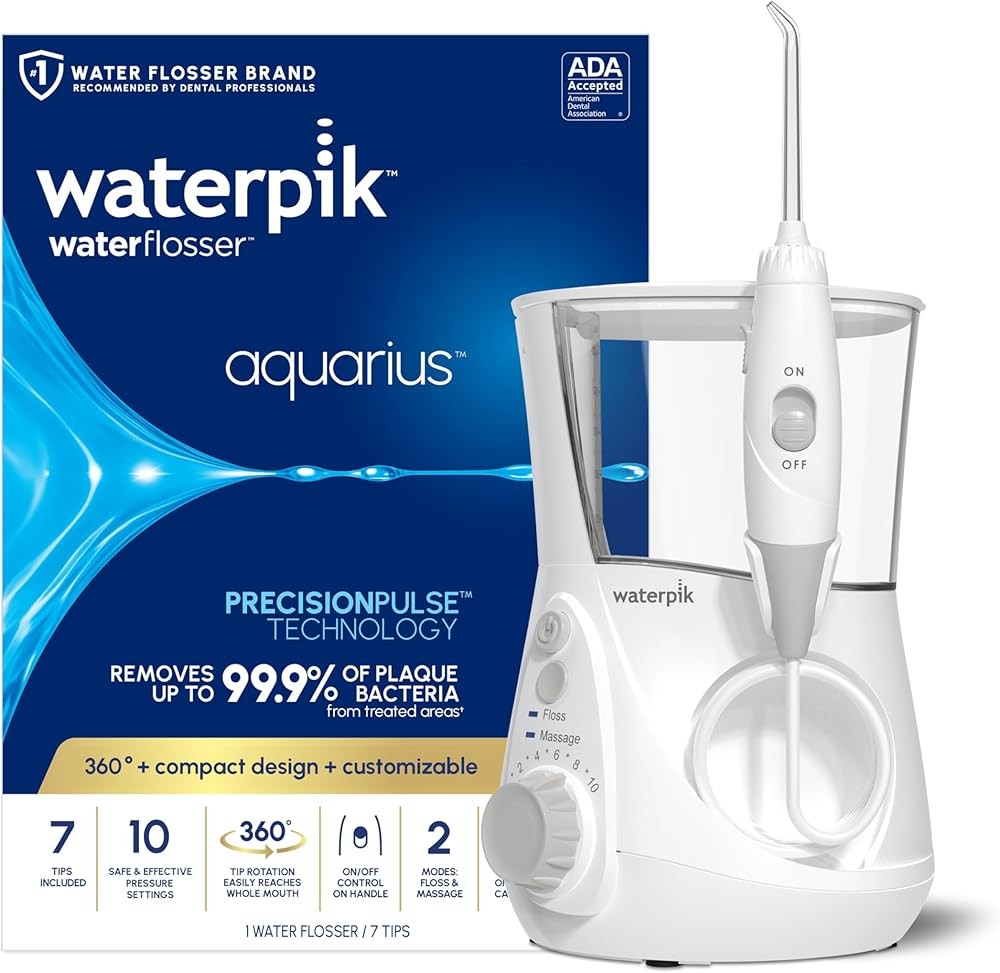
Waterpik Aquarius Water Flosser WP-660
Check Price on AmazonAs an Amazon Associate we earn from qualifying purchases.
The Waterpik Aquarius WP-660 represents the gold standard in water flosser technology, combining clinical validation with practical features that serve households with diverse oral health needs. This countertop model delivers 1,400 water pulses per minute across 10 pressure settings ranging from 10 to 100 PSI, providing unmatched customization for users from children with sensitive gums to adults seeking maximum cleaning power.
The generous 22-ounce reservoir eliminates mid-session refilling for most users, while the array of seven included tips addresses virtually any dental situation. The Classic Jet Tips handle general interdental cleaning, while specialized tips target orthodontic appliances, periodontal pockets, implants, and dental bridges. The built-in tip storage compartment keeps accessories organized and hygienic, with color-coded rings allowing family members to identify their personal tips.
Clinical research specifically testing this technology demonstrates substantial benefits. Studies show Waterpik water flossers reduce whole mouth gingivitis by 63.4% after four weeks, outperforming competing technologies by 80% for inflammation reduction and 70% for plaque removal. The pulsating water stream penetrates below the gumline to disrupt bacterial biofilm and flush debris from the gingival sulcus where traditional brushing cannot reach.
The digital control panel displays your selected pressure level, making it easy to return to your preferred setting each time. Three modes—Floss, Massage, and Custom—allow you to tailor the experience. The on/off switch integrated into the handle lets you pause water flow while repositioning between quadrants, avoiding splashing accidents.
The device has earned the ADA Seal of Acceptance, indicating it has undergone clinical testing demonstrating safety and effectiveness when used as directed. The 3-year warranty reflects manufacturer confidence in build quality and provides longer protection than most competing models.
Key specifications:
- 10 pressure settings (10-100 PSI)
- 1,400 pulses per minute
- 22 oz (650ml) reservoir capacity
- 7 specialized tips included
- 3 operating modes
- On-handle pause control
- Built-in tip storage
- 3-year warranty
- ADA Seal of Acceptance
Ideal users: Families sharing one device, users with diverse dental work requiring specialized tips, those with adequate bathroom counter space, anyone seeking the most clinically validated option with maximum pressure customization.
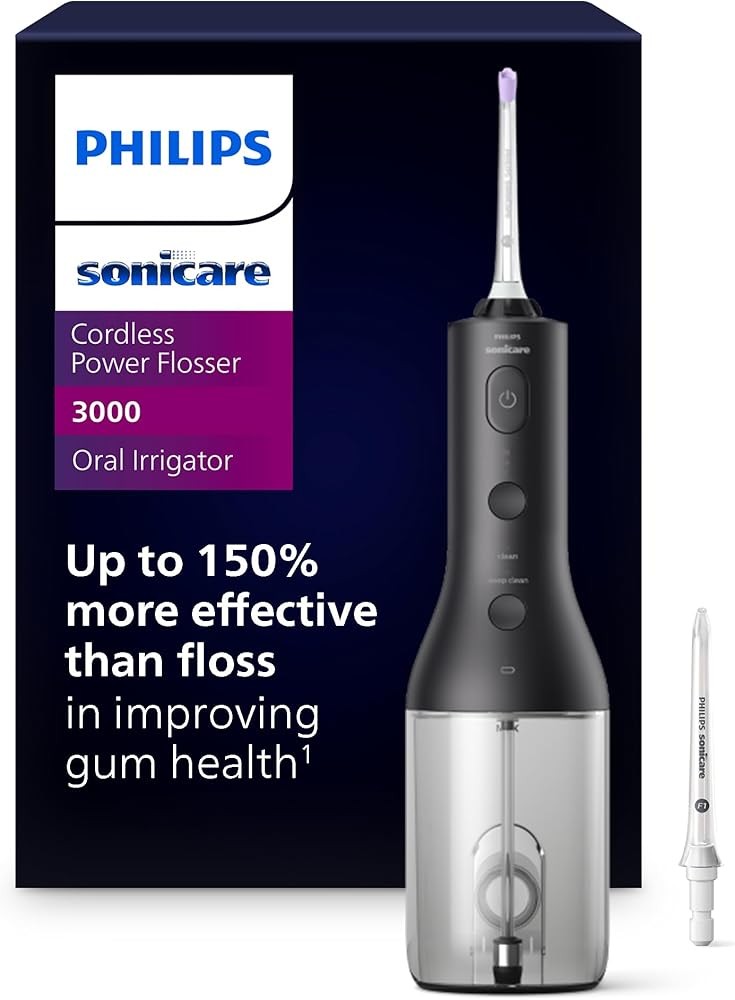
Philips Sonicare Cordless Power Flosser 3000
Check Price on AmazonAs an Amazon Associate we earn from qualifying purchases.
The Philips Sonicare Cordless Power Flosser 3000 brings innovative Quad Stream technology to a compact, portable format ideal for users prioritizing convenience and modern design. Unlike traditional single-jet water flossers, this device delivers four wide spray angles from each nozzle, theoretically covering more tooth surface area with each pass between teeth.
The sleek cordless design eliminates the counter footprint of traditional water flossers, making it ideal for small bathrooms, apartments, or travel. The rechargeable battery provides approximately 30 uses per charge, while the 250ml integrated reservoir keeps the overall size compact enough to store in a drawer or medicine cabinet when not in use.
Two flossing modes provide versatility—Clean mode for standard interdental cleaning and Deep Clean mode for more intensive sessions when you need extra attention to problem areas. Combine either mode with three pressure levels to create six different cleaning combinations matching your preferences and gum sensitivity.
The IPX7 waterproof rating means you can safely use it in the shower, which many users find more convenient than standing at the sink. Shower use eliminates concerns about water splashing on counters or mirrors while incorporating water flossing into an existing routine. The device is fully submersible for easy rinsing and cleaning.
The Quad Stream technology differentiates this Sonicare model from older Air Floss devices. While Air Floss used quick air-powered water bursts, the Power Flosser 3000 delivers continuous water flow through four angled streams simultaneously. This wider coverage pattern potentially speeds up the flossing process compared to single-jet devices that require more precise positioning at each tooth.
Philips backs the device with a 2-year warranty, standard for their cordless oral care products. The company’s reputation for quality electric toothbrushes extends to this water flosser line, though the Power Flosser 3000 is a newer entry without the decades of clinical research supporting Waterpik models.
Key specifications:
- Quad Stream nozzle technology with four wide spray angles
- 250ml integrated water reservoir
- 3 pressure intensity levels
- 2 flossing modes (Clean, Deep Clean)
- Rechargeable battery with ~30 uses per charge
- IPX7 waterproof rating (shower safe)
- Compact cordless design
- 2 nozzles included with color coding
- 2-year warranty
Ideal users: Travelers, users with limited bathroom counter space, those preferring shower use, individuals wanting simplified operation without extensive settings, anyone seeking a premium cordless option from an established oral care brand.
The Waterpik Cordless Advanced 2.0 WP-580 delivers the clinically-proven benefits of Waterpik’s pulsating water technology in a travel-ready cordless format. This rechargeable device maintains the 1,400 pulses per minute that research shows effectively disrupts plaque biofilm and reduces gingival inflammation, while eliminating the counter space requirements of traditional models.
The 207ml (7 oz) reservoir is integrated into the handheld unit, creating a compact design that fits easily in luggage with the included travel bag. The waterproof construction with IPX7 rating allows safe shower use—convenient for users who prefer to water floss during their shower routine rather than at the sink. The device can be fully rinsed under running water for easy cleaning.
Two pressure settings—normal (approximately 75 PSI) and gentle (approximately 45 PSI)—accommodate users with different gum sensitivity levels. While not as extensive as the 10 settings on the countertop Aquarius model, these two options cover the essential range from sensitive gums to standard cleaning power. The settings are easily toggled with a simple switch on the handle.
Four tip varieties are included: two Classic Jet Tips for general use, plus specialized Orthodontic, Plaque Seeker, and Pik Pocket tips. This selection addresses the most common specialized needs while keeping the package compact for travel. The tips conveniently store in the handle with a rotating mechanism to access each tip.
The rechargeable battery provides 45+ seconds of continuous runtime per charge—sufficient for one thorough flossing session. The global voltage compatibility (100-240V) makes it ideal for international travel, requiring only an outlet plug adapter rather than a voltage converter. The magnetic charger attaches securely and charges the device in approximately 4 hours.
Like the countertop Aquarius model, the WP-580 carries the ADA Seal of Acceptance and is backed by Waterpik’s clinical research demonstrating effectiveness for plaque removal and gingivitis reduction. The 2-year warranty is standard for cordless models where battery lifespan limits overall device longevity.
Key specifications:
- 1,400 pulses per minute (same as countertop Waterpik models)
- 207ml (7 oz) reservoir capacity
- 2 pressure settings (normal ~75 PSI, gentle ~45 PSI)
- 4 tips included (2 Classic, Orthodontic, Plaque Seeker, Pik Pocket)
- Rechargeable battery with 45+ seconds runtime per charge
- IPX7 waterproof rating (shower safe)
- Magnetic charging system
- Global voltage compatibility (100-240V)
- Includes premium travel bag
- ADA Seal of Acceptance
- 2-year warranty
Ideal users: Frequent travelers, users wanting Waterpik’s proven technology in cordless format, those preferring shower flossing, anyone with limited bathroom counter space, individuals needing specialized tips but in a portable device.
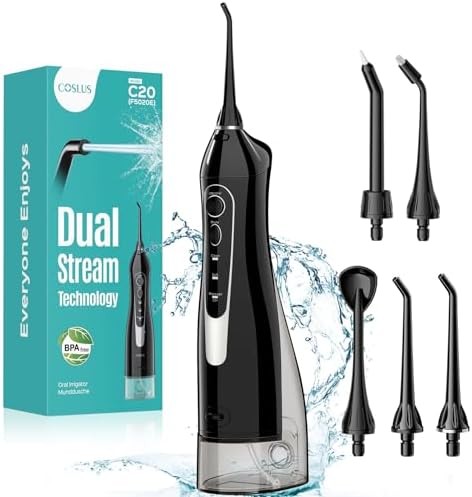
COSLUS Water Dental Flosser C20
Check Price on AmazonAs an Amazon Associate we earn from qualifying purchases.
The COSLUS C20 demonstrates that effective water flossing technology is accessible at budget-friendly prices, delivering 1,400-1,800 pulses per minute in a cordless package for under $30. This makes interdental cleaning with pulsating water technology available to students, young adults, first-time users, or anyone prioritizing value.
The 300ml water tank is notably larger than many competing cordless models, including the Sonicare Power Flosser 3000 (250ml) and Waterpik WP-580 (207ml). This generous capacity often eliminates the need for mid-session refilling, providing a practical advantage over more expensive cordless alternatives. The tank detaches for easy filling and cleaning.
Three pressure modes—normal, soft, and pulse—provide adequate range for different gum sensitivity levels and cleaning preferences. The pulse mode alternates between high and low pressure to massage gums while cleaning, similar to the massage mode on premium Waterpik models. The modes are easily selected via a single button on the handle.
An impressive eight tips are included: four classic jet tips for family sharing, three orthodontic tips, and one periodontal tip. This extensive assortment exceeds what many premium brands include in the box, providing excellent value. Color-coded rings help family members identify their personal tips for hygienic sharing.
The IPX7 waterproof rating allows safe shower use and easy cleaning under running water. The rechargeable battery advertises 21-30 days of use per charge, though actual runtime depends on session length and pressure settings used. The USB charging cable provides flexibility for charging via computer, power bank, or wall adapter.
A travel bag is included for portability, and the compact cordless design fits easily in luggage. While not built to the same durability standards as Waterpik or Philips products, the COSLUS C20 provides a low-risk entry point for users testing whether they’ll actually use a water flosser before investing in premium models.
Key specifications:
- 1,400-1,800 pulses per minute
- 300ml detachable water tank (larger than many premium cordless models)
- 3 pressure modes (normal, soft, pulse)
- 8 tips included (4 classic, 3 orthodontic, 1 periodontal)
- Rechargeable battery with 21-30 days per charge (claimed)
- IPX7 waterproof rating (shower safe)
- USB charging cable
- Travel bag included
- 1-year warranty
Ideal users: Budget-conscious consumers, first-time water flosser users testing the concept, students or young adults, households wanting multiple devices for different bathrooms, travelers wanting an inexpensive backup device, families needing multiple tips for sharing.
Frequently Asked Questions
Is Waterpik or Sonicare better for gum health?
Research shows Waterpik water flossers are significantly more effective than Sonicare Air Floss devices for reducing gingival bleeding and gingivitis. A randomized controlled trial found Waterpik was 80% more effective for whole mouth gingivitis reduction and 54% more effective for bleeding reduction compared to Sonicare Air Floss Pro after four weeks of use. The continuous pulsating water stream appears to disrupt bacterial biofilm more thoroughly than air-powered bursts, particularly along the gumline where inflammation typically begins.
What’s the main difference between Waterpik and Sonicare flossing technology?
Waterpik uses pulsating water stream technology that delivers 1,200-1,400 pulses per minute to flush debris and bacteria from between teeth and below the gumline. Sonicare Power Flosser uses Quad Stream technology with four wide spray angles that cover more surface area, while older Air Floss models use air-powered micro-droplet bursts. The fundamental difference is continuous pulsating water flow versus quad-angled spray or air-powered bursts.
Can Sonicare Power Flosser replace traditional floss?
Both Waterpik and Sonicare power flossers can serve as effective alternatives to traditional string floss for most people. Clinical studies show water flossers reduce bleeding on probing by 56-81% compared to interdental brushes and traditional floss. However, some extremely tight spaces may still benefit from occasional string floss use, and you should follow your dentist’s specific recommendations based on your individual dental anatomy.
Which is better for braces: Waterpik or Sonicare?
Both devices work well for orthodontic patients, but Waterpik has more published research supporting its effectiveness with braces and offers specialized orthodontic tips designed to clean around brackets and wires. The pulsating water action can reach areas where manual brushing struggles. A study with lingual bracket patients found 96.9% of users found water flossers helpful for cleaning around orthodontic appliances, though measured clinical outcomes didn’t differ significantly from careful manual brushing alone.
How do Waterpik and Sonicare compare for plaque removal?
Clinical trials show Waterpik water flossers remove significantly more plaque than Sonicare Air Floss models. One study found Waterpik was 70% more effective for whole mouth plaque removal (50.9% reduction vs 30%), 60% better for approximal areas between teeth (76.7% vs 48%), and more than three times as effective for marginal areas along the gumline compared to Sonicare Air Floss after four weeks of daily use.
Are cordless Waterpik and Sonicare models as effective as countertop versions?
Both brands offer cordless models that provide effective interdental cleaning based on the same fundamental technology—pressurized water disrupting biofilm. Countertop models typically have larger reservoirs, more pressure settings, and unlimited runtime from plug-in power, but cordless models delivering adequate pressure (45+ PSI) should achieve similar clinical benefits when used properly. The most important factor is consistent daily use with correct technique regardless of model type.
Which is easier to use: Waterpik or Sonicare Power Flosser?
User preference varies, but Sonicare Power Flosser models are generally more compact and easier to maneuver with simplified controls (3 pressure levels vs 10 for Waterpik Aquarius). Waterpik countertop models require more counter space but offer larger reservoirs eliminating mid-session refilling. Both have learning curves of about 7-10 days before use becomes routine. Research shows 96.9% of water flosser users find the devices helpful once they develop proper technique.
Do Waterpik and Sonicare work for sensitive gums?
Both devices offer multiple pressure settings to accommodate sensitive gums. Start with the lowest pressure setting and gradually increase as your gums become healthier. Water flossing can actually improve gum sensitivity over time by reducing inflammation—clinical studies show significant improvements in gingival health within 2-4 weeks of consistent use. Initial bleeding often indicates existing inflammation rather than damage from the device.
What’s the cost difference between Waterpik and Sonicare models?
Waterpik models range from $29 for basic cordless units to $80 for advanced countertop models like the Aquarius WP-660 ($59 typically). Sonicare Power Flosser 3000 costs around $79. Long-term costs including tip replacements average $44/year for Waterpik Aquarius over 5 years, $56/year for Sonicare over 3 years (battery lifespan), and $30/year for budget models over 2 years. Premium models cost more initially but may offer better long-term value through greater longevity.
Can I use mouthwash in Waterpik or Sonicare flossers?
Most manufacturers recommend using only water in power flossers to avoid potential damage to internal components from antibacterial agents or alcohol in mouthwash. If you want mouthwash benefits, rinse with mouthwash after water flossing rather than adding it to the reservoir. Some Waterpik models specifically state you can use diluted mouthwash (mixed 1:1 with water), but check your device manual first to avoid voiding the warranty.
Our Top Recommendations
After analyzing clinical research and product specifications, the Waterpik Aquarius WP-660 emerges as the best overall choice for most households. The extensive clinical validation demonstrating 80% superior gingivitis reduction and 70% better plaque removal compared to Sonicare Air Floss, combined with 10 pressure settings and seven specialized tips, provides unmatched versatility. The 3-year warranty and ADA Seal of Acceptance offer confidence in long-term reliability and effectiveness. At approximately $59, it delivers exceptional value for families or individuals with diverse dental needs.
For users prioritizing portability without compromising Waterpik’s proven technology, the Waterpik Cordless Advanced 2.0 WP-580 delivers the same 1,400 pulses per minute in a travel-ready format with IPX7 waterproof rating for shower use. The included specialized tips and magnetic charging system justify the $79 price for frequent travelers.
The Sonicare Power Flosser 3000 represents the best option for users who prefer Philips brand quality in a sleek, compact design. The innovative Quad Stream technology and simplified interface appeal to users wanting modern design and easy operation, though the higher $79 price requires accepting less clinical research validation compared to Waterpik models.
Budget-conscious consumers and first-time users should consider the COSLUS C20 at under $30. While lacking the clinical backing of premium brands, it delivers adequate pressure with an impressive 300ml reservoir and eight included tips, providing low-risk entry into water flossing with minimal financial commitment.
Regardless of which device you choose, the research clearly shows that consistent daily use with proper technique matters more than minor specification differences. Both Waterpik and Sonicare technologies significantly outperform traditional flossing and no interdental cleaning at all. The best water flosser is the one you’ll actually use every day.
Facebook | X | YouTube | Pinterest
Conclusion
The choice between Waterpik and Sonicare power flossers ultimately depends on your specific priorities—clinical validation versus modern design, countertop capacity versus cordless convenience, budget constraints versus premium features. However, the research evidence clearly favors Waterpik’s pulsating water stream technology for measurable improvements in gum health and plaque removal.
Multiple randomized controlled trials consistently demonstrate that Waterpik water flossers achieve superior results compared to Sonicare Air Floss models across all measured parameters. The 80% greater effectiveness for gingivitis reduction, 70% better whole mouth plaque removal, and particularly dramatic improvements in hard-to-reach lingual and marginal areas provide compelling evidence for choosing Waterpik when gum health is the primary concern.
The newer Sonicare Power Flosser 3000 with Quad Stream technology addresses some limitations of older Air Floss models and may perform better in head-to-head comparisons, though research specifically testing this newer technology against Waterpik remains limited. The compact cordless design, sleek aesthetics, and simplified operation appeal to users valuing convenience and modern product design over maximum clinical validation.
For most users with gingivitis, bleeding gums, or dental work requiring diligent oral hygiene, the Waterpik Aquarius WP-660 provides the best combination of proven effectiveness, versatility with seven specialized tips, and value with its 3-year warranty. Families sharing one device particularly benefit from the large reservoir and extensive pressure customization.
Travelers, users with limited bathroom space, or those preferring shower use should consider cordless options from our best cordless water flosser guide. The Waterpik WP-580 maintains the company’s clinical backing in portable format, while the Sonicare Power Flosser 3000 offers premium cordless convenience with innovative quad-stream technology. Budget models like the COSLUS C20 make water flossing accessible to users with financial constraints or those testing whether they’ll maintain the daily habit.
The most important takeaway from clinical research is that any water flosser used consistently with proper technique provides substantial benefits over traditional flossing or no interdental cleaning. Studies show significant improvements in gingival bleeding and inflammation within just two weeks, with continued benefits through four weeks and beyond. The device you’ll actually use daily is more valuable than the theoretically optimal device gathering dust in your cabinet.
Start with the lowest pressure setting regardless of which device you choose, allowing your gums to adapt over the first week. Develop a systematic approach to ensure you clean between all teeth, angling the tip toward the gumline rather than just spraying water straight between teeth. Give yourself 7-10 days of daily use before judging effectiveness—initial bleeding typically indicates existing inflammation that will improve with consistent use rather than damage from the device.
Pairing a water flosser with the best electric toothbrush creates a comprehensive oral hygiene system. Water flossers work by mechanically disrupting bacterial biofilm and flushing debris from below the gumline where toothbrush bristles cannot reach. This removes plaque before it mineralizes into tartar and disrupts bacteria before they trigger the inflammatory cascade leading to periodontal disease. Research shows that water flossers create favorable shifts in the oral microbiome, increasing beneficial commensal bacteria while reducing periodontal pathogens.
Whether you choose Waterpik’s extensive clinical validation, Sonicare’s innovative design, or a budget alternative to get started affordably, the decision to add interdental cleaning to your daily routine matters far more than subtle differences between premium brands. Both technologies significantly outperform traditional flossing for most users, making water flossing one of the most effective investments you can make in long-term oral health.
Related Reading
- Best Water Flosser
- Best Electric Toothbrush
- Best Cordless Water Flosser
- Water Flosser for Braces
- Water Flosser for Gum Disease
- Waterpik Cordless vs Countertop
- Tongue Scraper Benefits
References
Sharma NC, Lyle DM, Qaqish JG, Schuller R. Comparison of two power interdental cleaning devices on the reduction of gingivitis. The Journal of clinical dentistry. 2012;23(1):22-7. PMID: 22435321.
Goyal CR, Lyle DM, Qaqish JG, Schuller R. Efficacy of Two Interdental Cleaning Devices on Clinical Signs of Inflammation: A Four-Week Randomized Controlled Trial. The Journal of clinical dentistry. 2015;26(2):55-60. PMID: 26349127.
Goyal CR, Lyle DM, Qaqish JG, Schuller R. Comparison of Water Flosser and Interdental Brush on Reduction of Gingival Bleeding and Plaque: A Randomized Controlled Pilot Study. The Journal of clinical dentistry. 2016;27(3):61-65. PMID: 28390208.
van der Weijden F, Slot DE, van der Sluijs E, Hennequin-Hoenderdos NL. The efficacy of a rubber bristles interdental cleaner on parameters of oral soft tissue health-a systematic review. International journal of dental hygiene. 2022;20(1):3-18. PMID: 33630360.
Hohoff A, Stamm T, Kühne N, Wiechmann D, Haufe S. Effects of a mechanical interdental cleaning device on oral hygiene in patients with lingual brackets. The Angle orthodontist. 2003;73(5):579-87. PMID: 14580027.
Tyler D, Kang J, Goh HH. Effectiveness of Waterpik® for oral hygiene maintenance in orthodontic fixed appliance patients: A randomised controlled trial. Journal of orthodontics. 2023;50(3):294-302. PMID: 37203873.
Vogel M, Sener B, Roos M, Attin T, Schmidlin PR. Interdental cleaning and gingival injury potential of interdental toothbrushes. Swiss dental journal. 2014;124(12):1290-301. PMID: 25503477.
Ge Y, Bamashmous S, Mancinelli-Lyle D, Zadeh M, Mohamadzadeh M. Interdental oral hygiene interventions elicit varying compositional microbiome changes in naturally occurring gingivitis: Secondary data analysis from a clinical trial. Journal of clinical periodontology. 2024;51(2):186-201. PMID: 38088457.
Gandhi G, Masanam BSL, Nair AS, Semani N, Chopra A. Efficacy of oral irrigators compared to other interdental aids for managing peri-implant diseases: a systematic review. BDJ open. 2025;11(1):8. PMID: 39880827.
Mancinelli-Lyle D, Qaqish JG, Goyal CR, Schuller R. Effectiveness of a sonic-flosser toothbrush with different size brush heads and manual toothbrush plus dental floss on plaque, gingival bleeding and inflammation in adults with naturally occurring gingivitis: A 4-week randomized controlled trial. International journal of dental hygiene. 2023;21(3):649-658. PMID: 36951212.
Recommended Products