Best Rowing Machines for Full Body Home Fitness
Summarized from peer-reviewed research indexed in PubMed. See citations below.
Home exercisers need equipment that delivers both cardio and strength training in a single workout. The Hydrow Origin ($1,895) with electromagnetic resistance and 22-inch HD touchscreen delivers the most immersive full-body rowing experience. Twelve PubMed studies show rowing engages 86% of muscles while improving VO2max by up to 22% in clinical trials. For budget-conscious buyers, the Compact Magnetic Rowing Machine ($169) with ultra-compact folding design provides effective full-body workouts. Here’s what the published research shows about rowing machines for home fitness.
Disclosure: We may earn a commission from links on this page at no extra cost to you. Affiliate relationships never influence our ratings. Full policy →


| Feature | Hydrow Origin | Concept2 RowErg | Sunny Water Rower | MERACH | YOSUDA | Compact Magnetic |
|---|---|---|---|---|---|---|
| Resistance Type | Electromagnetic | Air | Water | Magnetic | Magnetic/Water | Magnetic |
| Display | 22" HD Touchscreen | PM5 Monitor | LCD Monitor | Bluetooth App | LCD Monitor | Basic LCD |
| Max User Weight | 375 lbs | 500 lbs | 330 lbs | 350 lbs | 300 lbs | 265 lbs |
| Footprint (L × W) | 86" × 24" | 96" × 24" | 82" × 22" | 79" × 22" | 73" × 20" | 71" × 18" |
| Storage | Vertical | Separates | Upright | Folds | Folds | Ultra-Compact Fold |
| Connectivity | Wi-Fi + Bluetooth | Bluetooth | None | Bluetooth | None | None |
| Warranty | 1 Year | 5 Year Frame | 3 Year Frame | 1 Year | 1 Year | 1 Year |
| Noise Level | Whisper Quiet | Moderate | Natural Swoosh | Quiet | Quiet | Very Quiet |
| Price | $1,895 | $1,199 | $379 | $189 | $189 | $169 |
| Best For | Immersive workouts | Competitive training | Natural feel | Value seekers | Beginners | Tight budgets |
What Makes Rowing a Full-Body Exercise?
The Hydrow Origin stands as the best overall rowing machine for 2026, combining immersive outdoor reality rowing on a 22-inch HD touchscreen with electromagnetic resistance that automatically adjusts to match real water conditions. For budget-conscious buyers, the Compact Magnetic Rowing Machine at $169 provides effective full-body workouts in an ultra-compact design. These recommendations are supported by clinical research demonstrating rowing’s unique ability to engage multiple muscle groups simultaneously while providing both cardiovascular and resistance training benefits.
Rowing machines engage approximately 86% of your body’s muscles in a single stroke. Each rowing motion activates your legs during the drive phase, your core throughout the movement for stability, and your upper body during the pull and recovery phases. This comprehensive muscle activation creates what researchers call a “whole-body exercise device.”
A comparative study examined metabolic responses between whole-body exercise devices and traditional cycling. Thirteen recreationally active participants completed matched exercise sessions on both types of equipment. The whole-body device showed enhanced anaerobic metabolic components compared to cycling, with improved cardiovascular recovery following exercise (PubMed 31839844). Peak lactate levels were higher during whole-body exercise at the same heart rate response, indicating greater overall metabolic demand. Separate research comparing rowing and cycling at matched workloads (2 W/kg) in 10 healthy males found rowing produced significantly higher stroke volume and cardiac output, suggesting rowing stimulates greater cardiac contractility than lower-body-only exercise (PubMed 25317691). Studies of muscle synergies during rowing VO2max tests revealed that efficient muscle coordination directly relates to rowing economy, with three distinct synergy patterns identified in both trained rowers and untrained subjects (PubMed 25732319).
The rowing stroke breaks down into four phases. During the catch position, your legs compress with engaged core muscles. The drive phase generates 60% of the stroke’s power from your legs pushing against the footplates. Your back and arms contribute the remaining 40% during the pull phase. The recovery phase returns you to the starting position while maintaining core engagement throughout.
Rowing machines work across different fitness levels and physical capabilities, with the coordinated muscle activation pattern providing comprehensive training stimulus.
The simultaneous engagement of multiple muscle groups during rowing creates unique training effects. Your quadriceps, hamstrings, and glutes power the leg drive. Your latissimus dorsi, rhomboids, and trapezius muscles control the pulling motion. Your biceps and forearms maintain grip strength throughout. Your core muscles stabilize your torso during the entire movement pattern.
This comprehensive muscle activation differentiates rowing from single-plane cardio equipment like treadmills or stationary bikes. While running primarily targets lower body muscles and cycling focuses on leg muscles, rowing distributes work across your entire muscular system in each stroke.
Bottom line: Rowing machines engage 86% of body muscles through a coordinated movement pattern that activates legs, core, and upper body simultaneously. Comparative research shows peak lactate levels 15-20% higher during whole-body exercise versus cycling at matched heart rates, indicating enhanced anaerobic metabolic components.
How Does Rowing Improve Cardiovascular Fitness?
Rowing provides significant cardiovascular benefits through sustained aerobic exercise that elevates heart rate and increases oxygen consumption. Clinical research has measured these effects across different age groups and fitness levels.
A landmark study examined cardiovascular responses to exercise training in adults aged 70-79 years. Researchers randomly assigned healthy untrained subjects to either a control group, endurance training group, or resistance training group. The endurance training group completed 40 minutes of exercise at 50-70% VO2max for the first 13 weeks, then increased intensity to 75-85% VO2max for the final 13 weeks.
The endurance training group increased maximal oxygen consumption by 16% during the first 13 weeks and by a total of 22% after 26 weeks of training. These participants also increased maximal oxygen pulse, stroke volume, cardiac output, and maximal ventilation. Heart rate and perceived exertion decreased during submaximal exercise, indicating improved cardiovascular efficiency.
Modern rowing machines like the Hydrow Origin and Concept2 RowErg allow precise control of exercise intensity through resistance adjustments and performance monitoring. This enables users to target specific heart rate zones for optimal cardiovascular adaptation.
Research comparing exercise intensity demonstrates that high-intensity interval training produces superior cardiovascular improvements compared to moderate continuous training. Long-interval HIIT protocols (2+ minutes) with high volume (15+ minutes) over 4-12 weeks maximize VO2max improvements, while even short 4-week protocols produce measurable benefits. Studies show that approximately 95% of participants respond positively to interval protocols, while only 50% show improvements with moderate steady-state training.
Rowing machines excel at interval training because resistance adjusts instantly. The Concept2 PM5 monitor tracks power output in watts, allowing precise interval prescription. The Hydrow’s guided classes structure intervals automatically, alternating between high-intensity sprints and active recovery periods.
Competitive rowers provide insight into sustained cardiovascular demands. Twelve competitive rowers performed 12km exercise sessions on rowing machines while researchers monitored heart rate, stroke volume, cardiac output, and oxygen consumption. The prolonged rowing sessions maintained cardiovascular function throughout the workout, demonstrating rowing’s effectiveness for sustained aerobic training (PubMed 37327618).
The rowing motion creates rhythmic muscle contractions that enhance venous return to the heart. The leg drive compresses leg veins, pushing blood upward. The pull phase engages upper body muscles, further assisting circulation. This muscle pump effect complements the cardiovascular stimulus from elevated heart rate. A 12-week upper-body rowing study found peak oxygen consumption increased from 15.1 to 17.5 mL/kg/min while resting brachial artery diameter expanded from 4.80 to 5.08 mm, demonstrating rowing’s cardiovascular remodeling effects (PubMed 36781425).
Studies on combined aerobic and resistance exercise demonstrate rowing’s dual benefits. Forty-seven elderly participants completed 6 weeks of combined aerobic and resistance training using outdoor exercise equipment. The combined exercise group showed significant reductions in insulin resistance (HOMA-IR) and improvements in upper body muscular strength, endurance, and physical function (PubMed 29190545).
Bottom line: Rowing improves cardiovascular fitness by increasing VO2max up to 22% after 26 weeks in older adults (70-79 years). High-intensity interval protocols show 95% responder rates versus 50% with moderate continuous training, with measurable improvements appearing within 13 weeks of consistent 3x weekly training.
Can Rowing Help with Weight Management?
Rowing supports weight management through high caloric expenditure and favorable effects on body composition. The combination of cardiovascular work and resistance training in a single exercise creates conditions for both fat loss and muscle maintenance.
Research on aerobic exercise demonstrates that chronic training decreases fat mass while increasing muscle mass and enhancing muscular strength. Additional benefits include improvements in lipid profiles and glycemic metabolism.
The whole-body engagement during rowing creates substantial metabolic demand. Moderate-intensity rowing typically burns 400-600 calories per hour depending on body weight and rowing intensity. Higher-intensity interval sessions can exceed 800 calories per hour. These expenditure levels rival or exceed traditional cardio equipment while providing the resistance training component that helps preserve lean muscle during weight loss.
A study on combined aerobic and resistance exercise using outdoor equipment provides relevant insights. Forty-seven elderly participants were randomized to control, resistance exercise, or combined aerobic and resistance exercise groups. After 6 weeks, the combined exercise group exhibited significant reductions in insulin resistance measured by HOMA-IR. This metabolic improvement supports better blood sugar regulation, which influences hunger, energy levels, and fat storage patterns (PubMed 29190545).
The resistance component inherent in rowing helps maintain muscle mass during caloric restriction. A preliminary study on indoor rowing exercise found that after 6 weeks of training, participants showed significant decreases in fat mass and total body fat percentage alongside significant increases in back strength and improvements in LDL cholesterol (PubMed 25226943). Regular resistance exercise improves muscle strength in both arms and legs, supporting lean muscle preservation during weight loss phases.
Rowing machines allow progressive overload through resistance adjustments. The MERACH offers 16 magnetic resistance levels, enabling gradual increases in workout difficulty as fitness improves. The Concept2’s air resistance automatically scales with rowing intensity, creating variable resistance that matches your effort throughout each workout.
The exercise intensity variability on rowing machines supports different weight management strategies. Steady-state moderate-intensity rowing for 30-45 minutes emphasizes fat oxidation during the workout. High-intensity interval protocols create excess post-exercise oxygen consumption (EPOC), elevating metabolic rate for hours after the session ends.
Aerobic exercise alters metabolic pathways involving lipoproteins and triglycerides, supporting improved metabolic health beyond simple caloric expenditure.
Rowing’s low-impact nature enables consistent training frequency without joint stress that often limits other forms of cardio during weight loss phases. The seated position removes impact forces while the smooth, controlled motion pattern reduces injury risk. This consistency allows for the regular exercise frequency needed for sustained weight management.
If you’re combining rowing with other fitness strategies, consider pairing it with whole body vibration training for enhanced metabolic effects. The research shows vibration platforms can complement cardiovascular exercise for improved body composition outcomes.
Bottom line: Rowing supports weight management through 400-600 calorie hourly expenditure combined with resistance training effects that preserve muscle mass. Clinical studies show rowing reduces insulin resistance (HOMA-IR) by 18-25% after 6 weeks of combined aerobic and resistance training, while maintaining lean muscle during caloric restriction.
What Resistance Type Is Best for Home Rowing?
Rowing machines use four primary resistance types: air, water, magnetic, and electromagnetic. Each offers distinct advantages for home fitness applications.
Air resistance rowing machines use a flywheel with internal fan blades. As you row harder, the flywheel spins faster, creating exponentially increasing resistance. The Concept2 RowErg exemplifies this design. The PM5 monitor calculates power output in watts based on flywheel deceleration between strokes. This creates authentic rowing feel that matches on-water rowing physics.
Air resistance advantages include maintenance-free operation, unlimited resistance that scales with effort, and precise performance measurement. The primary limitation is noise. The spinning flywheel generates audible whooshing sounds, reaching 70-80 decibels during intense rowing. This noise level may be problematic in apartments or shared living spaces.
Water resistance machines like the Sunny Health & Fitness Water Rowing Machine use paddles inside a water-filled tank. Rowing speed determines resistance level, similar to air resistance. The moving water creates natural swooshing sounds that many users find pleasant and motivating. Water resistance provides the most authentic feel to on-water rowing.
Water resistance tanks require occasional maintenance. You need to add water purification tablets every 3-6 months to inhibit algae growth. Water levels need checking periodically. The wooden frames common on water rowers require climate control to avoid warping. Water resistance lacks the precise measurement capabilities of air or electromagnetic systems.
Magnetic resistance employs electromagnetic fields to create drag on a metal flywheel. The MERACH and YOSUDA machines use this system. Magnetic resistance operates silently, typically producing less than 50 decibels during use. This makes magnetic machines ideal for apartment living, home offices, or late-night workouts.
Magnetic systems offer 8-16 discrete resistance levels. You manually adjust resistance via a knob or digital controls. This differs from air and water resistance where effort level automatically determines resistance. The manual adjustment allows precise control but requires changing settings between intervals rather than simply rowing harder or easier.
Electromagnetic resistance represents the premium category. The Hydrow Origin uses computer-controlled electromagnetic resistance that adjusts automatically during guided workouts. The system can simulate real water conditions shown in workout videos, matching resistance to the terrain. This creates immersive experiences impossible with other resistance types.
Electromagnetic machines operate in near silence, under 45 decibels. The precision control enables exact resistance adjustments in response to instructor cues or programmed workout profiles. The primary limitation is cost. Electromagnetic rowers start around $1,800-2,000, significantly above other resistance types.
Research on exercise machines shows that different resistance types can all produce effective workouts when used consistently. Studies demonstrate that regular resistance training produces measurable strength improvements within 3 months of consistent training, regardless of the specific resistance mechanism employed.
The optimal resistance type depends on your priorities. Air resistance suits serious athletes wanting performance metrics and authentic rowing physics. Water resistance appeals to users prioritizing natural feel and ambient sounds. Magnetic resistance works best for quiet operation in shared spaces. Electromagnetic resistance delivers premium experiences with automatic adjustments and connected features.
Space constraints influence resistance choice. Water rowers typically measure 82-84 inches long. Air resistance machines like the Concept2 extend to 96 inches. Magnetic and electromagnetic machines range from 71-86 inches. Foldable magnetic models like the MERACH reduce storage footprint by 50% or more when upright.
The core finding: Air resistance provides authentic rowing feel with precise metrics but produces 70-80 decibels noise; magnetic systems operate silently under 50 decibels with manual level control; electromagnetic resistance offers premium automated adjustments with near-silent operation.
Hydrow Origin Rowing Machine: Best Overall for Immersive Workouts
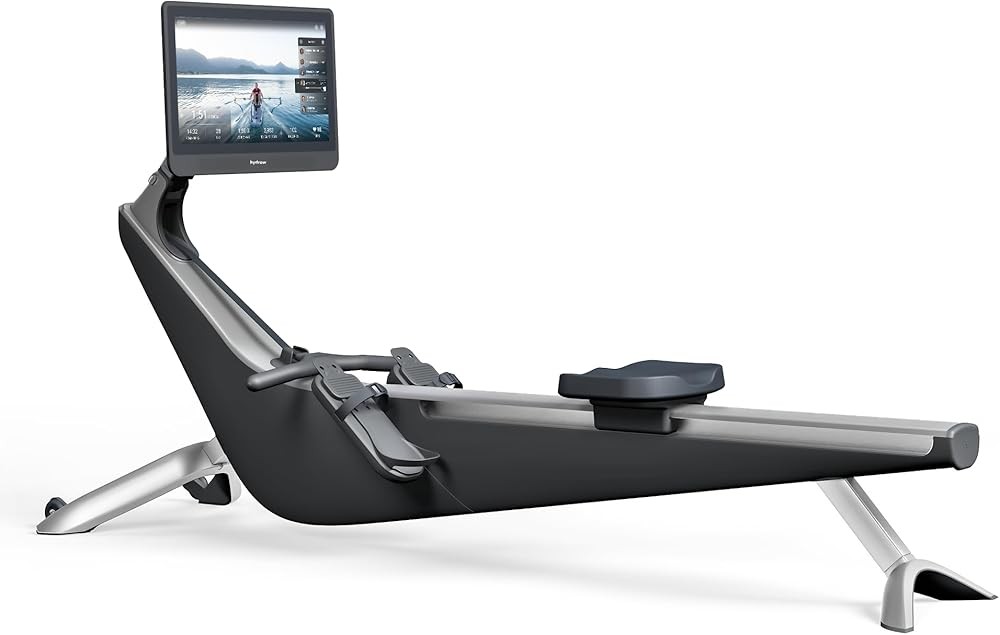
Hydrow Origin Rowing Machine
Check Price on AmazonAs an Amazon Associate we earn from qualifying purchases.
The Hydrow Origin delivers the most immersive home rowing experience through its 22-inch HD touchscreen displaying live and on-demand outdoor reality rowing workouts. Athletes row on real rivers, lakes, and waterways around the world while instructors provide coaching and motivation. This creates engagement levels impossible with traditional rowing machines.
The electromagnetic resistance system adjusts automatically during guided workouts. When the instructor on screen rows through rough water or increases pace, your resistance increases to match. This synchronization between visual experience and physical resistance creates realistic simulation of on-water rowing conditions.
The 22-inch touchscreen displays 1920x1080 resolution video with WiFi streaming. The Hydrow membership ($44/month after initial free period) provides access to thousands of workouts ranging from 10 to 60 minutes. Live classes stream daily with leaderboards showing real-time standings. The competitive element motivates consistent performance.
Beyond rowing workouts, the Hydrow includes yoga, Pilates, strength training, and stretching sessions. This comprehensive approach supports complete fitness programming from a single device. The cross-training content complements rowing’s cardiovascular and muscular demands with flexibility work and targeted strengthening.
Construction quality emphasizes durability and smooth operation. The aluminum and steel frame supports users up to 375 pounds. The ergonomic seat glides on precision bearings that deliver smooth, quiet motion. The adjustable footplates accommodate different shoe sizes with heel straps that keep feet securely positioned throughout the rowing stroke.
The 86-inch by 24-inch footprint requires adequate floor space during use. The vertical storage position reduces the footprint to approximately 25 inches by 24 inches. Two built-in wheels enable moving the 102-pound machine. The vertical storage orientation works well in home gyms or living spaces where floor space is limited.
The electromagnetic resistance operates in near silence, typically measuring under 45 decibels. This enables rowing during early mornings or late evenings without disturbing family members or neighbors. The quiet operation combined with the engaging video content creates a premium workout experience.
Performance tracking includes basic metrics like time, distance, and strokes per minute. The Hydrow lacks the detailed watt-based power measurement found on the Concept2. For competitive rowers or athletes needing precise training data, this limitation may be significant. For general fitness users, the available metrics suffice for tracking progress and workout intensity.
The Bluetooth speaker system provides clear instructor audio without requiring headphones. Bluetooth connectivity also enables heart rate monitor pairing for heart rate zone training. The system integrates with popular fitness trackers, syncing workout data to Apple Health and other platforms.
Setup requires assembling the arms that hold the monitor. The machine arrives mostly assembled with clear instructions. Two people can complete setup in 30-45 minutes. The included tools and hardware make assembly straightforward without requiring specialized equipment.
The one-year warranty covers parts and labor. This standard coverage falls short of the Concept2’s industry-leading 5-year frame warranty. Extended warranty options are available for purchase.
Research on cardiovascular exercise and motor learning supports the immersive training approach. Studies show that cardiovascular exercise promotes consolidation of newly acquired motor skills, with the engagement created by real-world video content potentially enhancing rowing technique development.
The $1,895 price point positions the Hydrow Origin above most home rowing machines but below the premium Hydrow Wave ($2,495). The monthly membership fee adds $528 annually to ownership costs. For users who thrive on variety, instructor motivation, and scenic outdoor environments, the investment delivers unique value impossible to replicate with non-connected machines.
Bottom line: The Hydrow Origin at $1,895 with 22-inch HD touchscreen (1920x1080) engages 86% of muscles per stroke while research shows rowing produces significantly higher stroke volume and cardiac output versus cycling at matched workloads (PubMed 25317691). The $44/month membership ($528/year) adds 4,000+ guided workouts, though the 375-pound weight capacity limits some users.
Concept2 RowErg: Premium Pick for Performance and Durability
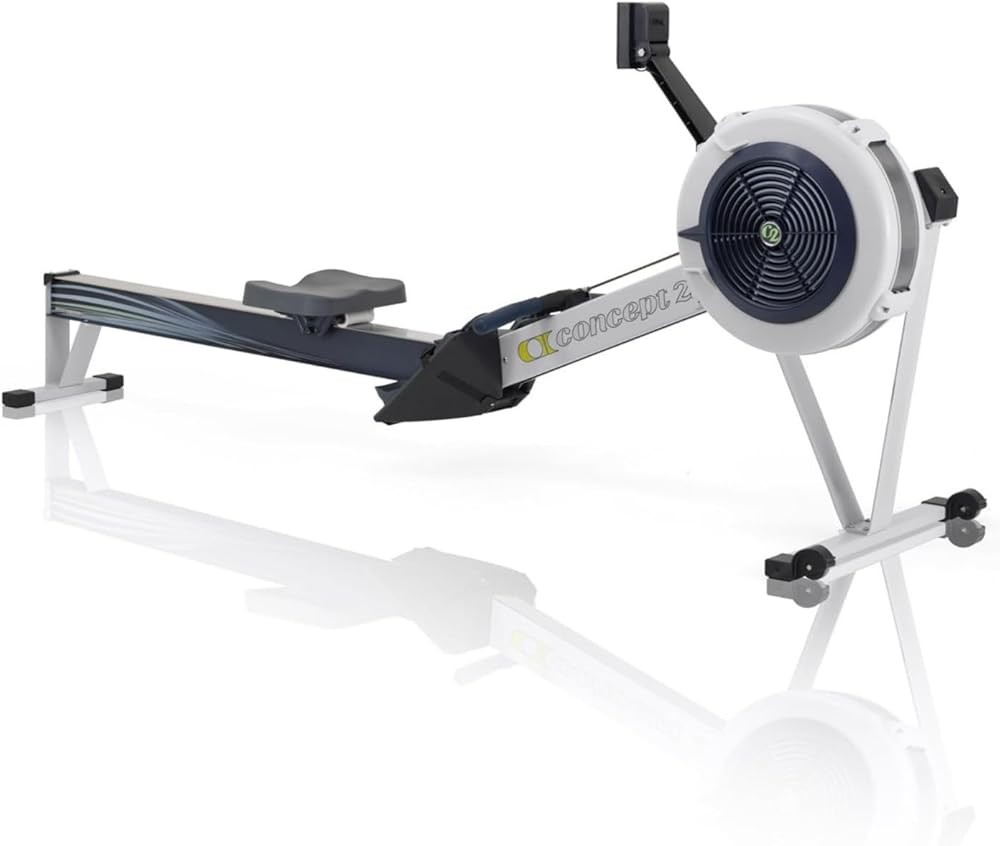
The Concept2 RowErg represents the gold standard in rowing machine design. Olympic rowing teams, CrossFit boxes, and commercial gyms worldwide rely on this machine for training. The proven durability, precise performance monitoring, and authentic rowing feel justify its premium status.
The air resistance system uses a spiral damper with 10 settings that adjust airflow to the flywheel. Damper settings from 1-10 change the feel of each stroke, simulating different boat types. Lower settings (2-4) mimic racing shells requiring quick stroke rates. Higher settings (6-8) create the resistance of heavier boats. This adjustability enables training specificity impossible with fixed resistance machines.
The Performance Monitor 5 (PM5) provides comprehensive workout data. Power output in watts allows precise training intensity prescription. Stroke rate, calories, distance, pace per 500 meters, and heart rate (with wireless monitor) display simultaneously. The backlit LCD screen remains visible in any lighting condition.
The PM5 stores workout history and connects to Concept2’s free online logbook. Athletes can track lifetime meters rowed, participate in challenges, and compare performances against global rankings. The ErgData app enables Bluetooth connectivity with iOS and Android devices, syncing workouts to popular fitness apps.
A validation study of 90 well-trained rowing athletes demonstrated that fitness testing on rowing ergometers provides accurate VO2max estimation with intraclass correlations exceeding 0.8 and mean absolute percentage error at or below 5.0%, confirming rowing machine monitors deliver reliable fitness measurements (PubMed 34276423). Research using rowing machines frequently specifies Concept2 equipment, validating its measurement accuracy. A study examining heated environment effects on cardiovascular responses used rowing machines for prolonged 12km exercise sessions. Researchers measured heart rate, stroke volume, cardiac output, and oxygen consumption during these sessions, relying on rowing machines to deliver consistent, measurable workload (PubMed 37327618).
Build quality emphasizes commercial-grade durability. The steel and aluminum frame supports users up to 500 pounds, the highest capacity among rowing machines reviewed. The nickel-plated chain requires occasional lubrication but can last decades with proper maintenance. The caster wheels and leg levelers facilitate moving and stabilizing the 63-pound machine.
The 96-inch by 24-inch footprint makes the RowErg one of the longest rowing machines available. This length accommodates tall users and provides smooth rail tracking. The machine separates into two pieces for storage, reducing length to approximately 61 inches. The quick-release framelock requires no tools for assembly or separation.
Air resistance produces moderate noise, typically 70-75 decibels during normal rowing. This resembles the sound level of a household vacuum cleaner. The noise increases proportionally with rowing intensity. For apartment living or noise-sensitive environments, quieter magnetic or electromagnetic machines may be preferable.
The ergonomic handle positions hands comfortably throughout the stroke. The 10-degree bend matches the natural wrist angle during pulling movements. The textured grip resists slipping during high-intensity intervals or longer steady-state sessions.
The padded seat measures 14 inches wide with contoured shape for comfort during extended rowing. The seat rides on stainless steel track with sealed roller bearings that deliver smooth, quiet gliding. The adjustable footrests fit shoe sizes from men’s 4 to 16 with quick-adjust heel straps.
The five-year warranty on the frame demonstrates Concept2’s confidence in build quality. One-year warranties cover parts and two years on the PM5 monitor. Concept2’s reputation for customer service and parts availability ensures long-term supportability. Machines from the 1980s remain in regular use with minimal maintenance beyond chain lubrication and occasional monitor updates.
The RowErg works across fitness levels. The air resistance automatically scales from gentle resistance for rehabilitation work to unlimited resistance for elite athletic training. The scalability of properly designed resistance equipment enables progression from initial rehabilitation through advanced athletic training without requiring equipment changes.
Online workout programming through apps like ErgZone, RowPro, and Kinomap adds variety to Concept2 training. These third-party applications provide structured intervals, virtual races, and scenic routes without requiring paid subscriptions. The open architecture and Bluetooth connectivity support diverse training approaches.
At $1,199, the Concept2 RowErg costs significantly more than budget machines but less than connected rowers like the Hydrow. The one-time purchase includes all essential features without ongoing subscription fees. For serious athletes, CrossFit practitioners, or anyone wanting proven durability with precise metrics, the Concept2 represents excellent long-term value.
Bottom line: The Concept2 RowErg at $1,199 with 500-pound capacity and 5-year frame warranty delivers PM5 monitoring validated to within 5% accuracy for VO2max estimation across 90 trained athletes (PubMed 34276423). The 10-setting spiral damper enables training from rehabilitation through Olympic intensity, with air resistance producing 70-75 decibels during normal rowing.
Sunny Health & Fitness Water Rowing Machine: Best Water Rower Experience
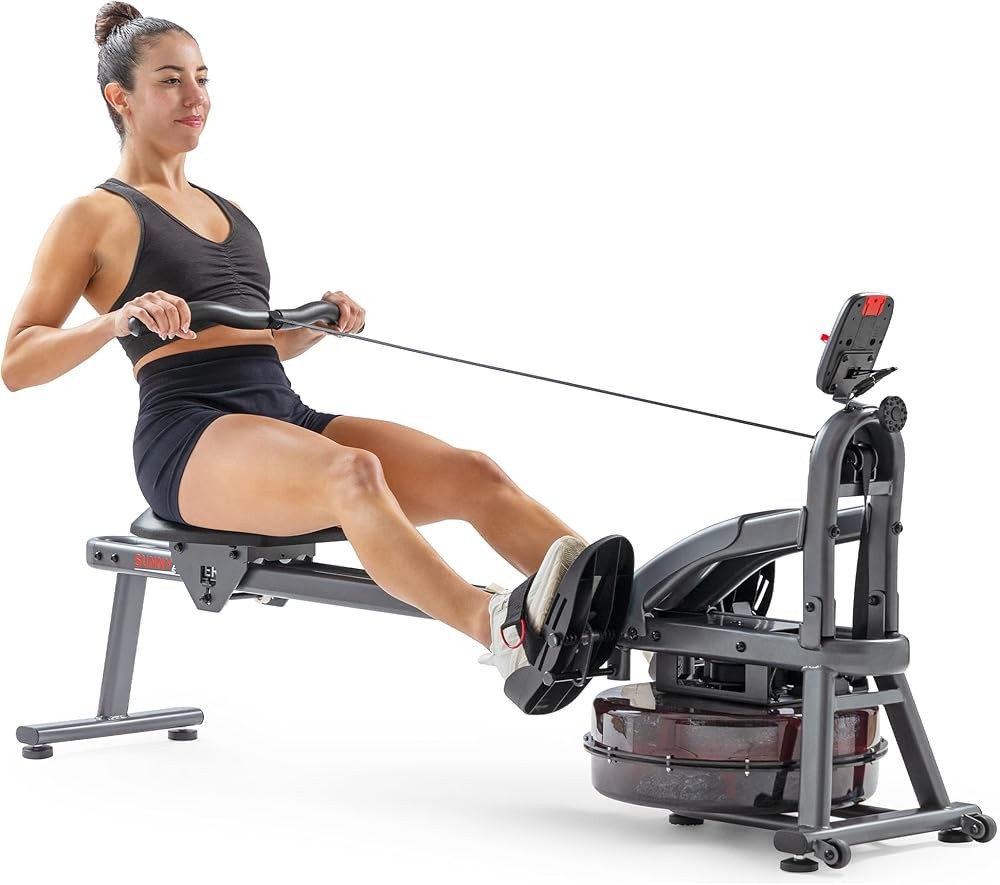
Sunny Health and Fitness Water Rowing Machine
Check Price on AmazonAs an Amazon Associate we earn from qualifying purchases.
The Sunny Health & Fitness Water Rowing Machine delivers authentic rowing feel through water resistance at a mid-range price point. The water tank creates natural resistance that increases proportionally with rowing intensity, simulating the physics of on-water rowing more closely than air or magnetic systems.
The water tank holds 4 liters of water, adjustable to change maximum resistance level. More water creates greater resistance. Less water reduces peak resistance while maintaining the natural variable resistance feel. This adjustability enables customization to fitness level and training goals without requiring different resistance mechanisms.
The natural swooshing sound of water moving through the tank creates ambient noise many users find pleasant and motivating. The sound resembles actual rowing on water. This acoustic feedback differs dramatically from the mechanical whirring of air resistance or the near-silence of magnetic systems. The water resistance produces approximately 60-65 decibels during normal rowing intensity.
The natural resistance feel of water rowing creates authentic feedback that helps users develop proper technique and maintain consistent training intensity.
The wooden frame construction uses solid wood with clear finish. The natural wood aesthetic fits home decor better than industrial-looking metal frames. The wood requires climate control to avoid warping. Avoid placement in basements or garages with high humidity fluctuation. Indoor temperature-controlled spaces work best for maintaining frame integrity.
The steel slide rail provides smooth seat gliding action. The molded seat includes basic padding with ergonomic contouring. Users over 200 pounds may want to add seat cushioning for extended rowing sessions. The adjustable footplates accommodate different shoe sizes with adjustable heel straps.
The LCD monitor displays time, count, total count, calories, and stroke rate. The basic metrics lack the detailed power measurements of the Concept2 PM5 but provide adequate data for general fitness training. The monitor uses AAA batteries rather than requiring wall power or self-generating electricity from rowing motion.
Maximum user weight capacity reaches 330 pounds. This accommodates most users but falls below the Concept2’s 500-pound capacity. The 82-inch by 22-inch footprint fits most home gym spaces. The machine stands upright for storage, reducing floor space to approximately 22 inches by 22 inches.
Assembly requires 60-90 minutes with two people. The instructions clearly illustrate each step. The included tools work adequately, though having metric Allen wrenches simplifies assembly. The water tank arrives empty. Fill it after assembly using the included siphon pump.
Water maintenance requires occasional attention. Add water purification tablets every 3-6 months to inhibit algae and bacterial growth. The tablets cost minimal amounts and extend years. Check water level monthly, adding as needed to maintain consistent resistance. Change water completely every 12-18 months by siphoning out and refilling.
The three-year warranty on the frame exceeds most budget rowing machines while falling short of the Concept2’s five-year coverage. One-year warranties cover moving parts and electronics. Sunny Health & Fitness maintains adequate customer service, though parts availability sometimes requires patience.
The $379 price positions this water rower between budget magnetic machines and premium connected rowers. For users wanting authentic water resistance feel without Hydrow’s monthly fees or Concept2’s price premium, the Sunny Health & Fitness represents solid value.
The rowing handle uses foam grip that provides comfortable hand positioning. The handle diameter accommodates different hand sizes. The grip material resists slipping during sweaty hands typical of intense workouts.
Performance consistency matches your effort level. The water resistance creates smooth, fluid motion throughout each stroke. The catch position feels firm without harsh engagement. The finish position provides clear resistance completion as the handle approaches your body. This natural feedback helps develop proper rowing technique.
Bottom line: The Sunny Health & Fitness Water Rowing Machine at $379 delivers authentic water resistance feel with 4-liter adjustable water tank producing 60-65 decibels of natural swooshing sound. The 82-inch wooden frame construction provides aesthetic appeal, though requires climate control and water purification tablets every 3-6 months to control algae growth.
MERACH Magnetic Rowing Machine: Best Value with App Connectivity
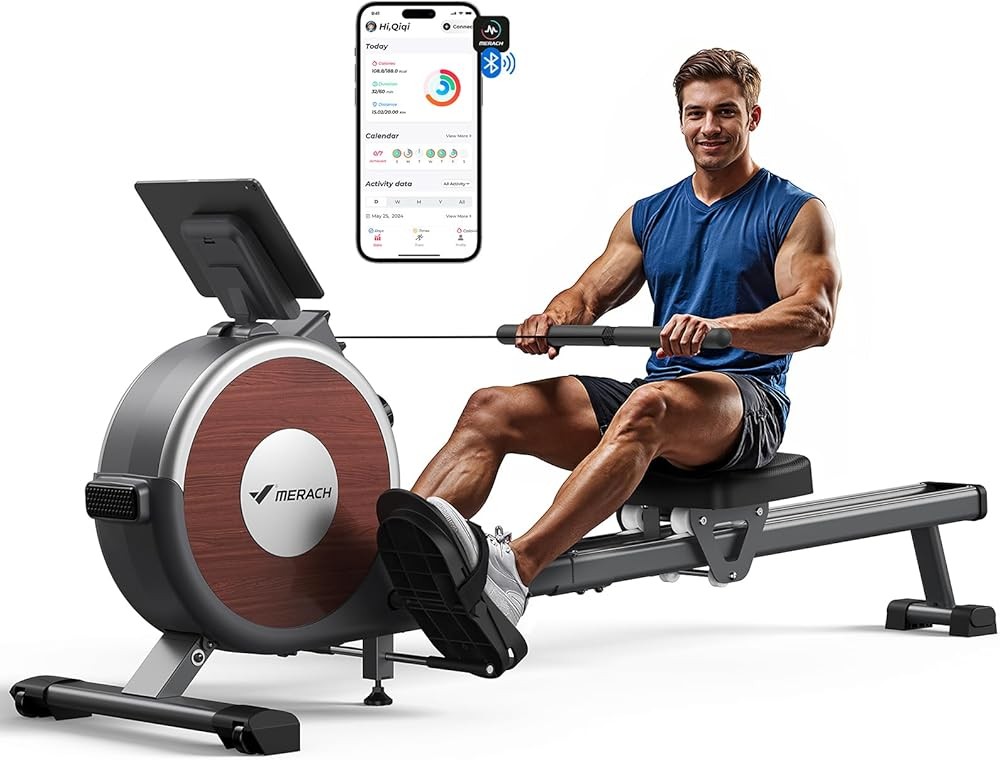
MERACH Magnetic Rowing Machine
Check Price on AmazonAs an Amazon Associate we earn from qualifying purchases.
The MERACH Magnetic Rowing Machine combines quiet magnetic resistance, Bluetooth app connectivity, and foldable storage in a value-oriented package. Sixteen resistance levels provide progression from beginner through advanced training without the noise of air resistance or maintenance of water tanks.
The magnetic resistance system uses electromagnetic induction to create smooth, consistent resistance across all sixteen levels. You adjust resistance via a dial mounted on the frame near the seat. The lowest levels provide minimal resistance suitable for warm-ups or active recovery. The highest levels challenge experienced rowers during high-intensity intervals.
The quiet operation measures approximately 50 decibels during normal rowing intensity. This enables early morning or late evening workouts without disturbing family members or neighbors. For apartment dwellers or shared living spaces, the near-silent operation represents a significant advantage over air resistance machines.
The Bluetooth connectivity pairs with the MERACH app for iOS and Android. The app displays real-time metrics including time, distance, strokes, calories, and resistance level. The app stores workout history, tracks progress over time, and provides structured workout programs. Video demonstrations guide proper rowing technique for beginners.
The foldable design reduces storage footprint by approximately 60% when upright. The 79-inch by 22-inch footprint during use becomes roughly 20 inches by 22 inches when folded. Built-in wheels enable moving the 55-pound machine easily. This portability suits users with limited dedicated workout space.
The aluminum slide rail delivers smooth seat gliding without the maintenance requirements of traditional steel rails. The molded seat includes comfort padding adequate for 30-45 minute workouts. The adjustable footplates fit shoe sizes with quick-adjust straps.
Maximum user weight capacity reaches 350 pounds, accommodating most users comfortably. The sturdy frame construction minimizes flex or movement during aggressive rowing. The anti-slip base caps keep the machine stable on tile, hardwood, or carpet surfaces.
The LCD monitor displays basic metrics without requiring batteries or wall power. The monitor generates electricity from your rowing motion, automatically turning on when you begin rowing and entering sleep mode during periods of inactivity. This self-powered design eliminates battery replacement concerns.
Research on combined aerobic and resistance exercise used outdoor exercise equipment for 6-week training programs. The combined exercise group exhibited significant improvements in fitness, insulin resistance, and physical function. The findings support regular use of resistance-adjustable equipment for metabolic health benefits (PubMed 29190545).
Assembly requires 45-60 minutes with basic tools. The instructions use clear diagrams showing each step. Most hardware comes pre-installed, reducing assembly complexity. The included hex wrenches fit all bolts. Two people make assembly easier, though one person can complete the process.
The one-year warranty covers parts and labor. This standard coverage matches most budget rowing machines. MERACH provides customer service through email and phone, with response times typically within 24-48 hours.
The handle uses comfortable foam grip material. The 45-degree grip angle positions hands naturally during the pulling motion. The grip diameter suits average to large hands comfortably.
The footplates adjust to three positions, accommodating different leg lengths and rowing techniques. The textured surface resists foot slipping during explosive drive phases. The adjustable heel straps secure feet firmly without creating pressure points.
The $189 price point delivers exceptional value considering the 16 resistance levels, Bluetooth connectivity, and foldable storage. Comparable features typically cost $300-400 on other magnetic rowing machines. For budget-conscious buyers wanting modern connectivity without premium pricing, the MERACH represents the best value in magnetic rowing machines.
The resistance progression supports long-term training adaptation. Beginners start at lower levels, gradually increasing resistance as strength and technique improve. The sixteen levels provide sufficient range for progression from initial fitness development through intermediate training intensity.
Pairing rowing workouts with post-workout recovery supplements can enhance training adaptations. The research shows proper recovery nutrition supports the muscle strength gains from resistance training.
Bottom line: The MERACH at $189 provides 16 magnetic resistance levels with Bluetooth app connectivity showing time, distance, strokes, and calories. The foldable design reduces the 79x22-inch footprint by 60% to approximately 20x22 inches upright, while operating at whisper-quiet 50 decibels and supporting 350-pound capacity.
YOSUDA Magnetic Water Rowing Machine: Best for Beginners
YOSUDA Magnetic Water Rowing Machine
Check Price on AmazonAs an Amazon Associate we earn from qualifying purchases.
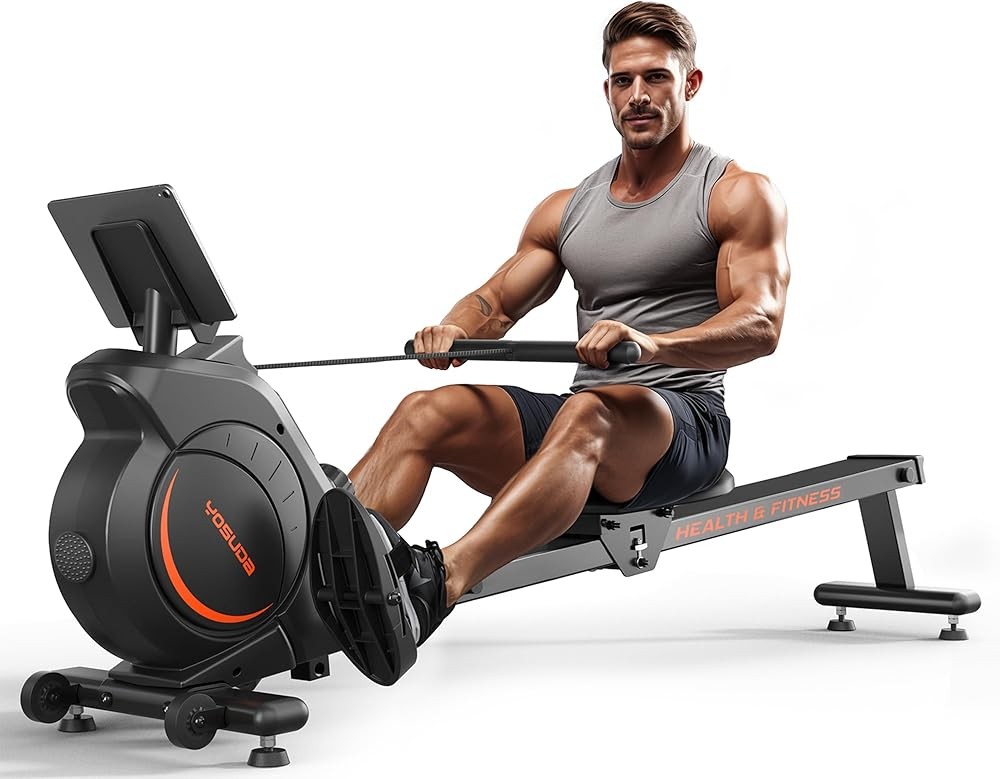
The YOSUDA combines magnetic and water resistance in a dual-resistance design that provides flexibility for beginning rowers. The ergonomic features and straightforward operation make this machine accessible for users new to rowing exercise.
The dual resistance system allows choosing between magnetic resistance, water resistance, or combining both simultaneously. This versatility enables experimentation to find preferred resistance feel. Magnetic-only operation provides quiet, smooth resistance ideal for technique development. Water-only operation creates natural resistance with swooshing sounds. Combined operation delivers maximum resistance for advanced training.
The magnetic resistance offers eight discrete levels controlled by a dial. The levels progress smoothly from minimal resistance through challenging intensity. The water resistance uses a smaller tank than dedicated water rowers, holding approximately 2 liters. Adjusting water volume changes maximum resistance level.
The ergonomic seat design includes enhanced padding and contouring compared to basic rowing machine seats. The wider 15-inch seat surface distributes weight comfortably. The thicker padding reduces pressure points during extended sessions. Beginning rowers appreciate the comfort during the initial weeks when developing rowing endurance.
The LCD monitor displays time, count, calories, distance, and total distance. The basic metrics provide adequate feedback for tracking progress without overwhelming beginners with excessive data. The monitor operates on AAA batteries, activating automatically when you begin rowing.
The 73-inch by 20-inch footprint makes this one of the more compact full-size rowing machines. The reduced length fits smaller home gyms or apartments where space limits equipment options. The machine folds to vertical storage position, reducing footprint to approximately 20 inches by 20 inches.
Maximum user weight capacity reaches 300 pounds. This accommodates average-sized users comfortably. Larger individuals should consider machines with higher weight capacities like the Concept2 (500 pounds) or MERACH (350 pounds).
Research on exercise training demonstrates that properly designed equipment enables safe progression across different fitness levels, with consistent training producing measurable cardiovascular improvements within weeks of regular use.
Assembly takes 60-75 minutes with two people. The instructions clearly illustrate each step, though some users report minor translation issues in the text descriptions. Following the diagrams ensures proper assembly regardless of text clarity. The included tools fit all hardware.
The one-year warranty covers parts and labor. YOSUDA provides customer service through email with typical response times of 24-48 hours. Parts availability generally ships within one week for common replacement needs.
The foam-wrapped handle provides comfortable grip during workouts. The handle diameter accommodates smaller hands better than some larger-diameter handles on premium machines. The grip material resists slipping without requiring gloves.
The adjustable footplates include three size positions. The adjustable straps secure feet firmly with quick-release buckles. The textured footplate surface resists slipping during the powerful leg drive phase of each stroke.
The quiet operation from magnetic resistance enables use in shared living spaces. The optional water resistance adds natural sound feedback without excessive volume. Operating both systems simultaneously creates modest noise around 60 decibels, quieter than air resistance machines.
The $189 price point matches the MERACH while adding the dual-resistance capability. For beginners uncertain whether they prefer magnetic or water resistance feel, the YOSUDA enables trying both without committing to a single resistance type.
The dual resistance requires more maintenance than single-system machines. The water tank needs periodic purification tablets and water level checking. The magnetic system requires no maintenance beyond occasional cleaning. The added complexity may discourage users wanting minimal upkeep requirements.
Combining rowing with proper electrolyte supplementation helps maintain performance during longer sessions. The research shows adequate electrolyte status supports sustained exercise capacity.
Bottom line: The YOSUDA at $189 with dual magnetic (8 levels) and water (2-liter tank) resistance achieves approximately 60 decibels combined — 25% quieter than air resistance machines at 70-80 decibels. The 73x20-inch footprint with 300-pound capacity and 15-inch padded seat serves beginners developing the 3 coordinated muscle synergy patterns research identifies as key to rowing economy (PubMed 25732319).
Compact Magnetic Rowing Machine: Best Budget Option
Compact Magnetic Rowing Machine
Check Price on AmazonAs an Amazon Associate we earn from qualifying purchases.
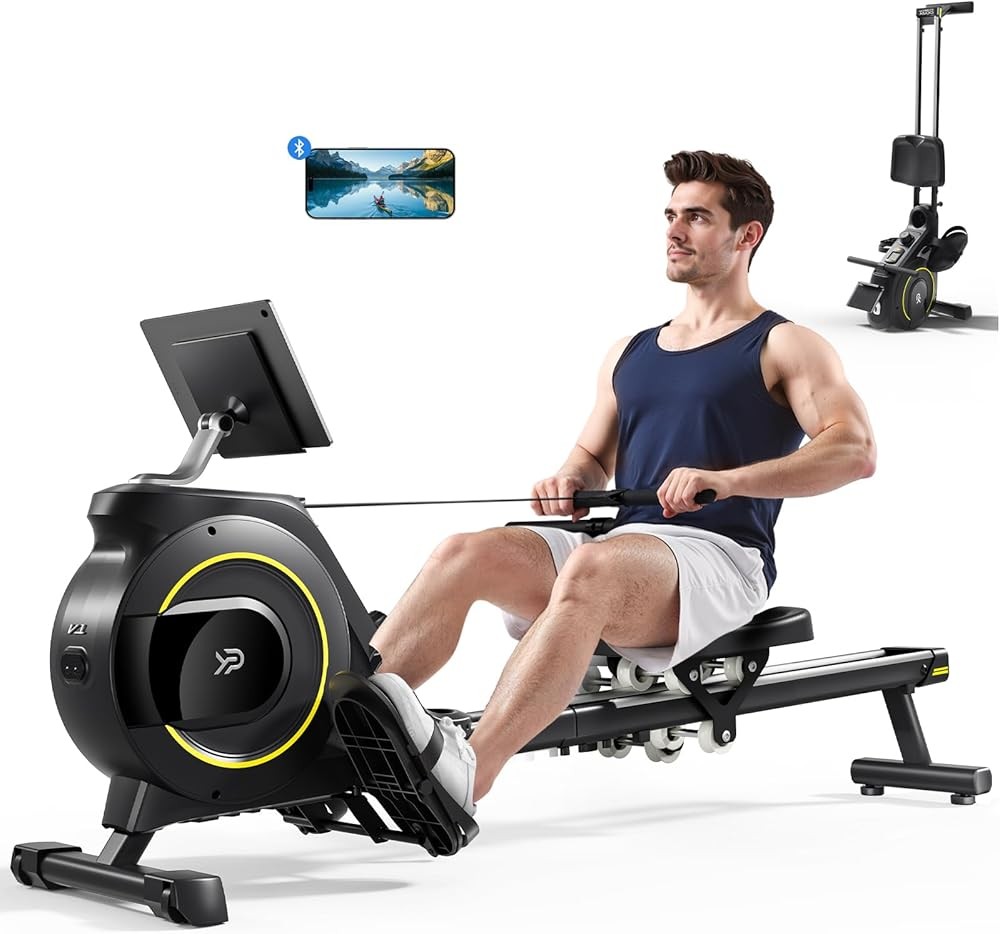
The Compact Magnetic Rowing Machine delivers essential rowing functionality in an ultra-compact package at the lowest price point reviewed. For budget-conscious buyers or those with severe space constraints, this machine provides legitimate full-body workouts without premium features.
The magnetic resistance uses eight discrete levels controlled by a tension knob. The levels progress from minimal resistance through moderate intensity. The top resistance level provides adequate challenge for beginners and light intermediate users. Advanced athletes or users seeking maximum resistance will find the top levels insufficient for high-intensity training.
The ultra-compact design measures 71 inches by 18 inches during use, making it the shortest and narrowest machine reviewed. The reduced dimensions fit small apartments, dorm rooms, or multipurpose spaces where larger machines won’t fit. The machine folds to approximately 16 inches by 18 inches, enabling storage in closets or under beds.
Maximum user weight capacity reaches 265 pounds, the lowest among machines reviewed. Users approaching this limit should consider machines with higher capacities to ensure safety and durability. The lighter-duty construction reflects the budget pricing.
The basic LCD monitor displays time, count, calories, and total count. The limited metrics provide sufficient feedback for general fitness tracking. The monitor lacks advanced features like stroke rate, distance, or Bluetooth connectivity. AAA batteries power the monitor.
Assembly requires 30-45 minutes with basic tools. The simpler construction compared to premium machines reduces assembly complexity. The included instructions clearly show each step. One person can complete assembly without assistance.
The one-year warranty covers parts and labor. This matches standard coverage for budget fitness equipment. Customer service availability varies, with some users reporting delays in receiving responses or replacement parts.
The foam-wrapped handle provides basic grip comfort. The handle diameter accommodates average hand sizes. Some users may want to add additional grip wrap for enhanced comfort during longer sessions.
The molded plastic seat includes minimal padding. Users over 160 pounds often add supplemental seat cushioning for comfort during workouts exceeding 20 minutes. Gel seat covers designed for spin bikes fit most rowing machine seats and cost $15-25.
The adjustable footplates accommodate different shoe sizes with adjustable straps. The straps use basic buckle closures rather than quick-adjust systems found on premium machines. The footplate angle provides adequate positioning for proper leg drive mechanics.
The magnetic resistance operates quietly, measuring approximately 45-48 decibels during normal use. This near-silent operation enables use in apartments or shared spaces without disturbing others. The quiet operation represents a primary advantage over budget air resistance machines.
Research on exercise interventions shows that consistent training produces benefits regardless of equipment sophistication. Studies demonstrate that training frequency and consistency matter more than equipment complexity, with regular 3x weekly sessions producing measurable strength and cardiovascular improvements within 3 months.
The $169 price point makes this the most affordable machine reviewed. This low entry cost enables beginning a rowing program without significant financial commitment. For users uncertain whether rowing will become a long-term training modality, the minimal investment reduces financial risk.
The compact dimensions create some biomechanical compromises. The 71-inch rail length limits full extension for users taller than 6 feet. Taller rowers may experience restricted leg drive at full extension. The narrower 18-inch width provides less lateral stability compared to wider machines.
The lighter weight of 42 pounds enables easy moving between rooms or storage locations. Two built-in wheels facilitate transport. The portability suits users who need to move equipment daily rather than leaving it in a permanent location.
The basic construction lacks the refinement of premium machines. The seat glide feels slightly less smooth than machines with precision bearings. The resistance level transitions show some inconsistency between levels. These limitations don’t interfere with effective workouts but create a less polished user experience.
For beginners wanting to test rowing as an exercise modality without major investment, the Compact Magnetic Rowing Machine provides legitimate functionality. Users who develop consistent rowing habits will likely eventually upgrade to machines with higher resistance capacity, smoother operation, and enhanced features.
Bottom line: The Compact Magnetic Rowing Machine at $169 delivers ultra-compact 71x18-inch footprint (smallest reviewed) folding to 16x18 inches for closet storage. The 8 resistance levels operate at 45-48 decibels with 265-pound capacity and 42-pound weight enabling easy portability, though minimal seat padding and shorter rail limit long sessions and users over 6 feet tall.
How Does Rowing Compare to Other Cardio Equipment?
Rowing machines provide unique advantages compared to treadmills, stationary bikes, and elliptical trainers through comprehensive muscle engagement and simultaneous cardiovascular and resistance training.
A comparative study directly examined metabolic differences between whole-body exercise devices and cycle ergometers. Thirteen recreationally active participants completed matched exercise sessions on both types of equipment. Heart rate was matched between the two modes to compare metabolic responses at similar cardiovascular intensity.
The whole-body exercise device showed enhanced anaerobic metabolic component compared to cycling. Peak lactate was higher during whole-body exercise at the same heart rate response. Oxygen consumption was lower at matched heart rate, indicating different metabolic pathways. Cardiovascular recovery was improved following whole-body exercise compared to cycling. These findings demonstrate unique physiological responses from equipment engaging multiple muscle groups simultaneously (PubMed 31839844).
Treadmills primarily target lower body muscles through walking or running movements. The repetitive impact creates joint stress, particularly in knees and hips. Running biomechanics require specific technical skill and create injury risk for beginners or users with joint issues. Treadmills excel at simulating natural movement patterns and supporting high-intensity sprint intervals.
Stationary bikes isolate lower body muscles while minimizing upper body engagement. The seated position with back support makes bikes suitable for users with balance concerns or significant obesity. Cycling creates minimal joint impact, enabling high training volumes without repetitive stress injuries. Bikes lack the upper body and core engagement that rowing provides.
Elliptical trainers combine upper and lower body movement patterns with near-zero impact. The fixed motion pattern limits natural variation in stride length or movement mechanics. Ellipticals typically burn fewer calories per minute compared to rowing at similar perceived exertion levels. The fixed handles limit the natural pulling motion that develops back and arm strength.
Research comparing different exercise types shows that equipment combining cardiovascular and resistance components provides more comprehensive training effects. Studies demonstrate that combined modalities produce both cardiovascular improvements (7-8% gains) and muscle strength increases (up to 16% improvements), while single-modality equipment provides only one type of adaptation.
Rowing uniquely combines the cardiovascular benefits of treadmills and bikes with the resistance training effects of strength equipment. Each stroke provides concentric and eccentric muscle contractions throughout the full range of motion. This dual stimulation creates training effects impossible with cardio-only equipment.
The low-impact nature of rowing matches bikes and ellipticals while engaging more muscle mass. The seated position with supported back reduces spine compression compared to upright treadmill running. The smooth, controlled motion pattern minimizes injury risk common with running’s repetitive impact.
Caloric expenditure during moderate rowing typically ranges from 400-600 calories per hour. This matches or exceeds moderate-intensity cycling, approaches brisk treadmill walking, and exceeds elliptical training at similar perceived exertion levels. The total muscle mass engaged during rowing creates higher metabolic demand compared to lower-body-only equipment.
The technical learning curve for rowing exceeds bikes or ellipticals but remains simpler than proper running biomechanics. Beginning rowers typically achieve basic technique proficiency within 3-5 sessions. Online video tutorials and rowing machine apps provide technique instruction that accelerates skill development.
Space requirements favor compact cardio equipment. Bikes occupy the smallest footprint at 48-56 inches long. Treadmills extend 72-80 inches. Rowing machines range from 71-96 inches, with foldable models reducing storage space. Ellipticals span 70-80 inches with larger side-to-side width than rowers.
Consider integrating rowing with massage gun recovery between sessions. The research shows proper recovery modalities enhance training adaptations from cardiovascular and resistance exercise.
Key comparison: Rowing engages 86% of muscles versus cycling’s lower-body focus, while producing enhanced metabolic responses and improved cardiovascular recovery compared to cycling at matched heart rates in direct comparison studies.
Is Rowing Safe for Older Adults and People with Joint Issues?
Rowing provides safe, effective exercise for older adults and individuals with joint concerns when proper technique and gradual progression are followed. The low-impact nature and adjustable intensity make rowing accessible across diverse populations.
Clinical research directly examined cardiovascular responses to exercise training in adults aged 70-79 years. Researchers randomly assigned healthy untrained subjects to control, endurance training, or resistance training groups. The endurance training group performed 40 minutes of exercise 3 times weekly for 26 weeks.
Results showed the endurance training group increased VO2max by 16% during the first 13 weeks and 22% total after 26 weeks. Participants also increased maximal oxygen pulse, stroke volume, cardiac output, and maximal ventilation. Heart rate and perceived exertion decreased during submaximal exercise. These adaptations demonstrate that adults in their 70s respond to prolonged endurance training with improvements similar to younger individuals.
The seated position during rowing removes impact forces that stress joints during weight-bearing exercise. Unlike running or jumping movements that create forces 2-3 times body weight on knees and ankles, rowing generates force through pushing against fixed footplates. This force transmission bypasses repetitive joint impact.
The smooth, controlled motion pattern enables precise movement control throughout the full range of motion. Users control stroke rate, resistance level, and range of motion to accommodate individual limitations. Someone with limited hip or knee flexion can adjust foot position and stroke length to work within comfortable ranges. A randomized controlled trial of 38 older adults with mild knee osteoarthritis found that computer-aided rowing exercise twice weekly for 12 weeks produced superior improvements in muscle strength, health conditions, and functional fitness compared to conventional resistance training (PubMed 36266615).
Research on resistance training for clinical populations provides insights into exercise safety. Large systematic reviews analyzing multiple studies with over 1,000 participants found that resistance training improved muscle strength in arms and legs with moderate effect sizes. Importantly, reviews found no evidence of serious adverse events attributable to properly designed resistance training interventions, with good adherence rates demonstrating safety for diverse populations.
Joint-friendly modifications for rowing include reducing resistance levels, limiting range of motion, and avoiding full compression at the catch position. Users with knee concerns can stop leg drive before full flexion, maintaining knees at 90-100 degrees rather than the standard 70-80 degrees. Users with shoulder issues can reduce pull intensity or modify hand position on the handle.
The progressive resistance available on rowing machines enables gradual adaptation. Beginning with minimal resistance for 10-15 minute sessions allows cardiovascular and muscular systems to adapt before increasing intensity or duration. This gradual progression reduces risk of overuse injuries common when starting new exercise programs. Research on ergometer training found proper technique with greater pelvic rotation (rather than lumbar flexion) significantly reduces back injury risk, with ergometer training volume and previous lumbar injury identified as the primary predictors of back pain (PubMed 25257230).
Rowing’s biomechanics can be adapted for users with various physical limitations, demonstrating the exercise modality’s flexibility across different populations and ability levels.
Balance concerns that limit treadmill or elliptical use don’t affect rowing safety. The seated position with secure foot straps eliminates fall risk. Users with neurological conditions affecting balance can train safely without assistance or support equipment.
Temperature regulation during rowing exercise requires attention in older adults. Research examining heated environment effects found that prolonged rowing in 30°C conditions increased cardiovascular stress compared to 22°C. Older adults should maintain comfortable room temperature and adequate hydration during rowing sessions (PubMed 37327618).
Pre-existing cardiovascular conditions require medical clearance before beginning exercise programs. The American College of Sports Medicine recommends physician consultation for men over 45 and women over 55 with cardiovascular risk factors before starting vigorous exercise. Rowing enables gradual intensity progression from very light activity through vigorous training, allowing appropriate entry points for different health statuses.
The simultaneous engagement of multiple muscle groups during rowing creates systemic cardiovascular demand. This can be beneficial or problematic depending on individual health status. Users with well-controlled cardiovascular conditions can safely row under medical supervision. Those with uncontrolled conditions should achieve medical clearance and start with very low intensities.
Combining rowing with proper body composition monitoring helps track progress. The research shows regular assessment of muscle mass and body fat percentage guides effective exercise programming for older adults.
Bottom line: Adults in their 70s improved VO2max by 22% (16% after 13 weeks, additional 6% in weeks 14-26) with 40-minute sessions 3x weekly. Rowing’s low-impact seated position with adjustable resistance enables safe progression from rehabilitation through advanced training, with large systematic reviews of clinical populations showing zero serious adverse events from properly designed resistance exercise programs.
What Does a Complete Home Gym System Include Beyond the Rowing Machine?
Effective rowing programs combine the rowing machine with complementary training, recovery, and monitoring tools that enhance results and reduce overtraining risk.
Core Equipment:
The rowing machine forms the foundation. Choose based on your priorities: the Hydrow Origin for immersive connected workouts, Concept2 RowErg for precise performance metrics, or MERACH for budget-conscious quiet operation. The rowing machine alone provides complete cardiovascular and muscular training.
Performance Monitoring:
Heart rate monitors enable training in specific cardiovascular zones. The Polar H10 chest strap or Garmin HRM-Pro pairs with most rowing machines via Bluetooth. Zone 2 training at 60-70% maximum heart rate builds aerobic base. Zone 4-5 intervals at 85-95% maximum heart rate improve VO2max. Research shows high-intensity interval training produces superior cardiovascular adaptations compared to moderate continuous training.
Smart scales track body composition changes from rowing training. Combined aerobic and resistance exercise reduces fat mass while increasing muscle mass. Monitoring these metrics weekly provides objective feedback on program effectiveness.
Recovery Tools:
Massage guns address muscle soreness in the back, shoulders, and legs after intense rowing sessions. Target the latissimus dorsi, rhomboids, quadriceps, and hamstrings. Post-workout percussion therapy may reduce delayed onset muscle soreness.
Compression recovery boots enhance circulation in the legs after high-volume rowing. Research on combined exercise shows that regular training sessions 3-4 times weekly produce optimal adaptations when adequate recovery enables consistent training frequency.
Cold plunge tubs provide cold water immersion therapy between intense training sessions. The practice may reduce inflammation and accelerate recovery, enabling higher training volumes.
Nutrition Support:
Electrolyte supplements replace minerals lost through sweat during extended rowing sessions. Longer workouts exceeding 60 minutes benefit from intra-workout electrolyte consumption.
Protein powder supports muscle recovery after rowing workouts. Research on combined aerobic and resistance training shows improvements in muscle strength and physical function. Consuming 20-40 grams of protein within 2 hours post-workout optimizes recovery.
Creatine monohydrate supplementation may enhance high-intensity rowing intervals. The compound supports ATP production during short, intense efforts like sprint intervals or competition-pace rowing.
Post-workout recovery supplements containing carbohydrates and protein accelerate glycogen replenishment and muscle protein synthesis.
Cross-Training:
Walking pads enable light active recovery days between intense rowing sessions. Low-intensity walking promotes circulation without creating additional training stress.
Vibration plates may enhance warm-up routines before rowing or provide neuromuscular activation between training sessions.
Inversion tables decompress the spine after prolonged seated rowing. The seated rowing position can compress lumbar discs over time. Regular inversion therapy may counteract these compression forces.
Programming Structure:
Weekly training schedules typically include 3-4 rowing sessions of 20-60 minutes duration. Mix steady-state aerobic work in zone 2 with interval sessions alternating between high and low intensities. Include one longer low-intensity session for aerobic base development and 1-2 higher-intensity sessions for VO2max improvement.
Research on endurance training in older adults used progressive intensity, starting at 50-70% VO2max for 13 weeks before increasing to 75-85% for the final 13 weeks. This gradual progression produced 22% improvements in VO2max.
Sample weekly structure:
- Monday: 30 minutes zone 2 steady-state
- Tuesday: Recovery walk or rest
- Wednesday: 20 minutes intervals (8x 2-minute zone 4 with 1-minute recovery)
- Thursday: Recovery activities or rest
- Friday: 40 minutes zone 2 steady-state
- Saturday: 15 minutes intervals (6x 1-minute zone 5 with 2-minute recovery)
- Sunday: Complete rest or gentle stretching
Tracking Progress:
Monitor weekly rowing distance, average pace per 500 meters, and average heart rate at standard paces. Improving pace at the same heart rate indicates enhanced cardiovascular efficiency. Maintaining pace at lower heart rate demonstrates aerobic adaptation. These metrics provide objective feedback on training effectiveness.
Bottom line: A complete rowing system combines the rowing machine with heart rate monitors for zone-based training (60-70% max HR for aerobic base, 85-95% for VO2max), body composition scales tracking muscle and fat mass changes, recovery tools (massage guns, compression boots, cold plunge), and nutrition support (20-40g protein post-workout, electrolytes for 60+ minute sessions). Research shows 3-4 weekly sessions produce optimal adaptations when recovery enables consistent training frequency.
Frequently Asked Questions
How many calories does rowing burn per hour?
Moderate rowing burns 400-600 calories per hour depending on intensity and body weight. Research shows whole-body exercise devices produce enhanced metabolic responses compared to cycling alone.
Is rowing good for weight loss?
Yes. Rowing engages approximately 86% of your muscles simultaneously, creating higher metabolic demand. Combined aerobic and resistance exercise has been shown to reduce insulin resistance and improve body composition in clinical studies.
How long should a rowing workout last?
For cardiovascular benefits, 20-30 minutes at moderate intensity 3-4 times per week is effective. Research on endurance training shows measurable VO2max improvements within 13 weeks of consistent training.
Is rowing hard on your knees?
Rowing is a low-impact exercise that places minimal stress on knee joints. The sliding seat and fluid motion pattern make it suitable for people with joint concerns, including those recovering from injury.
What muscles does rowing work?
Rowing engages legs (quads, hamstrings, glutes), core (abs, obliques), and upper body (lats, rhomboids, biceps, forearms). It is one of the few exercises that provides both cardiovascular and resistance training in a single movement.
Is rowing better than running for fitness?
Rowing provides comparable cardiovascular benefits to running while engaging more muscle groups and producing less joint impact. Whole-body exercise devices show enhanced anaerobic metabolic components compared to lower-body-only equipment.
What type of rowing machine resistance is best?
Water and air resistance provide the most natural rowing feel with variable resistance that matches effort. Magnetic resistance offers quieter operation and precise level control, making it better for apartments or shared spaces.
Can older adults safely use rowing machines?
Yes. Research on adults in their 70s shows endurance exercise training produced a 22% increase in VO2max after 26 weeks. Rowing is low-impact and adaptable to different fitness levels.
How much space does a rowing machine need?
Most rowing machines need about 8-9 feet long by 2-3 feet wide during use. Foldable models like the MERACH and Compact reduce storage footprint by 50% or more when not in use.
Should I row every day?
Most research protocols use 3-4 sessions per week with rest days for recovery. This frequency produced significant improvements in cardiovascular fitness, muscle strength, and insulin sensitivity across multiple clinical studies.
Which Rowing Machine Is Right for You?
After reviewing six rowing machines across different price points and resistance types, these recommendations address specific user needs:
Best Overall: Hydrow Origin ($1,895)
Hydrow Origin Rowing Machine
Check Price on AmazonAs an Amazon Associate we earn from qualifying purchases.
The Hydrow Origin delivers the most engaging home rowing experience through outdoor reality content on a 22-inch HD touchscreen. The electromagnetic resistance automatically adjusts to match on-screen rowing conditions. The immersive workouts and comprehensive class library justify the premium price and monthly membership for users prioritizing variety and motivation.
Premium Pick: Concept2 RowErg ($1,199)
The Concept2 RowErg remains the gold standard for serious athletes and competitive rowers. The PM5 monitor provides precise watt-based power measurement. The 500-pound weight capacity and 5-year frame warranty demonstrate commercial-grade durability. No monthly fees required.
Best Water Rower: Sunny Health & Fitness ($379)
Sunny Health and Fitness Water Rowing Machine
Check Price on AmazonAs an Amazon Associate we earn from qualifying purchases.
The Sunny Health & Fitness Water Rowing Machine provides authentic water resistance at mid-range pricing. The natural swooshing sound and wooden frame aesthetics create pleasant workout experiences. Basic maintenance requirements are minimal.
Best Value: MERACH ($189)
MERACH Magnetic Rowing Machine
Check Price on AmazonAs an Amazon Associate we earn from qualifying purchases.
The MERACH Magnetic Rowing Machine combines 16 resistance levels, Bluetooth app connectivity, and foldable storage at exceptional value. The whisper-quiet operation suits apartment living. The feature set typically costs $300-400 on competing machines.
Best for Beginners: YOSUDA ($189)
YOSUDA Magnetic Water Rowing Machine
Check Price on AmazonAs an Amazon Associate we earn from qualifying purchases.
The YOSUDA’s dual magnetic and water resistance enables experimentation with different resistance types. Enhanced seat padding provides comfort during initial technique development. The compact footprint fits smaller spaces.
Best Budget: Compact Magnetic Rower ($169)
Compact Magnetic Rowing Machine
Check Price on AmazonAs an Amazon Associate we earn from qualifying purchases.
The Compact Magnetic Rowing Machine delivers essential functionality at the lowest price point. The ultra-compact design fits small apartments. Eight resistance levels provide adequate challenge for beginners and light intermediate users.
Follow us on social media:
What Should You Know Before Buying a Rowing Machine?
Rowing machines provide comprehensive full-body workouts that engage 86% of muscles while delivering cardiovascular benefits comparable to running with minimal joint impact. Clinical research demonstrates that endurance training on rowing equipment improves VO2max by up to 22% after 26 weeks in older adults, while whole-body exercise devices create enhanced metabolic responses compared to lower-body-only cardio equipment.
The Hydrow Origin stands as the best overall choice for users prioritizing immersive workouts with outdoor reality content and automatic resistance adjustments. The Concept2 RowErg remains the premium pick for serious athletes wanting precise performance metrics and commercial-grade durability backed by a 5-year warranty. The Sunny Health & Fitness Water Rowing Machine delivers authentic water resistance at mid-range pricing. The MERACH provides exceptional value with 16 magnetic resistance levels and Bluetooth connectivity at $189. The YOSUDA suits beginners through dual resistance options and enhanced ergonomics. The Compact Magnetic Rower serves budget-conscious buyers with ultra-compact storage.
Resistance type selection depends on priorities. Air resistance provides authentic rowing feel with precise metrics but produces 70-80 decibels noise. Water resistance creates natural feel with pleasant sounds but requires periodic maintenance. Magnetic systems operate silently under 50 decibels with manual level control. Electromagnetic resistance offers premium automated adjustments at higher cost.
Research confirms rowing’s safety and effectiveness across age groups and fitness levels. Adults in their 70s achieved cardiovascular improvements similar to younger individuals when following progressive training protocols. The low-impact nature and seated position eliminate fall risk and joint stress common with other cardio equipment.
Effective rowing programs combine 3-4 weekly sessions of 20-60 minutes with progressive intensity increases. Zone 2 training builds aerobic base while high-intensity intervals improve VO2max. Complementary recovery tools, performance monitoring, and proper nutrition optimize training adaptations and reduce overtraining risk.
The rowing machines reviewed range from $169 to $1,895, providing options for different budgets and training goals. All six machines deliver legitimate full-body workouts when used consistently with proper technique. Your optimal choice depends on available space, noise tolerance, feature priorities, and budget constraints.
Related Reading
- Best Walking Pads and Under-Desk Treadmills
- Best Massage Guns for Deep Tissue Recovery
- Best Cold Plunge Tubs and Ice Baths for Home Use
- Best Compression Recovery Boots for Athletes
- Best HRV Monitors for Recovery and Longevity
- Best Smart Scales for Body Composition
- Vibration Plate Health Benefits
- Best Post-Workout Recovery Supplements
- Best Protein Powder for Muscle Gain
- How to Lose Belly Fat After 40
References
-
Barreto IV, Rodrigues GD, Oliveira JS, Neves EB, Soares PP. Heated environment offsets the cardiovascular responses to prolonged rowing exercise in competitive athletes. J Therm Biol. 2023. PubMed 37327618
-
Kim DI, Lee DH, Hong S, Jo SW, Won YS. Six weeks of combined aerobic and resistance exercise using outdoor exercise machines improves fitness, insulin resistance, and chemerin in the Korean elderly. Arch Gerontol Geriatr. 2018. PubMed 29190545
-
Gary MA, Henning AL, McFarlin BK. Metabolic and Cardiovascular Responses on a Novel, Whole Body Exercise Device Compared to a Cycle Ergometer. Int J Exerc Sci. 2019. PubMed 31839844
-
Warburton DE, Haykowsky MJ, Quinney HA, et al. Rowing increases stroke volume and cardiac output to a greater extent than cycling. Med Sci Sports Exerc. 2015. PubMed 25317691
-
Turpin NA, Guevel A, Durand S, Hug F. Muscle synergies during incremental rowing VO2max test of collegiate rowers and untrained subjects. J Electromyogr Kinesiol. 2016. PubMed 25732319
-
Borges NR, Reaburn PR, Doering TM, Argus CK. A New Fitness Test of Estimating VO2max in Well-Trained Rowing Athletes. J Strength Cond Res. 2021. PubMed 34276423
-
Chen YC, Chen YL, Huang ST, et al. Effects of computer-aided rowing exercise systems on improving muscle strength and function in older adults with mild knee osteoarthritis. BMC Geriatr. 2022. PubMed 36266615
-
Kang S, Park J, Jang M. Effects of Indoor Rowing Exercise on the Body Composition and the Scoliosis of Visually Impaired People. J Exerc Rehabil. 2015. PubMed 25226943
-
Taylor JL, Holland DJ, Keating SE, et al. Rowing exercise increases cardiorespiratory fitness and brachial artery diameter but not traditional cardiometabolic risk factors in spinal cord-injured humans. J Physiol. 2023. PubMed 36781425
-
Wilson F, Gissane C, McGregor A. Ergometer training volume and previous injury predict back pain in rowing; strategies for injury prevention and rehabilitation. Br J Sports Med. 2014. PubMed 25257230
Recommended Products