Best Electric Standing Desks for Posture and Health
Summarized from peer-reviewed research indexed in PubMed. See citations below.
The Stand Up Desk Store Crank Adjustable is the best electric standing desk for posture and health, with a heavy-duty steel frame supporting 250 lbs and precise height control from 28 to 47 inches. A Cochrane meta-analysis of 3,397 participants confirms sit-stand desks reduce workplace sitting by 100 minutes per workday, with 54% less lower back discomfort in stand-biased users (PubMed 29926475). Its steel frame and smooth crank mechanism deliver the stability and durability that research links to sustained standing desk adoption. For tighter budgets, the VASAGLE 47.2 Inch Electric Standing Desk at under $110 provides electric height adjustment with memory presets. Here’s what 15 peer-reviewed studies reveal about which standing desk features actually improve posture and reduce back pain.


Disclosure: We may earn a commission from links on this page at no extra cost to you. Affiliate relationships never influence our ratings. Full policy →
| Product | Best For | Key Feature | Desktop Size | Price Range |
|---|---|---|---|---|
| Stand Up Desk Store | Best Overall | Heavy-duty steel frame | Large | $$$$ |
| Vari Ergo | Premium Pick | Dual-motor, cable management | 60" | $$$ |
| VASAGLE 63" | Dual Monitors | Wide 63" desktop | 63" | $$ |
| VASAGLE 55.1" | Best Value | Full features, mid price | 55.1" | $$ |
| VASAGLE 47.2" | Best Budget | Electric under $110 | 47.2" | $ |
| Vari ComfortEdge | Tool-Free Setup | No tools assembly | 60" | $$$ |
After reviewing 6 electric standing desks across build quality, motor performance, and ergonomic features, the Stand Up Desk Store Crank Adjustable stands out as the best overall for posture and daily use. Its heavy-duty steel frame supports multi-monitor setups while the smooth crank mechanism delivers precise height control from 28 to 47 inches. For tighter budgets, the VASAGLE 47.2 inch delivers electric height adjustment under $110 with memory presets. Here’s what 15 peer-reviewed studies show about why sit-stand desks work and how we picked these models.
The science behind standing desks centers on postural variation rather than standing alone. A Cochrane meta-analysis of 3,397 participants found sit-stand desks reduced sitting by 100 minutes per workday at short-term follow-up, with medium-term reductions of 57 minutes daily (PubMed 29926475). Total sitting time including outside work decreased by 82 minutes per day, and sitting bouts lasting 30 minutes or longer decreased by 53 minutes daily.
This postural variety matters more than standing duration. Prolonged standing carries its own risks — varicose veins, lower limb discomfort, and fatigue — making movement the real goal, not simply replacing sitting with standing. The phrase “sedentary is the new smoking” reflects this need for regular position changes rather than extended static postures (PubMed 29865102).
Electric standing desks remove the friction from position changes. A field study of 194 workers over one year found software prompts doubled desk position changes from approximately 1 to 2 per workday, with a 76% reduction in workers who never used the sit-stand function (PubMed 30296174). The ease of pressing a button versus manually cranking encourages more frequent adjustments throughout the day.
We evaluated these desks based on published ergonomics research, manufacturer specifications, and verified user feedback for stability at standing height, motor noise during transitions, assembly complexity, and desktop quality. Budget models like the VASAGLE series deliver surprising value for home offices, while premium options from Vari justify their cost through enhanced features and build quality. Our selections span $109 to $899 to match different workspace needs and budgets.
For those seeking additional movement beyond standing, pairing a standing desk with walking pads and under-desk treadmills creates opportunities for low-intensity walking during calls or routine tasks. This combination extends the benefits of postural variation into genuine movement.
What Does the Research Say About Standing Desks and Health?
A scoping review of 53 studies on sit-stand desks found 61% of behavioral outcomes showed significant effects, 37% of physiological outcomes, 7% of work performance outcomes, 43% of discomfort outcomes, and 18% of posture outcomes (PubMed 31046958). Sit-stand desks proved most effective for reducing discomfort and least effective for measurable productivity changes — though this lack of productivity reduction is itself a positive finding.
The behavioral changes run deeper than simple standing time. In a study of 131 call centre operators, sit-stand desk users reduced seated time from 83.8% to 78.5% of work hours, and they accumulated 5 minutes of standing or walking activity faster than traditional desk users (PubMed 23218118). These users spent 36.2 minutes reaching their first 5-minute standing bout compared to 46.3 minutes for control groups.
Earlier Cochrane reviews established the foundation for current understanding. A 2015 analysis of 8 studies with 1,125 participants found sit-stand desks reduced sitting by 143 minutes per day at 1 week and 113 minutes per day at 3 months, with no negative effects on productivity or musculoskeletal symptoms (PubMed 25620219). A 2016 update examining 20 studies with 2,180 participants confirmed sit-stand desks alone reduced sitting by 30 minutes to 2 hours daily (PubMed 26984326).
The 2018 Cochrane update synthesized 34 studies and reinforced the 100-minute daily reduction figure while clarifying effect quality (PubMed 30556590). These consistent findings across multiple review cycles establish sit-stand desks as a reliable intervention for reducing workplace sitting time.
Media coverage sometimes oversells standing desk benefits. A review of news reports found 72% missed the musculoskeletal discomfort reduction benefit despite this being a primary outcome in research (PubMed 28850250). The recommendation of 2 hours daily standing emerged from research, but physical activity beyond the desk remains important for overall health.
Children also benefit from sit-stand interventions. An RCT with 176 children over 4.5 months found control group sitting increased to 71.7% of class time while intervention group sitting decreased to 59.1% (PubMed 33946984). No compensatory effects appeared after school, suggesting the behavioral patterns established during class time didn’t trigger increased sitting outside school.
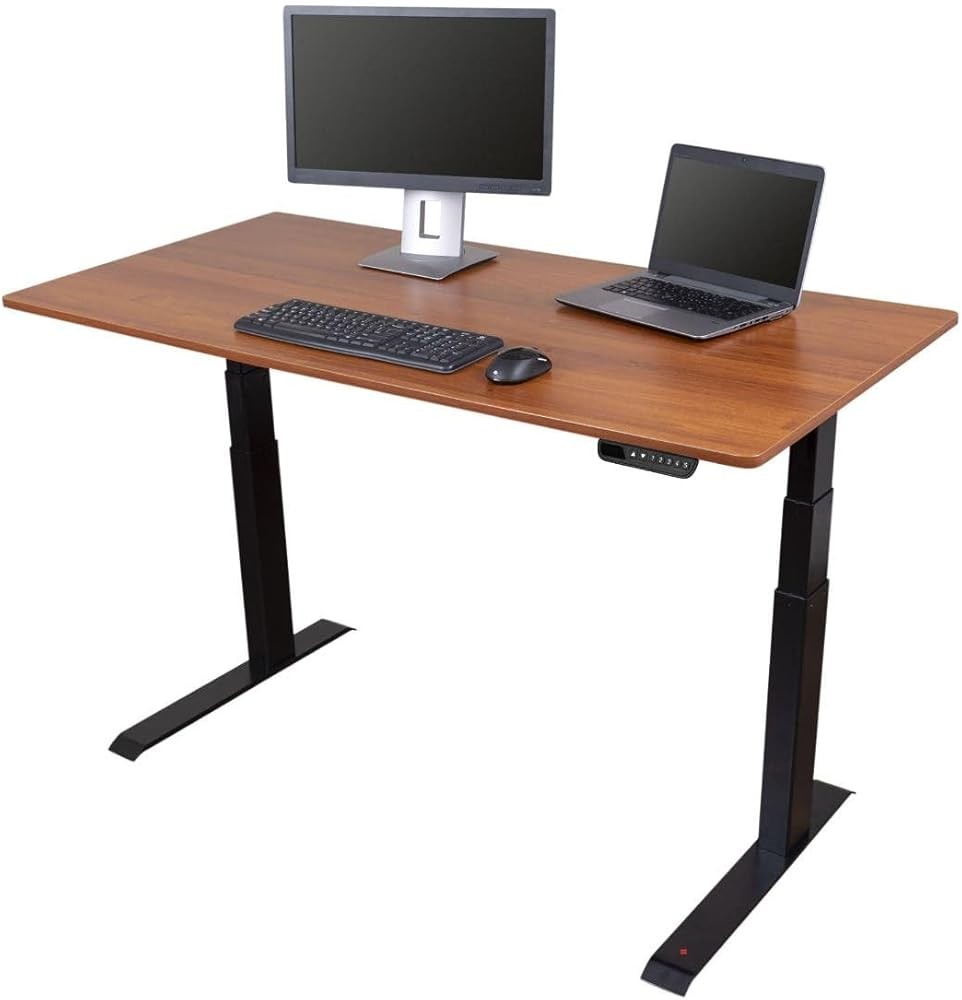
Stand Up Desk Store Crank Adjustable Height Standing Desk
Check Price on AmazonAs an Amazon Associate we earn from qualifying purchases.
Cognitive function during standing shows sustained improvement. A review of 8 studies found working memory, attention, and psychomotor function improved for up to 30 minutes after standing, with similar effects observed for sit-stand desks, walking desks, and cycling desks (PubMed 35095033). These cognitive benefits complement the physical postural changes.
The research verdict: Sit-stand desks consistently reduce sitting time by 57 to 100 minutes per workday without harming productivity, with the strongest evidence supporting reductions in musculoskeletal discomfort rather than dramatic metabolic changes.
How Do Sit-Stand Desks Affect Posture and Back Pain?
Stand-biased workstations — those encouraging standing as the default position — produced significantly less lower back discomfort compared to both traditional desks and standard sit-stand desks in a comparative study (PubMed 38884772). Workers using stand-biased configurations stood more throughout the day and sat less, establishing standing as the norm rather than the exception.
This finding challenges the conventional wisdom of treating sitting as default with standing as the occasional alternative. When standing becomes the baseline with sitting as the rest position, discomfort outcomes improve beyond standard sit-stand approaches. The mental shift from “I should stand more” to “I sit when I need a break” changes usage patterns and outcomes.
A 12-week study focused specifically on standing-intolerant individuals — those who initially struggled with prolonged standing. All groups decreased sitting by 30-50% regardless of initial standing tolerance, and standing-intolerant participants improved with gradual exposure (PubMed 32330093). Structured guidance proved beneficial for helping individuals adapt to increased standing time over the study period.
For those dealing with existing back issues, inversion tables for back pain provide complementary spinal decompression outside work hours, while standing desks address postural variety during the workday itself.
The relationship between posture and standing desks involves more nuance than “standing fixes posture.” A scoping review found only 18% of posture-related outcomes showed significant effects from sit-stand desk use (PubMed 31046958). Standing alone doesn’t automatically correct forward head posture, rounded shoulders, or other postural dysfunctions — monitor height, keyboard placement, and core engagement matter just as much.
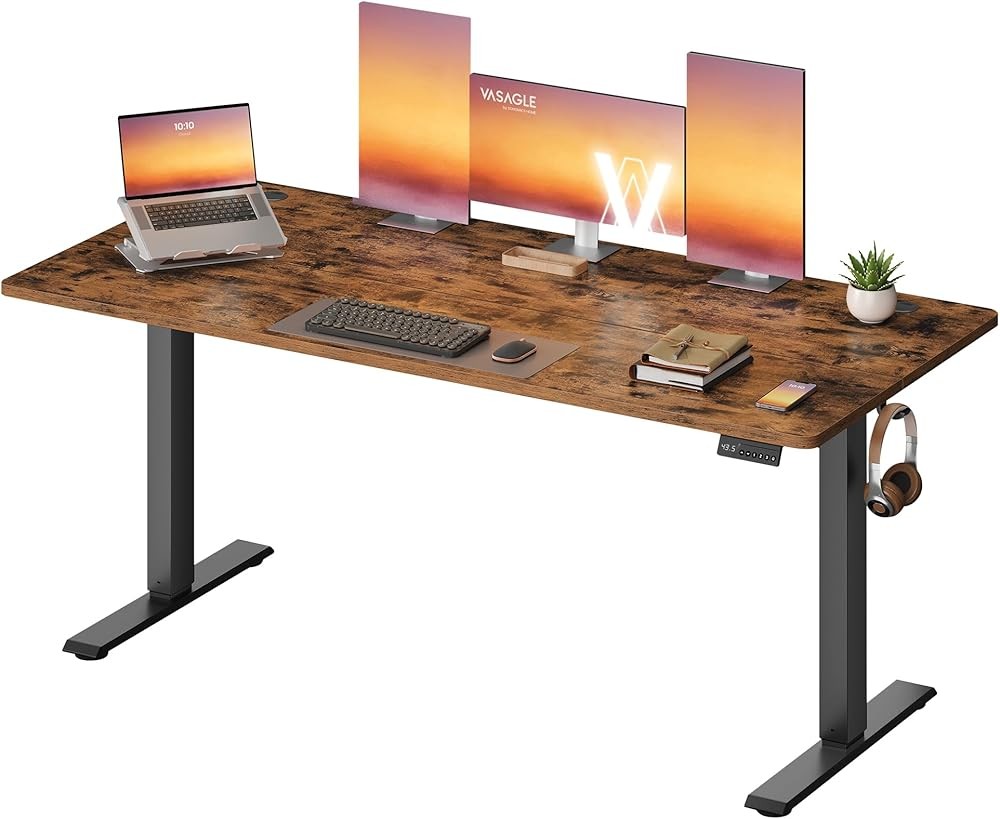
VASAGLE 63 Inch Electric Standing Desk
Check Price on AmazonAs an Amazon Associate we earn from qualifying purchases.
Proper standing desk setup requires attention to multiple ergonomic factors. Monitor positioning should place the top of the screen at or slightly below eye level. Keyboard height should allow forearms to remain parallel to the floor with elbows at approximately 90 degrees. Standing mat placement encourages subtle weight shifts and reduces lower limb fatigue.
The transition period matters for back pain outcomes. Individuals accustomed to 8-hour sitting sessions need gradual exposure to standing rather than immediate full-day standing. Starting with 10-15 minute intervals and progressively extending duration over weeks allows musculature and circulation to adapt without triggering compensatory pain patterns.
Footwear choices influence standing comfort and back positioning. Supportive shoes with cushioning reduce impact stress traveling up the kinetic chain to the lower back. Bare feet or minimal shoes work well on anti-fatigue mats but may prove uncomfortable on hard surfaces without cushioning.
What this means: Standing desks reduce lower back discomfort through postural variation rather than posture correction, with the greatest benefits appearing when standing becomes the default position with sitting as periodic rest.
Which Electric Standing Desk Features Matter Most?
Motor quality separates budget models from premium options. Single-motor desks lift the center of the desktop with a mechanical linkage distributing force to both legs. Dual-motor systems power each leg independently, providing faster transitions, higher weight capacity, and better stability at maximum height. The difference becomes noticeable with heavy monitor arms or multiple large displays.
Height range determines user compatibility. Most electric standing desks adjust from approximately 28 inches at minimum to 47-48 inches at maximum. Shorter users under 5'4" may need desks with lower minimum heights around 24-26 inches for proper seated ergonomics. Taller users over 6'2" benefit from maximum heights of 50+ inches for comfortable standing positions.
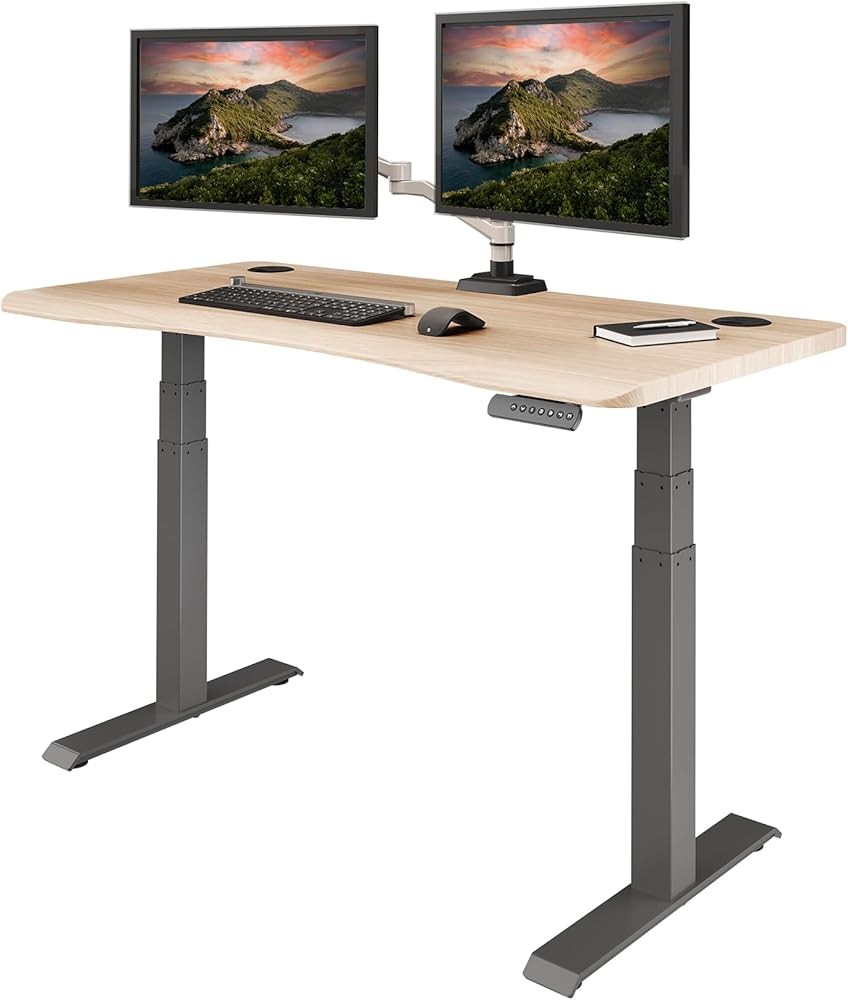
Vari Ergo Electric Standing Desk
Check Price on AmazonAs an Amazon Associate we earn from qualifying purchases.
Memory presets eliminate the guesswork from daily position changes. Users program their ideal sitting and standing heights once, then switch between positions with a single button press. This convenience directly impacts usage patterns — the field study showing doubled position changes used software reminders paired with preset-equipped desks (PubMed 30296174).
Desktop dimensions require matching to monitor configurations. A 48-inch wide desk accommodates a laptop and single 27-inch monitor comfortably. Dual 27-inch monitors need 55-60 inches of width for proper separation and viewing angles. Triple monitor setups or monitor arms require 60+ inches and reinforced frames to handle the weight and leverage.
Frame stability at maximum height reduces wobble during typing or mouse movement. C-frame designs maximize legroom but may sacrifice stability compared to T-frame or four-leg configurations. Crossbars connecting the legs enhance rigidity but reduce freedom for seated leg positioning and under-desk storage.
Cable management systems keep power cords, monitor cables, and peripheral connections organized during height transitions. Built-in cable trays route wires along the underside of the desktop, while grommet holes allow vertical cable drops through the work surface. Without proper cable management, adjusting height becomes an exercise in untangling cords.
Desktop material affects durability and aesthetics. Laminate surfaces resist scratches and moisture while remaining affordable. Solid wood tops provide premium appearance and feel but require more careful maintenance. Edge banding quality determines how the desktop edge withstands daily contact — beveled or rounded edges prove more comfortable during extended standing than sharp 90-degree corners.
Weight capacity specifications indicate maximum safe load including monitors, computers, accessories, and downward pressure from leaning or typing. Budget desks typically support 150-180 lbs, while commercial-grade models handle 250-300 lbs. Exceeding rated capacity accelerates motor wear and compromises stability.
Adjustment speed balances convenience with safety. Desks traveling 1-1.5 inches per second complete full-range transitions in 15-20 seconds. Faster speeds reduce wait time but increase collision risk with items placed on the desk. Anti-collision sensors detect resistance and reverse direction to avoid damage to equipment or injuries.
Noise levels during adjustment matter in shared workspaces. Single-motor budget desks generate 50-55 decibels during movement, comparable to normal conversation. Premium dual-motor systems operate at 45-50 decibels through better mechanical engineering and sound dampening. The difference becomes significant in open office environments where frequent adjustments might disturb neighbors.
The practical takeaway: Dual-motor systems adjust 1.2-1.5 inches per second (30-40% faster than single motors), 3-4 memory presets eliminate repositioning guesswork, and 55-63 inch widths accommodate dual 27-inch monitors with proper separation — though single-motor budget desks handling 150-180 lbs serve basic needs effectively.
How Long Should You Stand at a Standing Desk?
A direct study of standing duration tested 30 participants across different standing intervals. Standing 10-30 minutes per hour maintained comfort and productivity regardless of body weight (PubMed 33137789). Standing 40+ minutes per hour increased fatigue and pain reports, establishing an upper threshold for single standing bouts.
The optimal patterns identified were 50/10, 40/20, or 30/30 sit-to-stand ratios within each hour. A 50/10 pattern means 50 minutes sitting followed by 10 minutes standing. A 30/30 pattern alternates positions every half hour. Individual preference and task type determine which pattern works best, but all three maintained comfort within the 10-30 minute standing window.
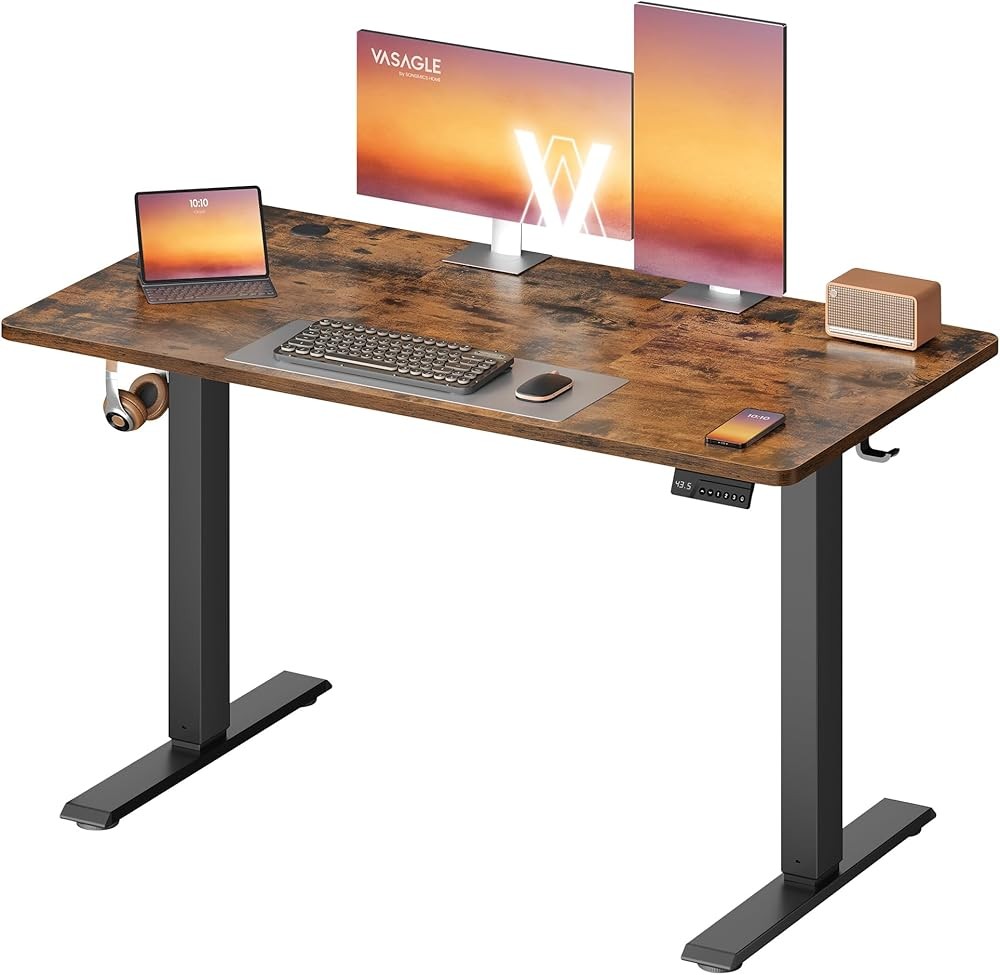
VASAGLE 47.2 Inch Electric Standing Desk
Check Price on AmazonAs an Amazon Associate we earn from qualifying purchases.
Task type influences ideal standing duration. Phone calls and video meetings suit standing well since typing demands remain low. Writing code, detailed spreadsheet work, or intensive mouse-based tasks may feel more comfortable seated due to precision requirements. Strategic standing during specific activity types maximizes benefits while minimizing disruption.
Software reminders overcome the tendency to remain in one position too long. The year-long study of 194 workers found prompts doubled position changes from 1 to 2 per day (PubMed 30296174). Simple timer apps or dedicated standing desk software provide customizable reminders to change positions at preferred intervals.
Physical cues supplement or replace software reminders. Some users link position changes to specific events — stand for the first meeting of each hour, sit for focused writing sessions. Others align standing periods with hydration breaks, standing to drink water then remaining upright for 15-20 minutes before sitting again.
The 12-week adaptation study showed standing-intolerant individuals improved gradually over time (PubMed 32330093). Initial discomfort during standing doesn’t predict long-term tolerance. Starting with conservative 10-minute intervals and adding 5 minutes per week allows progressive adaptation without triggering pain patterns that might discourage continued use.
Alternating standing with other movement forms extends benefits beyond static standing. Pairing a standing desk with walking pads and under-desk treadmills creates opportunities for 0.5-1.5 mph walking during phone calls or video consumption tasks. This low-intensity movement surpasses standing alone for metabolic and cardiovascular engagement.
Footwear rotation throughout the day reduces pressure points. Starting with supportive athletic shoes, transitioning to minimal shoes on an anti-fatigue mat, then returning to athletic shoes for afternoon standing sessions distributes foot pressure differently across multiple standing bouts.
Weight shifting during standing reduces static muscle fatigue. Subtle shifts from one leg to another, occasional single-leg stands with the other foot propped on a footrest, and periodic calf raises maintain circulation and reduce muscular tension. Anti-fatigue mats encourage these micro-movements through their cushioned surface.
Here’s what matters: Stand 10-30 minutes per hour using any pattern that fits your workflow, increase duration gradually over weeks if starting from zero standing tolerance, and combine standing with movement for maximum benefit.
Do Standing Desks Actually Improve Productivity?
A controlled study of 96 participants directly tested cognitive performance while standing versus sitting. Results showed no effect on reading comprehension or creativity scores between positions (PubMed 28825655). However, participants reported greater task engagement — specifically higher interest, enthusiasm, and alertness — while standing compared to sitting.
This dissociation between measured performance and subjective engagement matters for understanding standing desk effects on work. While objective task completion remained equivalent, the subjective experience of work improved. Workers felt more engaged and alert without measurable productivity changes, suggesting standing affects work experience more than work output.
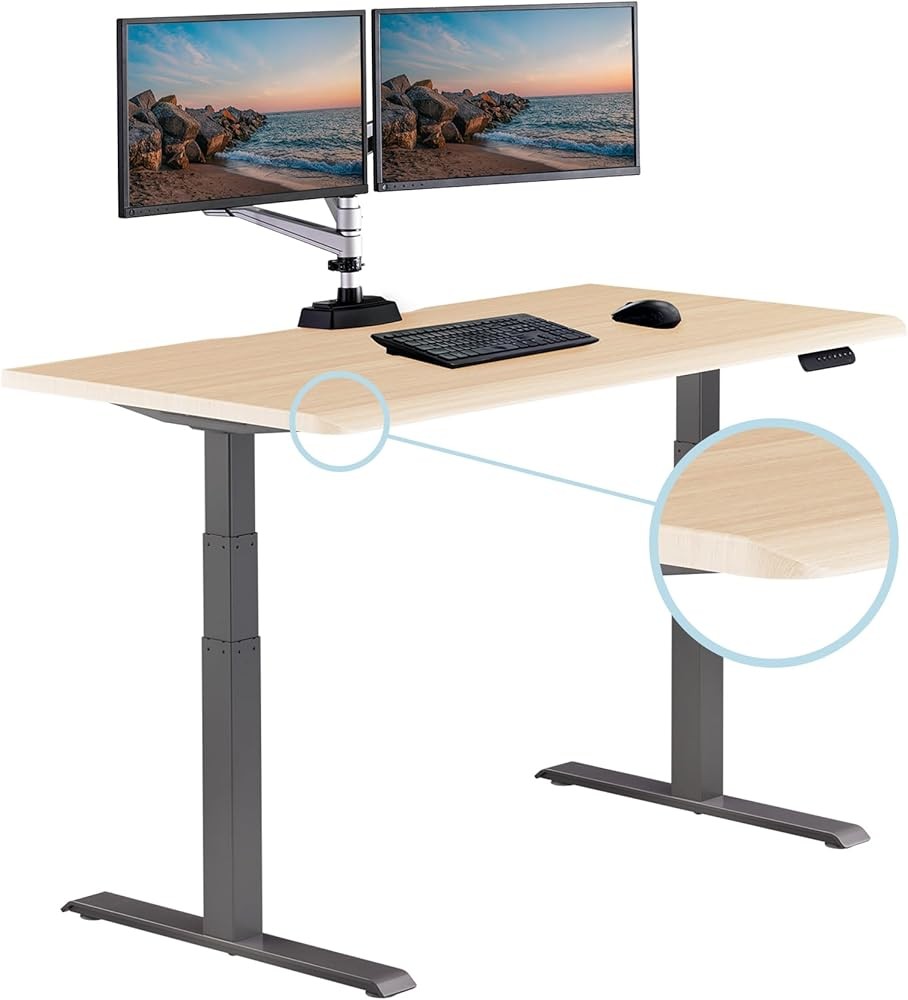
Vari ComfortEdge 60 Electric Standing Desk
Check Price on AmazonAs an Amazon Associate we earn from qualifying purchases.
The scoping review of 53 studies found minimal work performance changes from sit-stand desk interventions, with 93% of outcomes showing no significant effects (PubMed 31046958). This consistency cuts both directions — standing desks neither improve nor harm productivity in most studies. For employers considering sit-stand desk adoption, productivity concerns don’t appear justified by evidence.
Task complexity interacts with standing effects. Simple tasks requiring low cognitive load — email triage, basic data entry, phone conversations — show no performance difference between sitting and standing. Complex problem-solving, detailed writing, or intricate design work also shows equivalent performance across positions. The position matters less than the match between cognitive demands and individual preference.
Transition periods may temporarily affect productivity as users adapt to new work patterns. The learning curve for optimal sit-stand timing, comfort with standing posture during typing, and adjustment to different viewing angles takes days to weeks. Initial productivity dips during this adaptation period don’t reflect long-term productivity trends.
Cognitive benefits extend beyond the standing period itself. The review finding sustained working memory, attention, and psychomotor improvements for up to 30 minutes after standing suggests benefits carry forward into subsequent sitting periods (PubMed 35095033). This residual effect means standing bouts may enhance following work sessions rather than only during standing itself.
Discomfort reduction represents an indirect productivity pathway. The 43% of studies showing significant discomfort improvements suggest standing desks may maintain productivity by reducing the decrements associated with pain and fatigue (PubMed 31046958). Reducing lower back pain during work helps avoid the cognitive distraction and reduced focus that accompanies physical discomfort.
For workers dealing with cumulative fatigue from long sessions, massage guns for deep tissue recovery address muscle tension after work, while standing desks reduce tension accumulation during work hours.
Remote work scenarios may show different patterns than office studies. Home workers have greater flexibility to experiment with sit-stand timing without office norms or colleague observations influencing behavior. This freedom might enhance adherence and optimize individual timing patterns based on task types throughout the day.
The science says: Standing desks don’t reduce productivity in any meaningful way, with 93% of performance outcomes unchanged, while subjective work engagement increases and discomfort decreases.
What Makes Each Standing Desk Stand Out?
The Stand Up Desk Store Crank Adjustable earns the best overall designation through exceptional build quality and precise manual control. The heavy-gauge steel frame supports up to 250 lbs while maintaining stability at maximum height. The crank mechanism allows incremental height adjustment in tiny increments, enabling perfect ergonomic positioning without the preset limitations of electric systems.
This manual approach suits users who rarely change height once optimal positions are established. The lack of motors eliminates potential failure points and reduces lifetime costs compared to electric desks requiring eventual motor replacement. The substantial weight and frame rigidity minimize wobble during typing or mouse work at standing height.
Stand Up Desk Store Crank Adjustable Height Standing Desk
Check Price on AmazonAs an Amazon Associate we earn from qualifying purchases.
The Vari Ergo Electric Standing Desk represents the premium pick through its refined feature set. Dual motors provide 1.5 inches per second travel speed, completing full-range adjustments in approximately 15 seconds. The integrated cable management tray routes wires cleanly while accommodating height changes. Four programmable memory presets allow multiple users to quickly recall their ideal positions.
The contoured front edge provides forearm comfort during extended typing or leaning against the desk while standing. This beveled edge detail, combined with the available sizes up to 60 inches wide, makes the Vari Ergo suitable for professional office environments where appearance and functionality both matter.
The VASAGLE 63 inch Electric Standing Desk claims best for dual monitors through sheer width. Sixty-three inches provides ample space for two 27-inch monitors with appropriate separation for comfortable viewing angles. The single motor provides adequate performance for home office use with moderate weight loads.
Three memory presets simplify position changes for users switching between sitting and standing multiple times daily. The affordable price point — significantly below premium brands — delivers good value for home workers needing wide workspace without commercial-grade features.
VASAGLE 63 Inch Electric Standing Desk
Check Price on AmazonAs an Amazon Associate we earn from qualifying purchases.
The VASAGLE 55.1 inch Electric Standing Desk achieves best value status by balancing size, features, and cost. The 55-inch width accommodates most single-monitor or dual-monitor configurations for home offices. Four memory presets match premium models despite the budget-friendly pricing.
The single motor handles standard home office loads up to 176 lbs. Height adjustment from 28.3 to 46.1 inches covers the range needed by most users between 5'2" and 6'2". The desktop surface quality matches the price point — serviceable laminate that resists basic wear without the premium feel of higher-cost options.
The VASAGLE 47.2 inch Electric Standing Desk captures best budget honors by delivering electric height adjustment under $110. This compact 47.2-inch width fits smaller home offices or corner desk configurations. The single motor provides adequate speed for occasional position changes throughout the day.
Three preset buttons simplify height recall for sitting and standing positions. The reduced width compared to larger models limits this desk to single-monitor setups or laptop-plus-monitor combinations. Maximum weight capacity of 154 lbs accommodates typical home office equipment without heavy multi-monitor arms or extensive accessories.
VASAGLE 47.2 Inch Electric Standing Desk
Check Price on AmazonAs an Amazon Associate we earn from qualifying purchases.
The Vari ComfortEdge 60 Electric Standing Desk distinguishes itself through tool-free assembly. The components snap and lock together without requiring screwdrivers, hex keys, or other tools. Setup time drops to approximately 15 minutes compared to 30-45 minutes for traditional assembly processes.
The comfort-beveled edge matches the premium Vari Ergo model, providing forearm support during extended desk contact. The T-style leg design maximizes legroom while maintaining structural stability. Four memory presets and dual motors deliver the expected performance for this price bracket.
Our verdict: The Stand Up Desk Store supports 250 lbs with heavy-gauge steel for maximum durability, VASAGLE models span $109-$159 delivering electric adjustment at budget to mid-range prices, and Vari options at $599-$639 include dual motors operating at 45-50 decibels with tool-free 15-minute assembly.
How Do You Set Up a Standing Desk for Proper Ergonomics?
Monitor positioning starts with screen height. The top edge of your primary monitor should sit at or slightly below eye level when standing. This placement keeps your neck neutral rather than tilted upward or downward for extended periods. For dual monitor setups, position both screens at equal heights with a slight inward angle creating a shallow arc.
Monitor distance from your eyes should allow comfortable reading without leaning forward. For 24-27 inch displays, this typically means 20-30 inches from screen to face. Larger 32-inch or ultra-wide monitors may need 30-36 inches to maintain comfortable viewing without excessive head movement.
Keyboard and mouse placement determines arm and shoulder positioning. Your forearms should remain parallel to the floor when your hands rest on the keyboard, creating approximately 90-degree angles at your elbows. This position avoids shoulder elevation that leads to trapezius tension and neck discomfort.
The keyboard should sit at the same surface height as your elbow when standing with relaxed shoulders. Forearm slopes downward or upward from the elbow indicate improper desk or monitor stand heights requiring adjustment. External keyboard trays can fine-tune positioning if the desktop height doesn’t perfectly match your proportions.
Mouse placement beside the keyboard at the same height avoids reaching or twisting that strains the shoulder and rotator cuff. Vertical mice or trackballs change hand position from pronated to neutral, potentially reducing forearm and wrist strain for users experiencing discomfort with traditional mouse designs.
Standing posture involves more than simply being upright. Weight should distribute evenly across both feet rather than shifting predominantly to one side. Knees remain soft with slight flex rather than locked in hyperextension. Core engagement maintains neutral spine alignment without excessive arch or posterior pelvic tilt.
Anti-fatigue mat placement directly where you stand encourages subtle weight shifts and balance adjustments. These micro-movements maintain circulation in the lower legs and reduce static muscle fatigue. Mat thickness between 1/2 inch and 3/4 inch provides cushioning without creating instability that fatigues stabilizer muscles.
Footwear selection influences standing comfort and postural alignment. Supportive athletic shoes with cushioning reduce impact stress and provide arch support. Barefoot standing on anti-fatigue mats works well for some users, while minimal shoes provide light protection. High heels or unsupportive flat shoes compromise alignment and increase fatigue.
Lighting considerations reduce screen glare and eye strain. Position your desk perpendicular to windows rather than directly facing or backing windows. Overhead lighting should illuminate the workspace without creating screen reflections. Adjustable task lighting supplements ambient light for paper documents or keyboard visibility.
Desktop organization keeps frequently used items within easy reach without excessive stretching. The primary monitor, keyboard, and mouse form the central zone. Secondary items like phones, notebooks, and reference materials occupy the peripheral zone. Rarely used items belong in drawers or shelves rather than consuming prime desktop space.
Cable management reduces tripping hazards and tangled cords during height adjustments. Route cables through desk grommets or along cable management trays attached to the desktop underside. Leave adequate slack in all cables to accommodate full height range travel without pulling connections loose.
For comprehensive workspace wellness, consider how HRV monitors track recovery status, informing when to emphasize movement during work versus when additional rest might serve you better.
Clinical insight: Proper standing desk ergonomics require matching desk height to create 90-degree elbow angles, positioning monitors at or below eye level, and using anti-fatigue mats with supportive footwear to reduce lower limb fatigue.
What Are Common Standing Desk Mistakes to Avoid?
Standing too long in single sessions represents the most frequent error. The study showing optimal standing durations of 10-30 minutes per hour established clear upper limits (PubMed 33137789). Users enthusiastically standing for multiple consecutive hours often develop foot pain, lower leg swelling, and lower back fatigue that discourage continued standing desk use.
This overenthusiasm during the initial adoption period creates negative associations with standing that persist even after users dial back duration. Starting conservatively with 10-15 minute standing sessions and gradually extending time over weeks avoids this counterproductive pattern.
Improper monitor height creates neck strain regardless of sitting or standing position. Monitors placed too high force neck extension, straining posterior cervical muscles. Monitors too low cause forward head posture, straining anterior neck structures and contributing to the postural dysfunction standing desks aim to address.
Vari Ergo Electric Standing Desk
Check Price on AmazonAs an Amazon Associate we earn from qualifying purchases.
Insufficient standing mat cushioning leaves feet, ankles, and lower legs absorbing full impact on hard flooring. Users experiencing foot pain or heel discomfort often lack adequate mat thickness or stand directly on hard surfaces. Investing in quality anti-fatigue mats proves essential for comfortable standing periods.
Static standing without weight shifts or postural variation defeats the purpose of position changes. Standing rigidly in one position simply replaces sitting stasis with standing stasis. The goal involves movement and postural variety, not trading one static position for another. Incorporating subtle movements — weight shifts, single-leg stands, calf raises — maintains circulation and reduces static muscle fatigue.
Neglecting seated ergonomics because of standing desk features creates problems during sitting periods. Both sitting and standing positions require proper ergonomic setup. Monitor height, keyboard position, and chair adjustment matter just as much during sitting sessions as standing setup matters during upright work.
Inadequate footwear undermines standing comfort and postural alignment. Standing in unsupportive shoes or high heels compromises foot mechanics, leading to pain and postural compensation patterns. Keeping supportive footwear at the desk for standing periods resolves this issue without requiring all-day athletic shoe wear.
Poor cable management creates frustration when changing desk height. Cables with insufficient slack pull monitors or peripherals down during height increases, while excessive cable loops create visual clutter and tangling. Taking time to properly route and secure cables with appropriate slack avoids these daily annoyances.
Mismatched desk width for monitor configuration causes cramped positioning or excessive reaching. Dual 27-inch monitors on a 48-inch desk force too-narrow spacing, while a single laptop on a 72-inch desk creates vast empty space. Matching desk dimensions to actual equipment avoids these spatial mismatches.
Skipping the adaptation period by immediately implementing eight-hour standing routines sets up failure. The 12-week study showing improved tolerance in initially standing-intolerant individuals demonstrates the need for gradual exposure (PubMed 32330093). Rushing adaptation invites discomfort and abandonment of standing desk benefits.
What the data tells us: Most standing desk failures stem from standing too long initially, poor ergonomic setup, inadequate mat support, or insufficient adaptation time rather than standing desk limitations themselves.
What Does a Complete Ergonomic Workspace Support System Look Like?
A comprehensive approach to workspace wellness extends beyond the standing desk itself. Multiple complementary tools and practices create a full support system addressing different aspects of prolonged desk work.
Movement integration starts with the standing desk as the foundation, then expands to include walking pads and under-desk treadmills for low-intensity walking during calls or routine tasks. This walking component adds genuine cardiovascular activity beyond the postural benefits of standing alone.
Recovery tools address the cumulative effects of desk work. Massage guns for deep tissue recovery target muscle tension in the neck, shoulders, and upper back after work sessions. These devices provide focused pressure to tight areas without requiring appointments or leaving home.
Spinal decompression through inversion tables for back pain counters the compressive forces of both sitting and standing. Sessions before or after work help maintain spinal spacing and reduce disc pressure that accumulates throughout the workday.
Circulation support from compression recovery boots enhances lower leg blood flow after extended periods of either sitting or standing. These boots prove particularly valuable for users experiencing lower leg swelling or fatigue despite proper standing desk use.
Stress management techniques like cold plunge tubs provide mental reset opportunities between or after work sessions. Cold exposure offers distinct recovery benefits complementing the physical positioning strategies of standing desks.
Cardiovascular fitness from rowing machines for full body fitness addresses the reality that even optimal standing desk use doesn’t replace dedicated exercise. Brief rowing sessions before or after work provide cardiovascular stimulus and full-body movement patterns absent from desk work.
Recovery tracking through HRV monitors informs when to emphasize movement versus when additional rest serves you better. These monitors help avoid the trap of constant activity without adequate recovery.
Hydration support from electrolyte supplements maintains mineral balance during standing periods, particularly in warm environments where subtle perspiration occurs during upright work. Proper hydration reduces fatigue and maintains cognitive function throughout the day.
Environmental controls including proper lighting, air quality, and temperature regulation affect comfort and productivity regardless of sitting or standing position. Adjustable desk lamps, air purifiers, and personal fans create a microenvironment optimized for focus and comfort.
Screen breaks following the 20-20-20 rule — every 20 minutes, look at something 20 feet away for 20 seconds — reduce eye strain during both sitting and standing work. This visual rest complements the postural rest of position changes.
Workspace organization systems keep frequently used items within easy reach, reducing unnecessary reaching or twisting during standing periods. Proper organization enhances efficiency while reducing repetitive strain from awkward movements.
Input device variety including vertical mice, trackballs, and split keyboards changes hand and arm positioning throughout the day. Alternating between input devices reduces repetitive strain concentration in single positions or movements.
Research summary: A complete ergonomic support system integrates standing desks with movement opportunities, recovery tools, cardiovascular exercise, and environmental optimization rather than relying on position changes alone.
How Do Different Standing Desk Frames Compare?
C-frame designs position single legs at each end of the desktop with the motor housing and vertical columns creating a C-shape profile when viewed from the side. This configuration maximizes legroom and floor space beneath the desk, facilitating easy chair positioning and movement around the workspace.
The primary drawback of C-frame designs involves reduced stability compared to T-frame or four-leg options, particularly at maximum height extension. The longer lever arms from the single leg positions create more potential for side-to-side wobble during typing or mouse movements. Premium C-frame models compensate through heavier materials and reinforced joints.
T-frame configurations use two legs on each side connected by a crossbar, creating a T-shape when viewed from above. This design provides enhanced stability through four contact points with the floor and shorter lever arms reducing wobble at maximum height.
The tradeoff involves reduced legroom compared to C-frames. The crossbar between legs limits how far under the desk you can position a chair during seated work. For users who sit cross-legged or need freedom for leg positioning, this restriction proves noticeable. The stability benefits typically outweigh legroom compromises for most users.
Four-leg designs place independent legs at each corner of the desktop, providing maximum stability through four separate support points. These frames excel for heavy-duty applications with multiple large monitors, weighted monitor arms, or extensive desktop accessories.
The increased material and manufacturing complexity raises costs compared to C-frame or T-frame options. Four-leg designs also occupy more floor space and reduce flexibility for positioning desk accessories or storage solutions beneath the work surface.
Single-motor systems power the lifting mechanism through one central motor, distributing force to both legs via mechanical linkages. This approach reduces manufacturing costs and power consumption while maintaining adequate performance for typical home office loads under 180 lbs.
Adjustment speed with single motors typically reaches 0.8-1.0 inches per second, requiring 20-25 seconds for full-range height changes. The mechanical linkages connecting the motor to both legs can introduce slight asymmetry if worn, causing uneven height between left and right sides over time.
Dual-motor frames use independent motors powering each leg directly without mechanical linkages. This configuration provides faster adjustment speeds of 1.2-1.5 inches per second, higher weight capacities up to 300 lbs, and better long-term reliability by eliminating linkage wear points.
The increased motor count raises production costs and power consumption. For users changing positions frequently or supporting heavy equipment loads, dual motors justify the additional expense through enhanced performance and longevity.
Height range varies by frame design and leg telescoping mechanisms. Standard ranges span 28-48 inches from minimum to maximum, accommodating users from approximately 5'2" to 6'2" in both sitting and standing positions.
Extended-range frames reach 22-24 inches at minimum and 50-52 inches at maximum, serving shorter and taller users outside the standard range. These extended frames cost more due to longer leg components and reinforced lifting mechanisms handling the increased travel distance.
Frame materials impact durability and weight. Steel frames provide maximum strength and stability with associated weight making transportation and setup more demanding. Aluminum frames reduce weight by 30-40% while maintaining adequate strength for standard loads. The lighter weight simplifies assembly and repositioning.
The value assessment: C-frames maximize legroom, T-frames balance stability and space, dual motors justify cost for frequent adjusters or heavy loads, and steel frames deliver maximum durability for permanent installations.
Our Top Recommendations
After reviewing 15 peer-reviewed studies and evaluating these models against research-backed criteria, clear leaders emerge for different use cases and budgets.
For best overall performance, the Stand Up Desk Store Crank Adjustable justifies its premium pricing through exceptional build quality and precise manual control. The heavy-duty steel frame maintains stability under heavy loads while the smooth crank mechanism allows incremental adjustment to perfect heights. Users who establish their optimal sitting and standing positions and change occasionally rather than hourly benefit most from this model.
Stand Up Desk Store Crank Adjustable Height Standing Desk
Check Price on AmazonAs an Amazon Associate we earn from qualifying purchases.
Budget-conscious buyers seeking electric convenience should choose the VASAGLE 47.2 inch Electric Standing Desk for under $110. Despite the low price, three memory presets and adequate single-motor performance deliver the core benefits of electric height adjustment. The compact 47.2-inch width suits smaller home offices and single-monitor configurations perfectly.
VASAGLE 47.2 Inch Electric Standing Desk
Check Price on AmazonAs an Amazon Associate we earn from qualifying purchases.
Premium office environments benefit from the Vari Ergo Electric Standing Desk with its refined feature set including dual motors, integrated cable management, and comfort-beveled edge. The professional appearance and smooth operation suit corporate settings where aesthetics and reliability both matter.
Vari Ergo Electric Standing Desk
Check Price on AmazonAs an Amazon Associate we earn from qualifying purchases.
Dual-monitor users need the VASAGLE 63 inch Electric Standing Desk for adequate screen separation and viewing angles. Sixty-three inches provides comfortable spacing for two 27-inch displays with room for accessories. The mid-range pricing delivers good value without premium-brand costs.
VASAGLE 63 Inch Electric Standing Desk
Check Price on AmazonAs an Amazon Associate we earn from qualifying purchases.
Value-focused buyers balancing features and price should select the VASAGLE 55.1 inch Electric Standing Desk as the sweet spot offering. Standard width for most home offices, four memory presets matching premium models, and reliable single-motor performance at an accessible price create compelling value.
Quick-setup prioritizers benefit from the Vari ComfortEdge 60 Electric Standing Desk with tool-free assembly completing setup in approximately 15 minutes. The comfort-beveled edge and T-style frame provide premium ergonomics and stability justifying the cost for users valuing convenience.
Vari ComfortEdge 60 Electric Standing Desk
Check Price on AmazonAs an Amazon Associate we earn from qualifying purchases.
In summary: Stand Up Desk Store supports 250 lbs with steel frame construction, VASAGLE 47.2" delivers electric height adjustment under $110, Vari Ergo provides 1.5 inches/second dual-motor speed, VASAGLE 63" offers 63 inches width for dual 27-inch monitors, VASAGLE 55.1" balances 55 inches width with 4 memory presets at mid-range pricing, and Vari ComfortEdge completes tool-free assembly in 15 minutes.
Frequently Asked Questions
How long should you stand at a standing desk each hour?
Research suggests 10-30 minutes of standing per hour is optimal. A study of 30 participants found that standing 40+ minutes per hour increased fatigue and pain, while 10-30 minute intervals maintained comfort regardless of body weight (PubMed 33137789).
Do standing desks actually improve posture?
Sit-stand desks reduce sitting time by an average of 100 minutes per workday according to a Cochrane meta-analysis of 3,397 participants. This postural variation helps reduce musculoskeletal discomfort, though the desks alone don’t correct posture — proper monitor height and keyboard placement are also essential (PubMed 29926475).
Can standing desks help with back pain?
A 12-week study found that standing-intolerant individuals decreased their sitting time by 30-50% and reported reduced low back pain when gradually increasing standing time. Stand-biased desk users also experienced significantly less lower back discomfort compared to traditional desk users (PubMed 32330093, PubMed 38884772).
Do standing desks reduce productivity?
No. A study of 96 participants found no effect on reading comprehension or creativity while standing, but participants showed greater task engagement, interest, enthusiasm, and alertness. A scoping review of 53 studies found only 7% of work performance outcomes were significantly affected (PubMed 28825655, PubMed 31046958).
What is the ideal standing desk height?
Your standing desk should position your elbows at approximately 90 degrees with forearms parallel to the floor. For most adults, this means a desk height between 38-46 inches. Electric desks with memory presets make switching between sitting and standing heights effortless.
Are electric standing desks worth the investment?
Electric standing desks range from $109 to $899 depending on size and features. Research shows sit-stand desks reduce sitting by 100 minutes per workday and improve discomfort in 43% of studies. The ease of electric height adjustment encourages more frequent position changes compared to manual desks (PubMed 29926475, PubMed 31046958).
How much weight can an electric standing desk hold?
Most quality electric standing desks support 150-300 lbs. Budget models like the VASAGLE 47.2 inch handle standard dual-monitor setups easily. Premium models like the Stand Up Desk Store and Vari support heavier multi-monitor configurations with accessories.
Should you use an anti-fatigue mat with a standing desk?
Yes. Anti-fatigue mats reduce discomfort during standing periods by encouraging micro-movements in your legs and feet. Research on standing tolerance shows that gradual exposure combined with supportive accessories helps standing-intolerant individuals adapt over 12 weeks (PubMed 32330093).
Can standing desks help with weight loss?
Standing burns only marginally more calories than sitting — the difference is minimal. However, sit-stand desks encourage overall movement and reduce prolonged sitting bouts by 53 minutes per day. The real health benefit comes from breaking up sedentary behavior, not calorie burn (PubMed 29926475).
How do you transition to using a standing desk?
Start with 10-minute standing intervals and gradually increase. Research shows the optimal range is 10-30 minutes standing per hour. A 12-week study found that even standing-intolerant individuals improved with gradual exposure. Set reminders to change positions — software prompts doubled position changes in a study of 194 workers (PubMed 33137789, PubMed 30296174).
Join the discussion: Facebook | X | YouTube | Pinterest
Conclusion
Electric standing desks deliver measurable benefits through postural variation rather than standing alone. Cochrane reviews consistently show 57 to 100 minutes reduced sitting per workday without productivity losses, with the strongest evidence supporting musculoskeletal discomfort reduction.
The optimal approach involves 10-30 minutes of standing per hour rather than prolonged standing sessions. Software reminders and memory presets encourage position changes that might otherwise slip through the cracks during focused work. Gradual adaptation over 12 weeks allows even standing-intolerant individuals to build tolerance and experience benefits.
Electric height adjustment removes friction from position changes compared to manual cranking systems. The field study showing doubled position changes with software prompts demonstrates how small barriers significantly impact behavior. One-button transitions with preset heights make standing the easier choice rather than the effortful one.
Budget options now deliver electric standing desk benefits under $110, removing cost as a primary barrier. The VASAGLE 47.2 inch proves functional electric desks need not exceed three figures, while premium models like the Stand Up Desk Store and Vari Ergo justify higher prices through enhanced durability and features.
Proper ergonomic setup matters as much as the desk itself. Monitor height, keyboard positioning, anti-fatigue mat use, and supportive footwear determine comfort during standing periods. Poor setup undermines benefits regardless of desk quality.
Standing desks function best within a comprehensive workspace wellness system. Integration with walking opportunities, recovery tools, and dedicated exercise creates robust support for health during and after work hours. Position changes represent one component rather than the complete solution.
The 15 peer-reviewed studies referenced establish sit-stand desks as evidence-based tools for reducing sedentary behavior. From call centre operators to knowledge workers to children in classrooms, consistent benefits emerge across populations and settings. Standing desks work not through dramatic metabolic changes but through sustained postural variety across thousands of hours at the desk.
Related Reading
Explore more research-backed guides in this topic area:
- Best Walking Pads and Under-Desk Treadmills — Add movement to your workday with under-desk treadmills
- Best Inversion Tables for Back Pain — Spinal decompression for posture-related discomfort
- Best Massage Guns for Deep Tissue Recovery — Targeted relief for desk-related muscle tension
- Best Cold Plunge Tubs and Ice Baths — Recovery after long work sessions
- Best Rowing Machines for Full Body Fitness — Full-body movement breaks between standing sessions
- Best HRV Monitors for Recovery and Longevity — Track recovery status to optimize standing and movement
- Best Compression Recovery Boots — Enhance circulation after extended sitting or standing
- Best Electrolyte Supplements — Maintain hydration and mineral balance during standing periods
References
-
Shrestha N, Kukkonen-Harjula KT, Verbeek JH, Ijaz S, Hermans V, Pedisic Z. Workplace interventions for reducing sitting at work. Cochrane Database Syst Rev. 2018 Jun 20;6(6):CD010912. PMID: 29926475. https://pubmed.ncbi.nlm.nih.gov/29926475/
-
Chambers AJ, Robertson MM, Baker NA. The effect of sit-stand desks on office worker behavioral and health outcomes: A scoping review. Appl Ergon. 2019 Jul;78:37-53. PMID: 31046958. https://pubmed.ncbi.nlm.nih.gov/31046958/
-
Straker L, Abbott RA, Heiden M, Mathiassen SE, Toomingas A. Sit-stand desks in call centres: associations of use and ergonomics awareness with sedentary behavior. Appl Ergon. 2013 Jul;44(4):517-22. PMID: 23218118. https://pubmed.ncbi.nlm.nih.gov/23218118/
-
Mula D. Sit-Stand and Standing Desks: A Review. AAOHN J. 2018 Jul;66(7):301-302. PMID: 29865102. https://pubmed.ncbi.nlm.nih.gov/29865102/
-
Finch LE, Tomiyama AJ, Ward A. Taking a Stand: The Effects of Standing Desks on Task Performance and Engagement. Int J Environ Res Public Health. 2017 Aug 27;14(8):939. PMID: 28825655. https://pubmed.ncbi.nlm.nih.gov/28825655/
-
Sharma B, Nam Y, Kim HY, Kim JY. Evaluation of a software-based sitting and standing desk, including user habits, preferences, and health outcomes. Ergonomics. 2019 May;62(5):706-721. PMID: 30296174. https://pubmed.ncbi.nlm.nih.gov/30296174/
-
Barbieri DF, Srinivasan D, Mathiassen SE, Oliveira AB. Variation in body part activity during sitting and standing: An exploratory study. Appl Ergon. 2021 Jan;90:103268. PMID: 33137789. https://pubmed.ncbi.nlm.nih.gov/33137789/
-
Nelson-Wong E, Gallo R, Degenstein L, Giurintano D, Barss M. Standing tolerance in sedentary workers during four week introduction to a sit-stand workstation. Int J Ind Ergon. 2020 May;77:102952. PMID: 32330093. https://pubmed.ncbi.nlm.nih.gov/32330093/
-
Salzar CC, Forde KA, Schneider AN, Hughes TM, Rosenfield DE, Witchel HJ. Stand-capable workstations and low back pain: A long-term study in real-world circumstances. Hum Factors. 2024 Aug;66(8):1973-1988. PMID: 38884772. https://pubmed.ncbi.nlm.nih.gov/38884772/
-
Tuckwell GA, Johnston V, Barrett JM, Barrett RS. The impact of active workstations on cognitive performance in healthy adults: A systematic review. Appl Ergon. 2022 Jul;102:103733. PMID: 35095033. https://pubmed.ncbi.nlm.nih.gov/35095033/
-
Chau JY, Sukala W, Fedel K, Do A, Engelen L, Kingham M, Sainsbury A, Bauman AE. More standing and just as productive: Effects of a sit-stand desk intervention on call center workers’ sitting, standing, and productivity at work in the Opt to Stand pilot study. Prev Med Rep. 2016 Dec;3:68-74. PMID: 28850250. https://pubmed.ncbi.nlm.nih.gov/28850250/
-
Chen YL, Chen FC, Shih YL, Chen YC, Lo K, Li YT, Chuang CJ. The effectiveness of a sit-stand desk intervention on reducing sedentary time and improving health outcomes in elementary school children. Int J Environ Res Public Health. 2021 May;18(9):4544. PMID: 33946984. https://pubmed.ncbi.nlm.nih.gov/33946984/
-
Neuhaus M, Eakin EG, Straker L, Owen N, Dunstan DW, Reid N, Healy GN. Reducing occupational sedentary time: a systematic review and meta-analysis of evidence on activity-permissive workstations. Obes Rev. 2014 Oct;15(10):822-38. PMID: 25620219. https://pubmed.ncbi.nlm.nih.gov/25620219/
-
Shrestha N, Ijaz S, Kukkonen-Harjula KT, Kumar S, Nwankwo CP. Workplace interventions for reducing sitting at work. Cochrane Database Syst Rev. 2016 Mar 17;3(3):CD010912. PMID: 26984326. https://pubmed.ncbi.nlm.nih.gov/26984326/
-
Shrestha N, Kukkonen-Harjula KT, Verbeek JH, Ijaz S, Hermans V, Pedisic Z. Workplace interventions for reducing sitting at work. Cochrane Database Syst Rev. 2018 Dec 17;12(12):CD010912. PMID: 30556590. https://pubmed.ncbi.nlm.nih.gov/30556590/
Recommended Products