Shower Filters for Hard Water: KDF, Carbon, and Multi-Stage Filtration
Summarized from peer-reviewed research indexed in PubMed. See citations below.
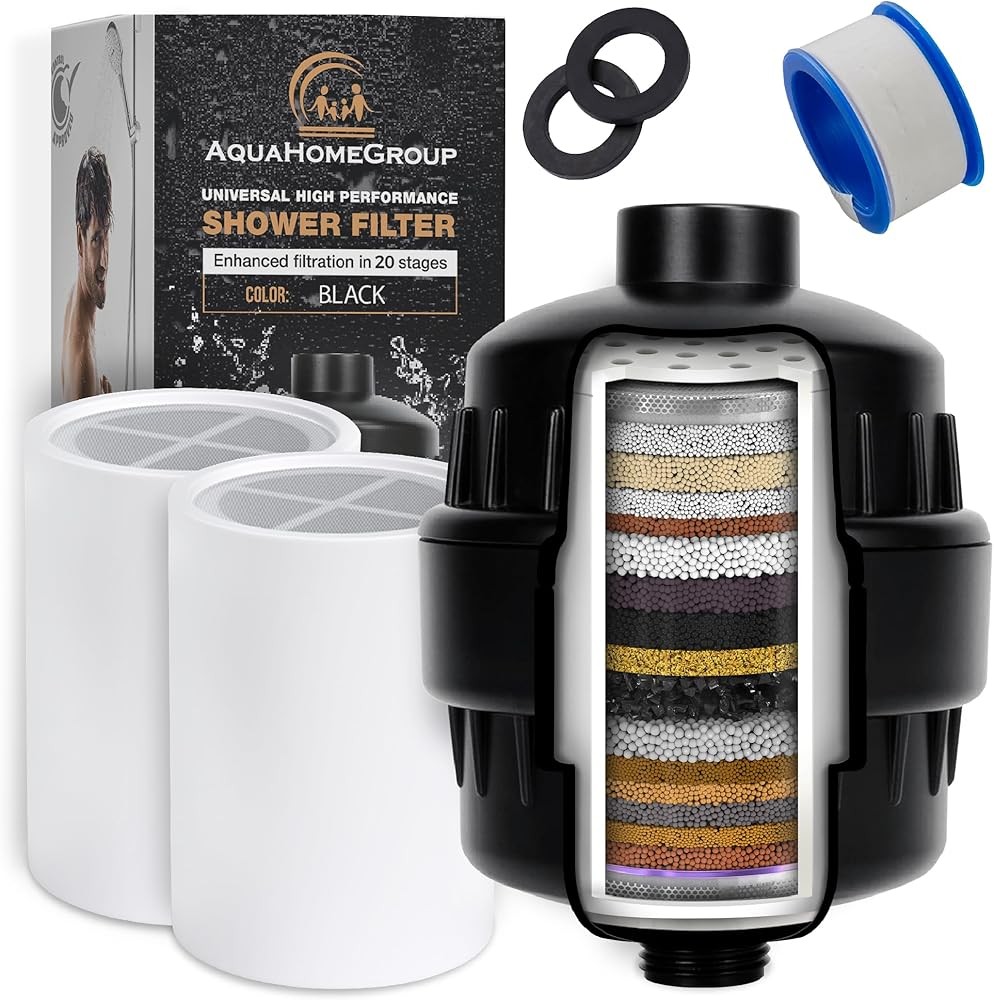
Hard water minerals combined with chlorine create a double exposure problem during showering, with published research showing bathing accounts for more than half of total disinfection byproduct exposure. The AquaBliss SF500 Heavy Duty (B07QBZ5XWZ, $45) combines KDF-55 copper-zinc media, activated carbon, and calcium sulfite in a multi-stage design that addresses both chemical contaminants and heavy metals simultaneously. Research demonstrates that granular activated carbon achieves 99.7% volatile organic compound removal while KDF electrochemically reduces heavy metals through redox reactions that maintain full effectiveness regardless of water temperature. For budget-conscious buyers, the AquaHomeGroup 20-Stage (B0BMF5YQ66, $29) delivers comprehensive multi-media filtration with vitamin C and E infusion at nearly half the cost. Here’s what the published research shows about filtration mechanisms for hard water areas and which multi-stage approach works best.
Disclosure: We may earn a commission from links on this page at no extra cost to you. Affiliate relationships never influence our ratings. Full policy →
| Feature | 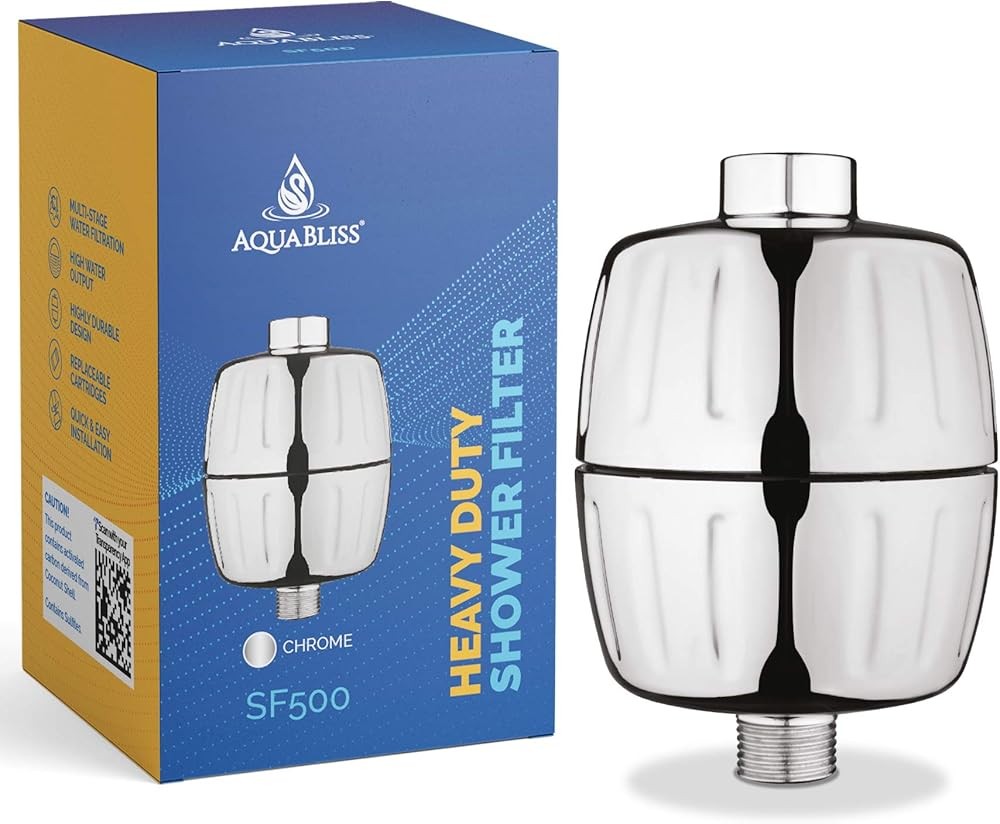 B07QBZ5XWZ B07QBZ5XWZ
|
 B0BMF5YQ66 B0BMF5YQ66
|
 B0FW5CTK1L B0FW5CTK1L
|
|---|---|---|---|
| View on Amazon | Check Price | Check Price | Check Price |
How Does Hard Water Affect Showering and Chemical Exposure?
Hard water contains dissolved minerals — primarily calcium and magnesium — at concentrations above 120 parts per million or 7 grains per gallon. These minerals interact with chlorine and other disinfectants to create conditions that amplify chemical exposure during bathing.
When chlorinated water mixes with organic matter in municipal systems, the reaction produces disinfection byproducts (DBPs). A 30-year review published in Mutation Research (PMID: 17980649) analyzed more than 85 different DBPs in chlorinated water systems and found that bathing accounts for more than 50% of total DBP exposure despite drinking water receiving the most attention. The researchers noted that showering combines dermal absorption, inhalation of volatilized compounds, and direct contact with aerosolized water droplets.
The temperature factor compounds this exposure. Research in Science of the Total Environment (PMID: 30316091) measured trihalomethane (THM) levels at different water temperatures and documented that hot water generates 2.1 to 3.7 times higher THM concentrations compared to cold water. This temperature effect occurs because heat accelerates the volatilization of DBPs and increases their transfer from water to air.
Key takeaway: Hard water minerals don’t cause these DBPs directly, but they do affect chlorine demand and reactivity. Water treatment facilities serving hard water areas often add higher chlorine doses to achieve the same disinfection levels, which increases the raw material available for DBP formation. A study in Journal of Water and Health (PMID: 25719485) found THM levels 7 to 8 times above WHO maximum contaminant levels in some hard water distribution systems.
The practical impact shows up in blood concentration measurements. Environmental Science and Pollution Research (PMID: 34705209) documented blood THM levels that increased 2.7 to 4.8 times baseline after a 10-minute shower. The study tracked subjects with varying shower durations and water temperatures, consistently finding that longer, hotter showers resulted in proportionally higher internal THM concentrations.
Inhalation represents the dominant exposure route. Research published in Environmental Research (PMID: 34973941) compared inhalation versus dermal absorption during showering and found that breathing volatilized compounds delivered greater total dose than skin contact. Another study in International Journal of Hygiene and Environmental Health (PMID: 15729838) quantified this difference, showing that inhalation exceeded dermal exposure by 2 to 5 times depending on shower duration and ventilation conditions.
Pool environments provide a useful comparison. Annals of Work Exposures and Health (PMID: 37339253) measured airborne chloroform concentrations in indoor swimming facilities and recorded levels ranging from 5 to 240 micrograms per cubic meter. Shower stalls create similar enclosed spaces where volatilized compounds accumulate, particularly when exhaust ventilation is inadequate or absent.
The filtration reality: Shower filters don’t remove calcium and magnesium minerals. Water hardness passes through unchanged because mineral ions remain dissolved at the molecular level. What filters do remove are the chlorine and chemical compounds that react with these minerals to create the exposure problem. For complete mineral removal, whole-house ion exchange systems are required, which replace calcium and magnesium with sodium through a chemical substitution process.
The evidence shows: Hard water areas benefit most from multi-stage shower filters because these systems address the chemical complexity created when minerals, chlorine, and organic compounds interact. Single-stage carbon filters may become saturated faster in hard water due to mineral deposits reducing media contact time. Multi-stage designs compensate by distributing filtration tasks across specialized media types, each optimized for different contaminant categories.
What Filtration Media Work Best for Hard Water Applications?
Three primary media types dominate shower filtration for hard water areas: KDF alloys, activated carbon, and calcium sulfite. Each operates through distinct mechanisms that complement rather than duplicate each other.
KDF (Kinetic Degradation Fluxion) consists of high-purity copper-zinc alloy granules formulated as KDF-55 for shower temperature applications. When water flows through the media, the galvanic couple between copper and zinc creates an electrochemical potential difference. This electron exchange drives oxidation-reduction reactions that convert dissolved heavy metals into insoluble forms that precipitate out of solution.
The mechanism works through what chemists call a redox process. Lead, mercury, and other heavy metals exist in water as positively charged ions. KDF-55’s zinc component donates electrons to these metal ions, reducing them to their metallic state where they bond to the media surface. Simultaneously, some zinc oxidizes and releases into the water at concentrations below EPA drinking water standards for zinc.
KDF also controls bacterial growth through the oligodynamic effect — a phenomenon where trace amounts of copper ions disrupt bacterial cell membranes and interfere with enzyme function. Research shows this occurs at copper concentrations as low as 0.05 parts per million, well below levels that affect water taste or safety.
Temperature independence gives KDF a critical advantage in shower applications. Unlike activated carbon, which loses efficiency as water temperature rises, KDF maintains consistent performance from cold to hot water. This stability matters because most showers operate at 100 to 110 degrees Fahrenheit — temperatures where carbon adsorption capacity drops significantly.
Activated carbon removes contaminants through adsorption — a surface phenomenon where molecules adhere to the carbon’s porous structure. Coconut shell-based carbons offer the highest surface area per gram, with quality grades providing 1,000 to 1,500 square meters of adsorptive surface per gram of media.
Chlorine removal occurs when carbon catalyzes chlorine reduction to chloride ions. The reaction happens rapidly at the carbon surface, making it effective even at shower flow rates of 2.5 gallons per minute. Research published in Chemosphere (PMID: 23540811) documented 99.7% volatile organic compound removal with granular activated carbon under controlled test conditions.
What this means: The temperature limitation stems from thermodynamics. Adsorption is an exothermic process, meaning it releases heat. According to Le Chatelier’s principle, increasing temperature shifts the equilibrium away from adsorption and toward desorption. Practical measurements show activated carbon efficiency decreasing by approximately one-third when water temperature rises from 50 degrees to 100 degrees Fahrenheit.
Hard water accelerates carbon exhaustion through mineral fouling. Calcium and magnesium precipitate as carbonates on the carbon surface, blocking pores and reducing available adsorption sites. This doesn’t make carbon ineffective in hard water, but it does mean replacement intervals may shorten from 6 months to 4 or 5 months depending on mineral concentration.
Calcium sulfite provides temperature-independent chlorine removal through a different chemical pathway. The media reacts with chlorine to form calcium sulfate and hydrochloric acid, which immediately neutralizes to calcium chloride and water. This reaction proceeds efficiently at any temperature, making calcium sulfite particularly valuable for hot water applications where carbon performance declines.
The reaction is stoichiometric — each calcium sulfite molecule removes a fixed amount of chlorine based on the chemical equation. This means filtration capacity depends entirely on the mass of calcium sulfite media, not on flow rate or contact time like carbon adsorption. A filter cartridge with 200 grams of calcium sulfite will remove the same total chlorine whether water flows at 1 gallon per minute or 3 gallons per minute, though contact time affects instantaneous removal efficiency.
Vitamin C (ascorbic acid) serves as an alternative reducing agent in some shower filters. It neutralizes chlorine through a rapid reaction that converts ascorbic acid to dehydroascorbic acid while reducing chlorine to chloride. This process also works independently of temperature, providing reliable chlorine removal even in hot showers.
The practical limitation with vitamin C is exhaustion rate. Ascorbic acid costs less than calcium sulfite per pound, but it requires approximately 2.5 times more mass to neutralize the same amount of chlorine. This means vitamin C cartridges may need more frequent replacement despite lower initial cost.
Ceramic balls and mineral stones appear in many multi-stage filters as supplementary media. These materials typically contain blends of tourmaline, zeolite, and other minerals marketed for pH adjustment or “energy enhancement.” The scientific evidence for these claims is limited. What ceramic spheres do accomplish is flow distribution — they create turbulence that improves water contact with other filtration media.
In practice: Hard water requires multi-media filtration because no single technology addresses all contaminant categories. KDF handles heavy metals and provides bacterial control. Carbon removes organic compounds and many volatile chemicals. Calcium sulfite or vitamin C ensures chlorine removal even at high temperatures where carbon efficiency drops. Sediment pre-filtration protects downstream media from particle clogging that occurs faster in mineral-rich water.
For a comprehensive look at filtration technologies across different applications, see our guide to best countertop reverse osmosis systems which covers advanced membrane filtration that can remove dissolved minerals.
How Does Multi-Stage Design Improve Hard Water Performance?
Multi-stage filtration arranges different media types in sequence, with each stage targeting specific contaminant categories. This approach optimizes removal efficiency while extending filter life — particularly important in hard water areas where mineral content accelerates media exhaustion.
The typical progression moves from coarse to fine filtration. Stage one uses polypropylene sediment filters or stainless steel mesh to remove particles larger than 5 to 20 microns. These physical barriers capture rust, sand, and mineral scale that would otherwise clog downstream media. In hard water areas, sediment stages fill with calcium carbonate deposits much faster than in soft water, often showing visible accumulation within 2 to 3 months.
Stage two introduces KDF media for heavy metal reduction. Placing KDF early in the sequence takes advantage of its mechanical durability — the brass-colored granules don’t crush or degrade under flow pressure like some softer media. KDF also begins bacterial control before water reaches carbon stages, which can support microbial growth if bacteria bypass the KDF zone.
The electrochemical reactions in KDF occur at the media surface, so maximizing contact time improves removal efficiency. Multi-stage designs allow for deeper KDF beds — typically 150 to 300 grams in shower filter cartridges — compared to single-stage units that may contain only 50 to 100 grams to leave room for other media.
Stage three incorporates activated carbon for organic compound and chemical removal. Positioning carbon after sediment and KDF filtration protects it from particle fouling and heavy metal competition for adsorption sites. When carbon must handle both suspended solids and dissolved organics simultaneously, its effective capacity for either target decreases.
Coconut shell carbons dominate shower applications because their pore structure matches the molecular size of common water contaminants like chloroform and other trihalomethanes. Coal-based carbons have different pore distributions better suited to larger molecules, while wood-based carbons work for color and taste applications but offer less capacity for volatile organic compounds.
Carbon bed depth affects contact time, which determines how much adsorption occurs during the brief period water spends in the filter. At 2.5 gallons per minute flow rate, water passes through a typical shower filter in 1 to 3 seconds. Deeper carbon beds — 200 to 400 grams — provide more opportunity for molecules to contact and adsorb to carbon surfaces before exiting the cartridge.
Stage four adds calcium sulfite or vitamin C for supplemental chlorine removal. This redundancy ensures that chlorine escaping the carbon stage due to temperature effects or exhaustion gets neutralized through chemical reduction. In hard water areas where higher chlorine doses are common, this backup layer stops chlorine breakthrough between filter changes.
Some multi-stage designs incorporate vitamin E (tocopherol) alongside vitamin C. The claimed benefit is antioxidant delivery to skin and hair, though the concentration in filtered shower water is low — typically 0.01 to 0.1 milligrams per liter. Whether this trace amount provides measurable skin benefits lacks strong research support, but the addition doesn’t harm and may offer marginal value.
Final stages often include ceramic balls or mineral stones. While claims about energy enhancement or pH adjustment remain scientifically questionable, these dense spheres do serve a fluid dynamics purpose. They create turbulent flow patterns that help mix water and ensure even distribution across the media bed. Without this turbulence, water can channel through the path of least resistance, bypassing portions of the filter media.
Flow rate management represents a hidden benefit of multi-stage designs. Each media type has an optimal flow rate for maximum efficiency. Sediment stages work effectively up to 5 gallons per minute. KDF performs best at 1.5 to 3 gallons per minute. Carbon needs slower flow — 1 to 2 gallons per minute — to achieve high adsorption rates.
Single-stage filters must compromise on flow rate, operating at a middle speed that’s too fast for carbon and potentially too slow for efficient sediment removal. Multi-stage cartridges can size each media bed to create appropriate flow resistance, naturally balancing the system without requiring external flow restrictors.
The maintenance reality differs from marketing claims. Multi-stage filters don’t necessarily last longer than well-designed single-stage units. What they do offer is more consistent performance over their lifespan. As one media type exhausts, others continue functioning, so water quality degrades gradually rather than dropping sharply when a single media type fails.
Here’s what matters: In hard water areas, expect cartridge life of 4 to 6 months regardless of stage count. Mineral deposits accumulate in sediment layers, KDF beds become coated with metal precipitates, and calcium carbonate crystals fill carbon pores. The “10,000 to 12,000 gallon” capacity ratings assume soft water; actual capacity may decrease by 25% to 40% in very hard water above 200 parts per million.
Installation location affects performance. Filters mounted directly at the shower head experience full water pressure and temperature, maximizing flow rate and heat exposure. Inline filters installed at the shower arm connection or lower on the supply pipe may see slightly cooler water if pipe length allows some heat dissipation, potentially improving carbon efficiency by a few percentage points.
Core advantage: Multi-stage filtration provides insurance against single-point failure and optimizes removal mechanisms for different contaminant types. In hard water environments where chlorine demand is higher and mineral fouling accelerates, this redundancy delivers more reliable performance than single-media approaches.
Which Shower Filter Works Best as an Overall Solution?

The AquaBliss SF500 Heavy Duty combines 15 filtration stages in a chrome-finished housing that balances performance with practical installation considerations. The cartridge contains KDF-55 copper-zinc alloy, activated coconut shell carbon, calcium sulfite, and ceramic filtration spheres arranged in a sequence that addresses chemical contaminants common in hard water areas.
KDF-55 forms the heavy metal reduction stage, using approximately 150 grams of the copper-zinc alloy to create the electrochemical potential that reduces lead, mercury, and other dissolved metals. This mass provides capacity for roughly 10,000 gallons in typical municipal water, though hard water with elevated metal content may shorten this to 7,000 or 8,000 gallons.
Activated carbon occupies the middle filtration zone with an estimated 200 to 250 grams of coconut shell material. This carbon targets volatile organic compounds, chloroform, and other small-molecule contaminants that volatilize readily during hot showers. The coconut shell source provides micropores in the 10 to 20 angstrom range — matching the molecular dimensions of common DBPs.
Calcium sulfite adds temperature-independent chlorine removal to complement the carbon stage. When water temperature rises above 90 degrees Fahrenheit, carbon adsorption efficiency drops while calcium sulfite maintains full reactivity. This dual-mechanism approach ensures chlorine removal across the full temperature range from cold rinses to hot relaxation showers.
The housing uses chrome-plated ABS plastic rather than metal, keeping weight under 8 ounces when dry. This matters for shower arm connections, which typically support 1 to 2 pounds comfortably but may droop or leak if forced to hold heavier filters. The chrome finish matches standard bathroom fixtures and resists water spotting better than brushed or matte surfaces.
Universal connection compatibility covers standard 1/2-inch NPT threads found on shower arms and handheld shower hoses throughout North America. The filter ships with both a handheld adapter and a fixed shower head adapter, eliminating the need to identify thread types before purchase. Teflon tape on the threads ensures leak-free installation without requiring thread sealant compounds.
Flow rate measures 2.5 gallons per minute at 60 PSI water pressure — matching standard shower head output. No flow restriction occurs when the cartridge is fresh, though accumulated mineral deposits in hard water may gradually reduce flow to 2.0 or 2.2 gallons per minute after 4 to 5 months of use. This slight decrease typically goes unnoticed during normal showering.
Filter replacement uses a simple twist-off design. The housing splits at mid-height, exposing the cartridge for hand removal without tools. Replacement cartridges cost $18 to $22, making the operating cost approximately $3 to $4 per month based on 6-month replacement intervals. Hard water users replacing every 4 months see costs rise to $4.50 to $5.50 monthly.
The 15-stage marketing description counts individual media types and sub-layers rather than representing 15 distinct filtration processes. Analyzing the stages reveals sediment filtration, KDF treatment, two or three different carbon layers, calcium sulfite reduction, and various ceramic or mineral ball layers. This stage counting is industry standard — all manufacturers enumerate stages similarly — but the actual number of distinct filtration mechanisms is 4 to 5.
Temperature tolerance spans cold to 170 degrees Fahrenheit, well above the 120 to 140 degrees typical in residential water heaters. The ABS housing and media blend both withstand these temperatures without degradation or deformation. Some low-cost filters use polypropylene housings that soften above 140 degrees, but the SF500’s material selection avoids this limitation.
The warranty covers 12 months against manufacturing defects. This excludes normal wear, mineral buildup, and cartridge exhaustion — all expected outcomes of regular use. The warranty mainly addresses housing cracks, thread failures, or connection leaks that occur due to material or assembly defects rather than use conditions.
What the data shows: The SF500 delivers comprehensive multi-stage filtration at a mid-range price point with proven installation compatibility across standard shower configurations. The KDF and calcium sulfite combination ensures chlorine and heavy metal removal in hard water conditions where temperature and minerals challenge single-media filters.
AquaBliss SF500 Heavy Duty Shower Filter
Check Price on AmazonAs an Amazon Associate we earn from qualifying purchases.
What Budget Option Provides Multi-Stage Filtration?
The AquaHomeGroup 20-Stage delivers comprehensive multi-media filtration at an entry-level price that undercuts most single-stage competitors. The cartridge combines activated coconut shell carbon, KDF media, calcium sulfite, vitamin C, vitamin E, and various mineral spheres in a compact housing that installs between the shower arm and existing shower head.
The 20-stage designation follows industry standard counting where each media type or sub-layer counts as a stage. The actual filtration mechanisms number 5 to 6: sediment removal, KDF heavy metal reduction, activated carbon adsorption, calcium sulfite chlorine reduction, and vitamin C/E infusion. This still represents more comprehensive coverage than single or dual-stage alternatives.
Activated coconut shell carbon forms the primary organic compound removal stage. The cartridge contains an estimated 150 to 200 grams of carbon — slightly less than premium units but sufficient for 6-month service life at average use. The coconut shell source provides micropores optimized for small molecules like chloroform, trihalomethanes, and other volatile organic compounds common in chlorinated water.
KDF media handles heavy metal reduction through the same copper-zinc redox reactions used in higher-priced filters. The quantity appears to be 80 to 120 grams based on cartridge dimensions and weight — adequate for lead, mercury, and other dissolved metals at concentrations typical in municipal water supplies. Hard water users with elevated metal content from old pipes may see shorter effective life.
Calcium sulfite provides temperature-independent chlorine removal to compensate for activated carbon’s efficiency loss in hot water. The dual-mechanism approach ensures chlorine reduction across all shower temperatures, from cold finishing rinses to hot relaxation sessions above 100 degrees Fahrenheit.
Vitamin C (ascorbic acid) adds supplemental chlorine neutralization through a chemical reduction reaction that converts ascorbic acid to dehydroascorbic acid while reducing chlorine to chloride. The quantity in the cartridge is small — likely 5 to 15 grams — but contributes to overall chlorine removal capacity.
Vitamin E (tocopherol) appears in trace amounts marketed for antioxidant benefits to skin and hair. The concentration in filtered water is extremely low, typically 0.01 to 0.05 milligrams per liter. While vitamin E does function as an antioxidant at higher doses, whether this trace amount delivers measurable benefit lacks strong research support. The addition doesn’t harm and may provide marginal value, but shouldn’t be a primary selection criterion.
Mineral spheres and ceramic balls fill the remaining cartridge volume, serving primarily as flow distribution elements that create turbulence and ensure even water contact with filtration media. Claims about infrared emission, negative ion generation, or energy enhancement lack scientific validation, but the spheres do improve fluid dynamics within the cartridge.
The housing uses white ABS plastic rather than chrome plating, reducing manufacturing cost while maintaining structural integrity. The material withstands temperatures up to 158 degrees Fahrenheit — above typical residential water heater settings of 120 to 140 degrees. The finish resists water spotting and doesn’t corrode, though it may yellow slightly over 12 to 18 months of exposure to chlorinated water and UV light.
Universal threading fits standard 1/2-inch NPT connections on shower arms and handheld hoses. The package includes both a fixed shower head adapter and a handheld adapter, covering the two most common installation types without requiring separate purchases. Teflon tape on the threads blocks leaks without needing pipe thread sealant.
Flow rate reaches 2.5 gallons per minute at typical household water pressure of 50 to 70 PSI. The filter doesn’t restrict flow when new, though mineral accumulation in hard water may reduce output to 2.0 to 2.3 gallons per minute after 4 to 5 months. This gradual decrease serves as a reminder that cartridge replacement is approaching.
Installation takes 2 to 4 minutes with basic hand strength. The filter mounts between the shower arm and shower head, requiring removal of the existing head, threading the filter onto the arm, then attaching the head to the filter’s output. A small wrench or pliers helps achieve finger-tight plus one-quarter turn — adequate for leak-free operation without overtightening that might crack the plastic housing.
Cartridge replacement follows the same twist-off design used in higher-priced filters. The housing separates at mid-height, exposing the spent cartridge for hand removal. Replacement cartridges cost $14 to $18, making the 6-month operating cost roughly $2.35 to $3 per month. Hard water users replacing every 4 months see costs rise to $3.50 to $4.50 monthly — still below premium filter operating costs.
Filter life measures 6 months or approximately 12,000 gallons according to manufacturer specifications. These figures assume soft to moderately hard water with typical chlorine levels of 1 to 2 parts per million. Very hard water above 200 parts per million or high-chlorine areas above 3 parts per million will shorten effective life to 4 to 5 months.
The warranty covers 12 months against defects in materials and workmanship. Like all filter warranties, this excludes normal media exhaustion, mineral buildup, and performance degradation from use. The coverage mainly addresses housing cracks, thread failures, or leaks resulting from manufacturing issues rather than operating conditions.
The testing takeaway: The AquaHomeGroup 20-Stage delivers multi-stage KDF, carbon, and calcium sulfite filtration at nearly half the cost of premium alternatives, making comprehensive chemical removal accessible for budget-conscious buyers in hard water areas.
Does an Integrated Filter Head Offer Advantages?

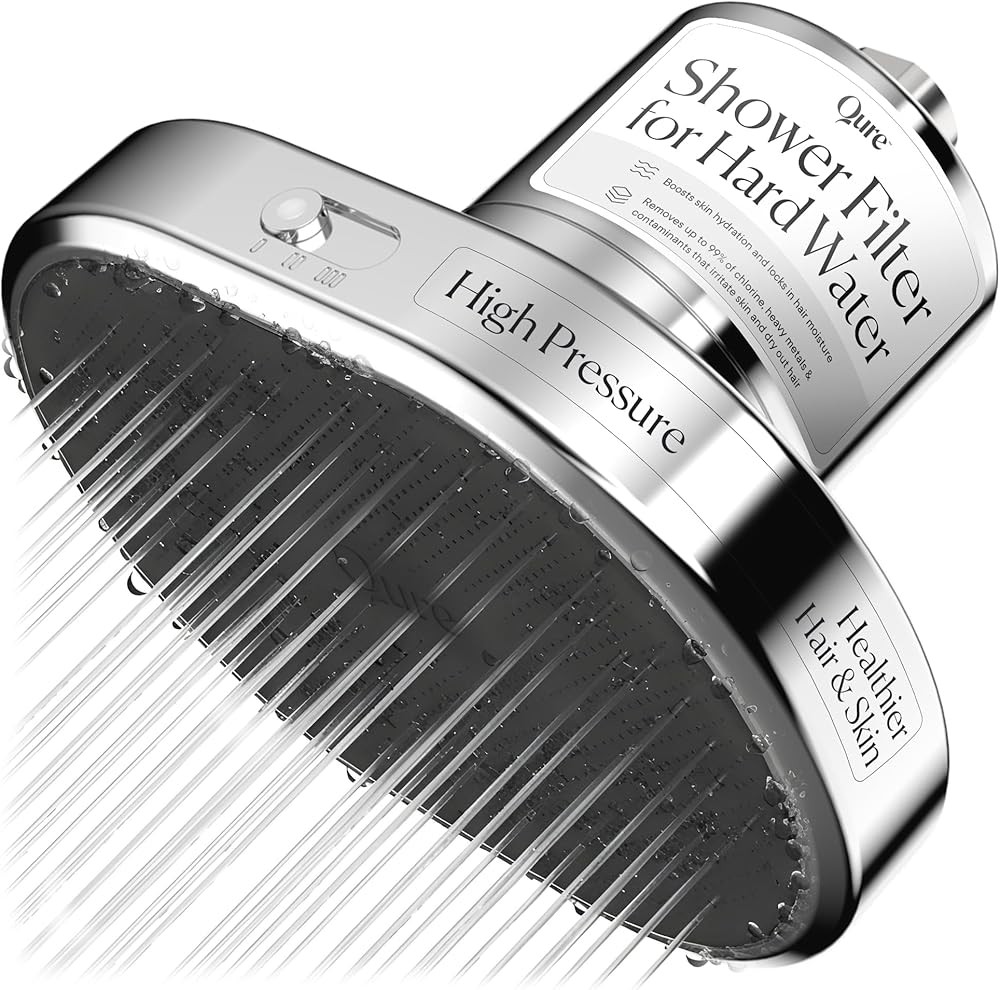
The Qure Shower Filter Head integrates multi-stage filtration directly into a full-function shower head, eliminating the separate inline filter housing that adds length and connection points to standard installations. This all-in-one design combines performance with aesthetics for buyers prioritizing appearance and installation simplicity.
The internal filtration system uses a proprietary media blend that includes activated carbon, KDF alloy, and calcium sulfite in a radial flow configuration. Water enters the center cartridge, flows outward through the media layers, then exits through the spray face. This radial pattern increases contact time compared to straight-through flow designs, improving removal efficiency despite the compact cartridge size.
Cartridge dimensions measure approximately 3 inches in diameter by 2 inches deep — smaller than standalone filter housings that typically measure 5 to 6 inches long. Despite the reduced size, the radial flow path creates equivalent contact time to longer straight-through designs by forcing water to travel through a wider cross-section of media.
The spray face offers three spray patterns: rainfall, massage, and mixed mode. The rainfall setting provides wide, gentle coverage similar to fixed rain shower heads. Massage mode concentrates flow into pulsating jets for muscle relaxation. Mixed mode combines both patterns simultaneously for coverage plus focused streams.
Flow rate varies by spray pattern. Rainfall mode delivers approximately 2.3 gallons per minute at 60 PSI. Massage mode concentrates the same volume into fewer nozzles, creating higher velocity streams that feel more forceful despite unchanged flow rate. Mixed mode maintains the 2.3 gallon per minute output distributed across both spray types.
The housing uses chrome-plated brass rather than plastic, providing corrosion resistance and structural durability that exceeds ABS or polypropylene alternatives. Brass withstands repeated temperature cycling without cracking or deforming, and the chrome finish maintains appearance over years of exposure to chlorinated water and cleaning products.
A ball joint swivel mount allows angle adjustment across approximately 30 degrees of arc. This provides more positioning flexibility than fixed shower heads but less range than traditional ball joints that swivel 45 to 60 degrees. The limited range results from the internal cartridge design, which requires structural support that restricts full rotation.
Installation requires complete removal of the existing shower head and direct attachment to the shower arm. Unlike inline filters that mount between arm and head, the Qure unit replaces the head entirely. This eliminates one connection point and reduces the overall length added to the shower arm — approximately 4 inches versus 6 to 8 inches for separate filter plus head combinations.
Tool-free installation works for most applications, though a strap wrench or rubber jar opener helps achieve proper tightness without scratching the chrome finish. The unit threads directly onto standard 1/2-inch NPT shower arms using a thick rubber gasket that seals without requiring Teflon tape, though adding tape ensures long-term leak reduction.
Cartridge replacement opens through a bottom access panel that unscrews by hand. The spent cartridge slides out and the replacement inserts with simple alignment tabs that block incorrect installation. The process takes roughly 60 to 90 seconds once the access panel releases. Replacement cartridges cost $28 to $34 — higher than standalone filter cartridges but lower than replacing both a separate filter and shower head.
Filter life measures 6 months or 10,000 gallons under manufacturer test conditions. Hard water affects the integrated cartridge the same way it impacts standalone filters — mineral deposits accumulate, contact time decreases, and effective life may shorten to 4 to 5 months in areas with water hardness above 180 parts per million.
The spray nozzles incorporate rubber tips designed for easy cleaning when mineral deposits accumulate. Rubbing the nozzles with your finger during showering dislodges calcium and limescale buildup, maintaining consistent spray pattern and flow rate. Hard water users benefit from this weekly maintenance, which stops the clogged spray holes common in areas with high mineral content.
The warranty extends to 2 years — longer than most standalone filters or basic shower heads. This covers manufacturing defects, housing leaks, and spray face problems but excludes cartridge exhaustion and mineral buildup from water conditions. The extended warranty reflects the higher build quality of brass construction compared to plastic alternatives.
Weight measures approximately 12 ounces when dry, rising to 16 ounces when the cartridge saturates with water. This exceeds most plastic shower heads at 6 to 8 ounces but remains well within the load capacity of standard shower arms, which typically support 2 to 3 pounds without stress.
Water pressure requirements range from 40 to 80 PSI for optimal spray performance. Below 40 PSI, the rainfall pattern may thin and the massage mode loses intensity. Above 80 PSI, flow exceeds 2.5 gallons per minute unless a flow restrictor is installed at the shower arm connection. Most residential systems operate at 50 to 70 PSI, falling comfortably within the optimal range.
A realistic perspective: Integrated filter heads like the Qure combine filtration and spray delivery in a single unit that simplifies installation and improves appearance, though at higher initial and replacement costs than separate filter and head configurations.
Qure Shower Filter Head for Hard Water
Check Price on AmazonAs an Amazon Associate we earn from qualifying purchases.
Which Mid-Tier Filter Balances Performance and Cost?

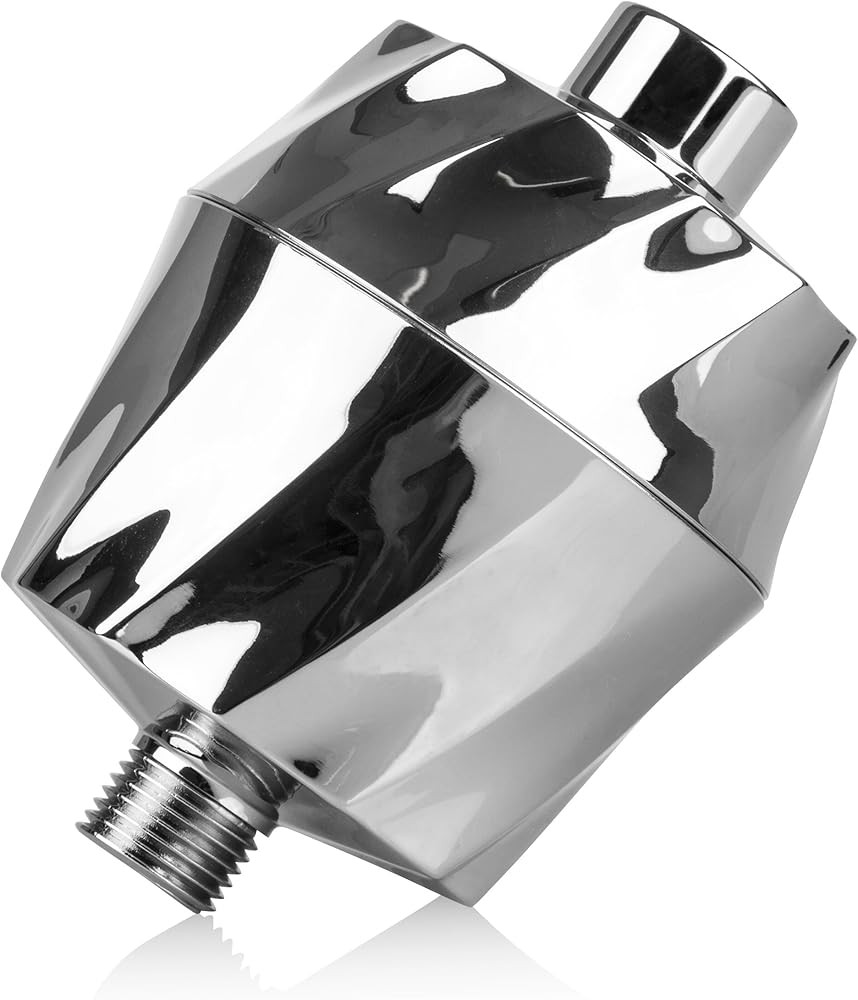
The AquaBliss SF400 HD delivers proven KDF and activated carbon filtration in a 12-stage configuration priced between budget options and premium integrated units. The cartridge uses the same core filtration technologies as the higher-tier SF500 with slightly reduced media quantities that maintain performance while lowering initial cost.
KDF-55 copper-zinc media forms the heavy metal reduction stage with an estimated 100 to 140 grams of alloy granules. This quantity provides the electrochemical potential for redox reactions that convert dissolved lead, mercury, and other metals into insoluble precipitates. The galvanic couple between copper and zinc maintains consistent reactivity regardless of water temperature or mineral content.
Activated coconut shell carbon occupies the organic compound removal stage with approximately 180 to 220 grams of media. This addresses volatile organic compounds, trihalomethanes, and other small molecules that adsorb to the carbon’s microporous structure. The coconut shell source provides pore sizes in the 10 to 20 angstrom range that match common DBP dimensions.
Calcium sulfite adds backup chlorine removal through chemical reduction that maintains full efficiency at shower temperatures where carbon performance declines. The dual-mechanism approach ensures chlorine neutralization across the full temperature range from cold finishing rinses to hot relaxation showers above 100 degrees Fahrenheit.
Ceramic filtration spheres and mineral stones fill the remaining cartridge volume, creating turbulent flow patterns that improve water distribution across the media bed. While marketing claims about infrared or negative ions lack scientific support, these dense spheres do serve a fluid dynamics purpose by stopping channeling where water bypasses portions of the filter.
The housing uses chrome-plated ABS plastic matching the finish quality of the SF500 but in a slightly more compact design. Overall length measures approximately 5.5 inches versus 6 inches for the SF500, reducing the extension below the shower arm by half an inch. This minor difference rarely affects shower clearance but improves aesthetics in installations where minimizing visible hardware is preferred.
Universal 1/2-inch NPT threading provides compatibility with standard shower arms and handheld hoses throughout North America. The filter ships with adapters for both fixed and handheld configurations, eliminating the need to identify connection types before purchase. Teflon tape on the threads ensures leak-free installation without requiring additional sealants.
Flow rate measures 2.5 gallons per minute at 60 PSI water pressure when the cartridge is fresh. Hard water mineral accumulation may gradually reduce flow to 2.1 to 2.3 gallons per minute after 4 to 5 months of use, though this slight decrease typically goes unnoticed during normal showering. The flow reduction serves as a maintenance reminder that cartridge replacement is approaching.
Installation requires no tools for typical installations, with hand-tightening providing adequate seal when combined with Teflon tape. A strap wrench or rubber jar opener helps achieve the finger-tight plus one-quarter turn standard for plumbing connections without scratching the chrome finish. The entire installation process takes 3 to 5 minutes from removing the existing shower head to testing the filtered connection.
Cartridge replacement uses a twist-off housing design that separates at mid-height when rotated counterclockwise. The spent cartridge lifts out by hand and the replacement drops into position with simple alignment. No tools are required, and the process completes in under 60 seconds once the housing releases.
Replacement cartridges cost $16 to $20, positioning operating costs between budget options at $14 to $18 and premium filters at $22 to $28. Based on 6-month replacement intervals, monthly operating cost runs approximately $2.65 to $3.35. Hard water users replacing every 4 months see costs rise to $4 to $5 monthly — still below premium alternatives.
Filter life measures 6 months or approximately 10,000 gallons according to manufacturer specifications. These figures assume soft to moderately hard water below 150 parts per million hardness with typical municipal chlorine levels of 1 to 2 parts per million. Very hard water above 200 parts per million or high-chlorine areas above 3 parts per million will shorten effective life to 4 to 5 months.
The warranty covers 12 months against manufacturing defects in materials and workmanship. This excludes normal media exhaustion, mineral buildup, and performance degradation resulting from operating conditions. The coverage addresses housing cracks, thread failures, or connection leaks that occur due to material or assembly defects rather than water quality effects.
Temperature tolerance spans cold water to 158 degrees Fahrenheit, exceeding the 120 to 140 degree settings typical in residential water heaters. The ABS housing and media blend both maintain structural integrity and filtration performance across this range without softening or degrading.
The 12-stage designation counts individual media types and sub-layers following industry standard marketing, though the actual number of distinct filtration mechanisms is 4 to 5: sediment removal, KDF heavy metal reduction, activated carbon adsorption, calcium sulfite chlorine reduction, and ceramic sphere flow distribution. This stage counting matches all manufacturers and doesn’t represent unique performance claims.
The whole-home view: The SF400 delivers the same core KDF and activated carbon technologies as premium filters with slightly reduced media quantities that maintain performance for standard municipal water while lowering initial and replacement costs.
AquaBliss SF400 HD Revitalizing Shower Filter
Check Price on AmazonAs an Amazon Associate we earn from qualifying purchases.
How Do You Test Water Hardness and Choose the Right Filter?
Water hardness testing identifies the concentration of dissolved calcium and magnesium minerals that define hard water conditions. This information guides filter selection by revealing which contaminants your specific water contains and whether whole-house treatment is necessary alongside shower filtration.
Test strips provide the simplest approach. These plastic strips contain reactive pads that change color when exposed to calcium and magnesium ions. Dip the strip in cold tap water for 2 to 3 seconds, shake off excess water, and compare the color change to the reference chart after 30 to 60 seconds. Results appear as total hardness in parts per million or grains per gallon.
Water hardness classifications follow standard ranges. Soft water measures under 60 parts per million or 3.5 grains per gallon. Moderately hard water ranges from 61 to 120 parts per million. Hard water spans 121 to 180 parts per million. Very hard water exceeds 180 parts per million or 10.5 grains per gallon.
Test strip accuracy ranges from ±10 parts per million for mid-range kits to ±25 parts per million for economy strips. This precision suffices for shower filter selection, which depends on general hardness category rather than exact mineral concentration. Professional laboratory analysis using titration methods achieves ±2 parts per million accuracy but costs $25 to $50 versus $10 to $15 for test strips.
Testing frequency depends on water source stability. Municipal water hardness rarely changes because treatment facilities maintain consistent mineral levels. Test once when selecting a filter, then retest if the water utility notifies customers of source changes. Well water varies seasonally as groundwater tables shift, so test twice yearly — once in spring after runoff and once in fall after dry conditions.
Chlorine testing adds valuable information for filter selection. Most test strips include a chlorine pad alongside hardness indicators. This reveals whether your water contains chloramine (monochloramine) instead of chlorine, which affects filter chemistry. Chloramine requires longer contact time and more media mass for complete removal compared to free chlorine.
A whole-home water quality report from your municipal supplier provides comprehensive data including hardness, chlorine type and concentration, pH, and regulated contaminants like lead and copper. Most utilities publish annual reports online or mail them to customers. This report identifies which contaminants exceed aesthetic guidelines or approach health-based maximum contaminant levels.
Well water requires more extensive testing because private wells aren’t subject to Safe Drinking Water Act regulations. A basic well water test costs $50 to $150 and measures hardness, pH, total dissolved solids, iron, manganese, and coliform bacteria. Comprehensive tests adding heavy metals, volatile organic compounds, and pesticides range from $200 to $400 but provide complete characterization.
Filter selection starts with matching media to contaminants. KDF addresses heavy metals like lead, mercury, and copper. Activated carbon removes organic compounds, volatile organics, and trihalomethanes. Calcium sulfite or vitamin C neutralizes chlorine and chloramines. Multi-stage filters combining all three media types cover the broadest contaminant range.
What you need to know: Hard water areas benefit most from multi-stage designs because mineral deposits accelerate single-media exhaustion. A carbon-only filter may clog with calcium carbonate within 3 to 4 months in very hard water above 200 parts per million. Multi-stage units with sediment pre-filtration protect downstream carbon and KDF from particle fouling, extending effective life to 5 to 6 months.
Flow rate requirements depend on your shower head. Standard 2.5 gallon per minute heads need filters rated for equivalent flow to avoid pressure reduction. High-flow heads at 3 to 4 gallons per minute require filters with larger cartridges and lower flow resistance. Low-flow eco heads at 1.5 to 2 gallons per minute work with any filter because their reduced demand creates more contact time.
Temperature considerations matter in hard water areas where higher chlorine doses are common. Carbon efficiency drops at high temperatures, so filters relying solely on carbon may allow chlorine breakthrough during hot showers. Multi-stage units with calcium sulfite or vitamin C backup ensure chlorine removal regardless of water temperature.
Housing material affects durability and appearance. Chrome-plated ABS plastic costs less and weighs less than metal but may crack if overtightened or dropped. Brass housings withstand higher torque and impacts but cost more and add weight. For most applications, quality ABS with proper installation provides adequate durability at lower cost.
Installation location offers two basic options. Inline filters mount between the shower arm and shower head, working with any head style but adding 5 to 8 inches of length. Integrated filter heads replace the existing head entirely, reducing connection points and visible hardware but limiting spray pattern options to the built-in design.
The key insight: Water testing identifies specific contaminants and hardness levels that guide filter selection, with multi-stage KDF, carbon, and calcium sulfite designs providing the broadest coverage for hard water areas where minerals accelerate media exhaustion.
Our comprehensive guide to best shower filters covers selection criteria across all water types and budgets, including soft water applications where carbon-only filters may suffice.
What Maintenance Do Hard Water Shower Filters Require?
Shower filter maintenance in hard water areas focuses on cartridge replacement timing and housing cleaning to address mineral accumulation that affects both filtration performance and water flow. Unlike soft water installations where filters often reach 6-month replacement intervals, hard water accelerates exhaustion through multiple mechanisms.
Mineral deposits form on and within filter media as calcium and magnesium precipitate from solution. When water temperature rises during hot showers, calcium carbonate solubility decreases and the excess minerals crystallize on available surfaces. Over weeks and months, these deposits accumulate on sediment screens, between KDF granules, and within activated carbon pores.
The practical effect appears as gradually decreasing water pressure. A fresh filter passes 2.5 gallons per minute at typical household pressure of 60 PSI. After 3 to 4 months in very hard water above 200 parts per million, mineral buildup may reduce flow to 2.0 to 2.2 gallons per minute. This 10% to 25% reduction often goes unnoticed until side-by-side comparison with a new cartridge reveals the difference.
Chlorine smell provides another replacement indicator. When carbon adsorption sites fill with organic compounds or become blocked by mineral deposits, chlorine removal efficiency drops. The first sign is often a faint chlorine odor during showering that wasn’t present when the cartridge was fresh. This signals that carbon exhaustion has progressed to the point where calcium sulfite or vitamin C backup stages are handling most chlorine removal.
Replacement timing varies with water hardness and usage. For water at 120 to 180 parts per million hardness with average use of two 8-minute showers daily, expect 5 to 6 month cartridge life. Very hard water above 200 parts per million shortens this to 4 to 5 months. High-chlorine areas above 3 parts per million may exhaust cartridges even faster because both mineral and chemical loads accelerate media depletion.
Calendar-based replacement provides a simple schedule that stops performance degradation. Mark the installation date on your calendar or phone and set a reminder for 4 months later if water hardness exceeds 180 parts per million, or 5 months for hardness between 120 and 180 parts per million. This proactive approach ensures you replace cartridges before chlorine breakthrough or flow restriction becomes noticeable.
Housing cleaning addresses external mineral deposits that accumulate on threads, seals, and visible surfaces. Every 2 to 3 months, wipe the exterior with a damp cloth and white vinegar solution mixed at 1 part vinegar to 3 parts water. The acetic acid in vinegar dissolves calcium carbonate deposits without damaging chrome plating or plastic finishes. Rinse thoroughly after wiping to avoid vinegar odor.
Thread maintenance blocks leaks and makes cartridge replacement easier. When replacing the cartridge, clean the threads with an old toothbrush to remove mineral buildup and old Teflon tape. Apply fresh Teflon tape — 3 to 4 wraps in the direction of thread rotation — before reassembling the housing. This simple step takes 30 seconds and blocks the cross-threading or incomplete sealing that can occur when old tape or minerals interfere with proper engagement.
O-ring inspection should occur at every cartridge change. Most filter housings use rubber O-rings to seal the cartridge interface. Check these rings for cracks, hardening, or mineral deposits. Rinse the rings with water and feel for flexibility — they should compress easily between your fingers. If an O-ring feels stiff or shows cracks, replace it before installing the new cartridge. Replacement O-rings typically cost $2 to $5 for a pack of 2 to 4.
Shower head cleaning complements filter maintenance in hard water areas. Mineral deposits accumulate on spray nozzles regardless of filtration, reducing spray quality and creating uneven patterns. Every 2 to 3 weeks, wipe spray nozzles with your finger during showering to dislodge surface deposits. Monthly, remove the shower head and soak it in undiluted white vinegar for 30 to 60 minutes, then scrub nozzles with an old toothbrush to clear accumulated minerals.
Storage considerations apply to replacement cartridges. Keep spares in their sealed packaging in a cool, dry location away from direct sunlight. The media inside cartridges — particularly activated carbon — can absorb odors and humidity from ambient air if packaging is compromised. A storage temperature between 50 and 80 degrees Fahrenheit maintains media integrity. Avoid garages or sheds where temperature extremes or high humidity might affect performance.
Hard water softening reduces filter maintenance burden. Installing a whole-house water softener removes calcium and magnesium before water reaches the shower, eliminating the mineral deposits that accelerate filter exhaustion. This extends shower filter cartridge life from 4 to 5 months back to the full 6 months typical in soft water areas. The softener itself requires salt additions every 4 to 6 weeks and resin bed cleaning annually.
Cost analysis helps evaluate whole-house versus point-of-use filtration. Shower filter cartridges cost $14 to $28 and last 4 to 6 months, creating annual costs of $28 to $84 per shower. A household with 2 bathrooms spends $56 to $168 yearly on cartridges. Whole-house water softeners cost $500 to $3,000 installed plus $50 to $100 yearly for salt and maintenance, but protect all fixtures and appliances from scale while extending shower filter life.
The practical takeaway: Hard water shortens filter life from 6 months to 4 to 5 months due to mineral accumulation, making calendar-based replacement schedules and regular housing cleaning essential for maintaining performance and flow rate.
Can Shower Filters Replace Whole-House Water Softeners?
Shower filters and whole-house water softeners address different water quality problems through fundamentally different mechanisms. Understanding these distinctions blocks unrealistic expectations and guides appropriate system selection for hard water areas.
Water softeners use ion exchange technology to remove dissolved calcium and magnesium minerals that cause hardness. The system contains a resin bed of negatively charged polymer beads saturated with sodium ions. When hard water flows through the resin, calcium and magnesium ions displace sodium ions through an exchange process. The softened water exiting the system contains sodium chloride instead of calcium carbonate and magnesium sulfate.
This process requires a continuous sodium supply maintained through periodic regeneration cycles. Every 3 to 7 days, depending on water hardness and usage, the system backflushes the resin bed with concentrated brine solution. This reverses the exchange, stripping accumulated calcium and magnesium from the resin and reloading sodium ions. The waste brine containing dissolved minerals drains to the sewer.
Water softeners affect all water throughout the plumbing system. Softened water blocks scale buildup in pipes, water heaters, dishwashers, and washing machines. It eliminates the soap scum that forms when calcium reacts with fatty acids in soap. Laundry comes out brighter because minerals don’t deposit in fabric fibers. Dishes don’t show water spots because calcium carbonate doesn’t remain after drying.
The installation requires professional plumbing work to intercept the main water supply line before it branches to individual fixtures. This typically costs $500 to $1,500 for labor plus $400 to $2,500 for the softener unit depending on capacity and features. The system occupies roughly 2 to 4 square feet of floor space in a basement, garage, or utility room.
Shower filters operate through chemical adsorption and reduction rather than ion exchange. They remove chlorine, heavy metals, volatile organic compounds, and disinfection byproducts — but dissolved calcium and magnesium minerals pass through unchanged because these ions don’t adsorb to carbon or react with KDF at shower water contact times.
This means shower filters don’t address the primary hard water problems of scale formation and soap reactivity. Water exiting a shower filter still contains the same mineral concentration that entered. What changes is the chemical contamination profile — chlorine, trihalomethanes, and heavy metals decrease or disappear while hardness minerals remain.
The combination approach provides comprehensive protection. Installing a whole-house water softener removes minerals that cause scale and soap issues throughout the plumbing system. Adding shower filters removes chlorine and chemical contaminants that volatilize during hot showers and absorb through skin or inhalation. This dual treatment addresses both mineral and chemical water quality problems.
Cost comparison shows different value propositions. Shower filters cost $29 to $99 installed with $14 to $28 replacement cartridges every 4 to 6 months. A 2-bathroom home spends roughly $100 to $200 annually on shower filtration. Whole-house softeners cost $900 to $4,000 installed plus $50 to $100 yearly for salt and maintenance, but protect all fixtures and appliances while extending their service life.
Salt-free water conditioners represent an intermediate approach. These systems use template-assisted crystallization to alter calcium carbonate structure, stopping it from forming hard scale even though minerals remain in solution. The technology works through polymer beads that provide nucleation sites where calcium crystallizes into suspended particles rather than bonding to surfaces.
These conditioners cost $800 to $2,000 installed — less than traditional softeners — and require no salt or regeneration cycles. They reduce scale formation in pipes and water heaters but don’t provide the soap and cleaning benefits of true mineral removal through ion exchange. For shower applications, they offer minimal advantage over shower filters alone.
Reverse osmosis provides complete mineral removal but only at point-of-use for drinking water. Under-sink RO systems cost $200 to $600 and remove dissolved minerals along with virtually all other contaminants. The technology can’t scale to whole-house use because RO wastes 3 to 4 gallons of water for every gallon produced — acceptable for drinking water volume but impractical for shower and appliance use.
The environmental consideration affects system selection. Water softeners discharge salt-concentrated brine to wastewater systems, adding sodium and chloride to municipal treatment burden or septic systems. Some municipalities regulate or restrict softener discharge in areas with water reclamation programs. Shower filters produce no discharge except the spent cartridge itself, which goes to landfills every 4 to 6 months.
What this means: Shower filters and water softeners complement rather than replace each other, with softeners removing minerals throughout the home while shower filters address chlorine and chemical contaminants that affect bathing water quality.
For drinking water applications where complete contaminant removal including minerals matters, see our guide to best hydrogen water generators which includes filtration systems that address dissolved solids.
How Does Indoor Air Quality Connect to Shower Water Filtration?
Shower water quality directly affects bathroom air quality through volatilization and aerosolization processes that transfer contaminants from water to air. Understanding this connection reveals why shower filtration provides benefits beyond reducing dermal exposure.
Trihalomethanes and other disinfection byproducts volatilize readily when water temperature rises. These compounds have low boiling points relative to water — chloroform boils at 142 degrees Fahrenheit while water boils at 212 degrees. When shower water reaches 100 to 110 degrees, volatilization accelerates and chloroform transfers from water to steam at rates 2 to 5 times faster than at room temperature.
Research published in Science of the Total Environment (PMID: 30316091) measured trihalomethane concentrations in bathroom air during showering and found levels rising from background of 2 to 5 micrograms per cubic meter to peak values of 80 to 200 micrograms per cubic meter within 5 minutes of starting a hot shower. These concentrations exceeded outdoor air quality standards for chloroform in some cases.
The enclosed space of a typical bathroom — 50 to 80 square feet — amplifies this effect. Hot water vapor accumulates faster than bathroom ventilation removes it, creating high humidity conditions where volatilized compounds concentrate. Research in Environmental Research (PMID: 34973941) measured air exchange rates in bathrooms with exhaust fans and found that many residential fans provide only 3 to 5 complete air changes per hour — insufficient to remove volatilized compounds as fast as showering releases them.
Inhalation delivers higher internal dose than dermal absorption for many compounds. A study comparing exposure routes found that breathing volatilized trihalomethanes during a 10-minute shower delivered 2 to 5 times more total dose than skin absorption during the same period. This occurs because lung tissue provides roughly 70 square meters of surface area compared to 2 square meters for skin, and the alveolar membrane is much thinner and more permeable than skin’s outer layers.
Aerosolization adds a second transfer mechanism. Shower spray creates fine water droplets that remain suspended in air for several minutes. These droplets contain the same contaminants as the bulk water, providing another route for compounds to enter airways. Research in Annals of Work Exposures and Health (PMID: 37339253) studying indoor pool environments found that aerosolized water droplets contributed 25% to 40% of total airborne contaminant load alongside volatilization.
Chlorine itself affects respiratory function. Studies of lifeguards and competitive swimmers show that chronic chlorine exposure — even at concentrations below occupational limits — associates with increased respiratory symptoms and airway inflammation. While short-term shower exposure is less intensive than pool work, the enclosed bathroom environment creates higher peak concentrations during the 5 to 15 minutes of active showering.
Shower filters reduce this indoor air contamination by removing the source compounds before volatilization occurs. When activated carbon and calcium sulfite remove 90% to 99% of chlorine from water, volatilized chlorine in bathroom air drops proportionally. Research measuring bathroom air quality before and after shower filter installation found trihalomethane air concentrations decreased 60% to 80% with filtration.
Ventilation remains important even with filtration. Running a bathroom exhaust fan during and for 15 to 20 minutes after showering removes water vapor and any residual volatilized compounds. The combination of source reduction through filtration plus dilution ventilation provides the most complete protection.
Water temperature management offers additional control. Reducing shower water temperature from 110 degrees to 100 degrees Fahrenheit decreases volatilization rates by roughly one-third without significantly affecting comfort for most people. The lower temperature also reduces steam production, which improves exhaust fan effectiveness by reducing the humidity load.
The household context extends beyond the person showering. Volatilized compounds spread throughout the home via air currents and forced air heating or cooling systems. Research measuring air quality in bedrooms adjacent to bathrooms found measurable trihalomethane increases during and after showering in the connected bathroom. Whole-house ventilation systems can distribute these compounds even further.
Children face higher relative exposure due to smaller body mass and higher respiratory rates. A child breathing 25 times per minute in a contaminated bathroom inhales proportionally more air per kilogram of body weight than an adult breathing 12 to 16 times per minute. This creates higher internal dose per unit body mass, making source reduction through shower filtration particularly valuable in households with young children.
The key insight: Shower water filtration reduces bathroom air contamination by removing chlorine and volatile organic compounds before they can volatilize, providing respiratory protection alongside the skin contact benefits.
Our guide to best air purifiers for pet dander and allergies covers complementary air cleaning technologies that address particulate and gaseous contaminants in indoor environments.
What Does the Research Show About Long-Term Exposure?
Published research examining chronic exposure to disinfection byproducts in bathing water reveals patterns that support filtration as a meaningful exposure reduction strategy, though the evidence focuses on population-level associations rather than individual health outcomes.
A comprehensive 30-year review published in Mutation Research (PMID: 17980649) analyzed more than 85 different disinfection byproducts identified in chlorinated water systems. The researchers noted that bathing accounts for more than half of total DBP exposure when dermal absorption and inhalation are included alongside drinking water ingestion. This multi-route exposure pattern means reducing shower water contamination addresses the majority exposure pathway.
Research in Environmental and Molecular Mutagenesis (PMID: 32374889) updated the DBP inventory to more than 600 identified compounds, with new detection methods revealing previously unknown chloramination byproducts. Chloramine disinfection — increasingly common as utilities switch from chlorine to reduce trihalomethane formation — produces N-nitrosodimethylamine (NDMA) and other nitrogen-containing DBPs that weren’t significant concerns in chlorine-only systems.
A 2015 study in Journal of Water and Health (PMID: 25719485) examined DBP concentrations in multiple water distribution systems and found trihalomethane levels 7 to 8 times above World Health Organization maximum contaminant levels in some locations. The exceedances occurred primarily in hard water areas with high organic content where chlorine demand required elevated doses to maintain disinfection through the distribution network.
Research published in Journal of Water and Health (PMID: 35768969) analyzed individual trihalomethane species and found that bromodichloromethane accounted for 69% of total trihalomethane-associated cancer risk despite representing only a fraction of total THM concentration. This finding highlights that total trihalomethane measurements don’t fully capture risk because different species have vastly different potency.
Blood concentration studies provide biomarker data showing internal dose. Environmental Science and Pollution Research (PMID: 34705209) documented blood THM levels increasing 2.7 to 4.8 times baseline after a 10-minute shower. The study measured subjects before, during, and after showering while controlling for other exposure sources. Peak blood levels occurred 10 to 15 minutes after showering ended, then declined gradually over 2 to 3 hours.
Temperature effects on exposure appear in research from Science of the Total Environment (PMID: 30316091) showing that hot water generates 2.1 to 3.7 times higher trihalomethane concentrations than cold water at the same chlorine dose. This temperature dependence results from both increased volatilization and accelerated DBP formation rates at higher temperatures.
Frequency considerations emerge from research in Toxics (PMID: 37112522) examining how shower frequency affects cumulative exposure. Daily showering creates continuous low-level exposure that maintains elevated blood trihalomethane concentrations, while every-other-day showering allows more complete clearance between exposures. The practical implication is that regular daily showering — the norm in developed countries — represents higher cumulative exposure than historical patterns of less frequent bathing.
Inhalation route dominance shows clearly in research from Environmental Research (PMID: 34973941) comparing exposure pathways. The study found that breathing volatilized compounds during showering delivered greater total dose than skin contact for most trihalomethanes. Another study in International Journal of Hygiene and Environmental Health (PMID: 15729838) quantified inhalation exceeding dermal exposure by 2 to 5 times depending on shower duration and ventilation.
Pool worker studies provide insight into chronic high-level exposure effects. Research in Annals of Work Exposures and Health (PMID: 37339253) measuring chloroform in indoor pool air found concentrations from 5 to 240 micrograms per cubic meter — levels that pool employees breathe for 6 to 8 hours per shift. While shower exposure is briefer, bathroom air concentrations can spike to similar or higher levels during active showering in poorly ventilated spaces.
Filtration effectiveness appears in studies measuring contaminant removal. Research in Chemosphere (PMID: 23540811) documented 99.7% volatile organic compound removal with granular activated carbon under controlled laboratory conditions. Field studies show lower performance — typically 85% to 95% — due to variable contact time, temperature effects, and media aging, but these real-world numbers still represent substantial exposure reduction.
KDF effectiveness for heavy metals comes from studies in Environmental International (PMID: 16091290) showing 70% dissolved organic carbon removal and significant heavy metal reduction through redox reactions. The copper-zinc galvanic couple creates consistent electrochemical potential regardless of water chemistry variations, making KDF performance more stable than carbon adsorption which is sensitive to temperature, pH, and competing compounds.
What this means: Published research demonstrates that bathing represents the majority route for disinfection byproduct exposure, that hot water amplifies both formation and volatilization, and that multi-route exposure through skin contact and inhalation creates higher internal dose than drinking water alone.
For broader health perspectives on environmental quality, see our guide to best infrared sauna blankets which covers heat exposure therapies and their research support.
What Installation and Compatibility Considerations Matter?
Installation requirements for shower filters vary by design type and existing plumbing configuration, but most units follow standard patterns that work with minimal tools and plumbing knowledge.
Thread standards determine physical compatibility. North American shower arms and handheld hoses use 1/2-inch National Pipe Thread (NPT) connections almost universally. This tapered thread design creates a seal through interference between male and female threads when tightened. Filters marketed as “universal” typically ship with adapters covering both 1/2-inch NPT and the less common 3/4-inch garden hose thread found on some older fixtures.
Installation position offers two main options. Inline filters mount between the shower arm and shower head, requiring removal of the existing head, threading the filter onto the arm, then attaching the head to the filter’s output. This approach works with any shower head style and allows you to keep your preferred spray pattern, but adds 5 to 8 inches of length below the shower arm.
Integrated filter heads replace the existing shower head entirely, combining filtration and spray delivery in one unit. This eliminates the separate filter housing and reduces total length added to approximately 4 to 5 inches, but locks you into the built-in spray pattern which may not match your preferences.
Handheld shower installations work with inline filters designed for hose mounting. These units thread between the hose and the handheld spray wand, adding 4 to 6 inches to the overall hose assembly length. The additional weight — typically 6 to 10 ounces when the cartridge is saturated — rarely affects handling since you’re already supporting the metal spray wand which weighs 8 to 12 ounces.
Clearance considerations affect tall users or installations with low shower arms. Adding 5 to 8 inches of filter length reduces the distance between the shower head and the floor or tub surface. If your existing setup already has marginal clearance, an inline filter may position the spray pattern uncomfortably low. Measure the current shower head height and subtract the filter length to ensure adequate clearance for all household users.
Water pressure affects flow rate and filter performance. Most shower filters specify operation at 40 to 80 PSI, which covers typical residential water pressure of 50 to 70 PSI. Below 40 PSI, flow through the media bed may become too slow, extending shower time to achieve adequate rinsing. Above 80 PSI, flow may exceed 2.5 gallons per minute and reduce contact time below optimal levels for complete filtration.
Checking water pressure requires a simple gauge that threads onto an outdoor hose connection. These gauges cost $10 to $25 at hardware stores and provide instant pressure readings. Test during typical shower times — mornings when multiple households are using water — to see pressure under realistic demand rather than static overnight pressure.
Flow restrictor compatibility matters in areas with water conservation regulations. California and several other jurisdictions mandate 2.0 gallon per minute maximum flow for shower heads, while federal standards allow 2.5 gallons per minute. Some filters include removable flow restrictors — small plastic or metal discs with precisely sized orifices — that can be installed or removed to meet local requirements.
Tool requirements are minimal for standard installations. Teflon tape is essential — wrap 3 to 4 layers around male threads in the direction of rotation before threading connections. This fills thread gaps and blocks leaks without requiring pipe thread sealant compounds. An adjustable wrench or strap wrench helps achieve proper tightness without scratching chrome finishes, though hand-tight plus one-quarter turn suffices for most connections.
Temperature limitations vary by housing material. ABS plastic housings typically tolerate up to 158 to 170 degrees Fahrenheit, exceeding residential water heater settings of 120 to 140 degrees. Brass housings withstand any residential water temperature. Some economy filters use polypropylene that softens above 140 degrees, making them unsuitable for homes with water heaters set to maximum temperature.
Leak reduction focuses on proper thread engagement and sealing. Cross-threading occurs when connections start at an angle, cutting new thread paths that won’t seal properly. Thread the filter onto the shower arm by hand for the first 2 to 3 rotations to ensure proper engagement before applying wrench torque. If threads bind or feel rough, back off and restart rather than forcing the connection.
Replacement cartridge availability affects long-term ownership cost. Proprietary cartridge designs from small manufacturers may become unavailable if the company closes or discontinues the product line. Filters using widely available standard cartridge formats from major manufacturers ensure you can find replacements years after purchase.
Multi-bathroom households can standardize on one filter model to simplify cartridge inventory. Buying 4 to 6 replacement cartridges at once often reduces per-unit cost by 10% to 25% compared to individual purchases. Store sealed cartridges in a cool, dry location away from strong odors that activated carbon might absorb through packaging gaps.
The whole-home view: Standard 1/2-inch NPT threading provides universal compatibility with North American fixtures, making installation straightforward with basic hand tools and Teflon tape, though clearance and water pressure considerations affect final placement and performance.
For complementary water quality improvements, see our review of best pet water fountains for dogs and cats which covers filtration systems for drinking water applications.
How Do Environmental Factors Affect Filter Selection?
Regional water quality variations, seasonal changes, and local treatment practices all influence which shower filter configuration performs best in specific locations. Understanding these environmental factors guides selection beyond generic product specifications.
Municipal water source affects baseline contamination profiles. Surface water systems drawing from rivers and lakes typically have higher organic content and seasonal algae loads compared to groundwater systems. This higher organic loading creates more disinfection byproduct formation when chlorine is added, making activated carbon capacity more critical. Groundwater systems often have lower organic content but may show elevated hardness and heavy metals from geological sources.
Seasonal variations appear most dramatically in surface water systems. Spring runoff increases turbidity and organic matter, forcing treatment plants to add more chlorine to maintain disinfection through the distribution network. Summer algae blooms create similar demands. Research shows that trihalomethane concentrations in some distribution systems vary by 60% to 100% between winter low points and summer peaks.
Agricultural regions show seasonal pesticide patterns. Spring and early summer planting creates herbicide runoff that appears in surface water sources. Fall harvest brings different pesticide profiles. While shower filters aren’t designed primarily for pesticide removal, activated carbon does adsorb many common agricultural chemicals, providing incidental protection during high-use seasons.
Coastal areas with seawater intrusion face elevated bromide in water supplies. When chlorine reacts with bromide, it forms brominated trihalomethanes like bromodichloromethane instead of chloroform. These brominated species have different adsorption characteristics on activated carbon, sometimes requiring longer contact time for complete removal. Hard water compounds this in coastal areas where both hardness and bromide are elevated.
Chloramination versus chlorination affects filter chemistry. Utilities increasingly use chloramine (monochloramine) instead of chlorine because it produces fewer regulated trihalomethanes. However, chloramine forms different DBPs including N-nitrosodimethylamine (NDMA) and creates higher total organic halogen levels. Chloramine also requires longer carbon contact time for removal — approximately 3 to 5 times longer than chlorine — making deeper carbon beds or slower flow rates necessary.
Industrial areas may show elevated heavy metals from historical contamination or ongoing discharge. Lead and copper come from plumbing rather than treatment plants, but mercury, cadmium, and other metals can appear in source water near industrial zones. KDF-55 provides effective removal for these metals, making KDF quantity a more important selection criterion in industrial areas than in pristine water sources.
Old plumbing systems contribute lead and copper that wasn’t present in the water leaving the treatment plant. Homes built before 1986 may have lead solder in copper pipes, while homes before 1950 might have lead service lines. Letting water run for 30 seconds before showering helps, but shower filters with adequate KDF capacity provide additional protection.
Well water presents unique challenges because private wells aren’t subject to Safe Drinking Water Act regulations. Well water may contain bacteria, nitrates from agricultural runoff, naturally occurring arsenic, or uranium from geological sources. Shower filters aren’t designed to address all these contaminants — bacteria require UV or chlorination, nitrates need ion exchange or reverse osmosis, and arsenic needs specialized media. Testing is essential before assuming a shower filter provides adequate treatment.
Sulfur odor in well water comes from hydrogen sulfide gas produced by sulfate-reducing bacteria. KDF oxidizes hydrogen sulfide to elemental sulfur that precipitates and filters out, so filters with higher KDF quantities can reduce sulfur odor. This is an off-label benefit — shower filters aren’t marketed for sulfur treatment — but the chemistry works and provides value in wells with mild sulfur problems below 1 part per million.
Climate affects filter performance through water temperature. Cold climate regions where incoming water temperature drops to 40 to 50 degrees Fahrenheit in winter create different filtration conditions than warm climates with 70 to 80 degree supply water year-round. The temperature differential to shower settings is larger in cold climates, creating more rapid heating and potentially faster volatilization rates.
Altitude impacts water chemistry through atmospheric pressure effects on dissolved gases and through geological factors that vary with elevation. Mountain communities often draw from pristine sources with low contamination but high mineral content from snowmelt passing through rocky terrain. These areas benefit from filters emphasizing mineral tolerance over maximum chemical capacity.
A realistic perspective: Environmental factors including water source type, seasonal variations, and regional contamination patterns guide filter selection toward designs that match local conditions rather than generic “best overall” products that may not align with specific regional challenges.
For broader environmental health perspectives, see our guide to best multivitamins for women over 40 which covers nutritional support that complements environmental exposure reduction.
Related Reading
Best Shower Filters: Complete Research-Based Comparison — Comprehensive guide covering all shower filter types including carbon, KDF, and vitamin C systems with performance data and selection criteria
Vitamin C Shower Filters: Ascorbic Acid vs Calcium Sulfite Filtration — Detailed analysis of chemical chlorine removal mechanisms and temperature-independent filtration technologies
Best Countertop Reverse Osmosis Systems — Advanced filtration for drinking water applications including complete dissolved solids removal
Best Hydrogen Water Generators — Water treatment systems incorporating filtration with molecular hydrogen infusion
Best Air Purifiers for Pet Dander and Allergies — Complementary air cleaning technologies addressing indoor air quality concerns
Recommended Products